
Why is Walking so Difficult in India?
In India, walking might just hurt you more than it heals you!
At ReadOn, we don’t just report the markets. We help you understand what truly drives them, so your next decision isn’t just informed, it’s intelligent.
“35 years later… Our cities have not really improved.”
“The quality of life of our cities is not very significantly better in the public sphere.”
We’re not saying this. This is what Sanjay Sanyal, advisor to PM Narendra Modi said about the development of roads in India on an ANI podcast. He also mentions that there hasn’t been a lot of investment in last mile connectivity, or walking. Citizens walk out of metros into absolute chaos.
63% of all trips in Indian cities are made on foot. Pedestrians outnumber car users nearly 8 to 1. When it comes to daily commutes? Walking is, by a massive margin, the most common mode of transport in urban India?
Yet India’s pedestrian infrastructure leaves a lot to be wanted.
Today we take a look at the systemic pains of walking in India.
The Shocking Numbers
Let’s start with some data that doesn’t get enough attention.
An estimated 45 million Indians walk to work every day. When you factor in people walking to bus stops, metro stations, and markets, over half of all urban trips involve walking. A 2019 multi-city survey found that pedestrians are the single largest category of road users. They are bigger than two-wheelers, bigger than cars, bigger than public transport users.
Yet here’s what this invisible majority gets in return. 35,221 pedestrian deaths in 2023. A 7.3% increase from the previous year. That’s roughly 96 people dying every single day just trying to get somewhere on foot.
Pedestrians now account for 20.4% of all road deaths in India. But independent researchers suggest even this undercounts reality. When auditing police reports, studies found that at least 30% of road fatalities are pedestrians, with the figure climbing past 50% in metros like Delhi and Mumbai. The gap exists because pedestrian casualties are often miscoded in official records.
India signed the Brasilia Declaration in 2015, promising to halve road deaths by 2020. Instead, pedestrian deaths doubled from about 34 per day in 2014 to 70 per day in 2019. The trend has only worsened since.
So what’s going wrong?
The Missing Footpath Problem
Walk through any Indian city, and you’ll notice a pattern.
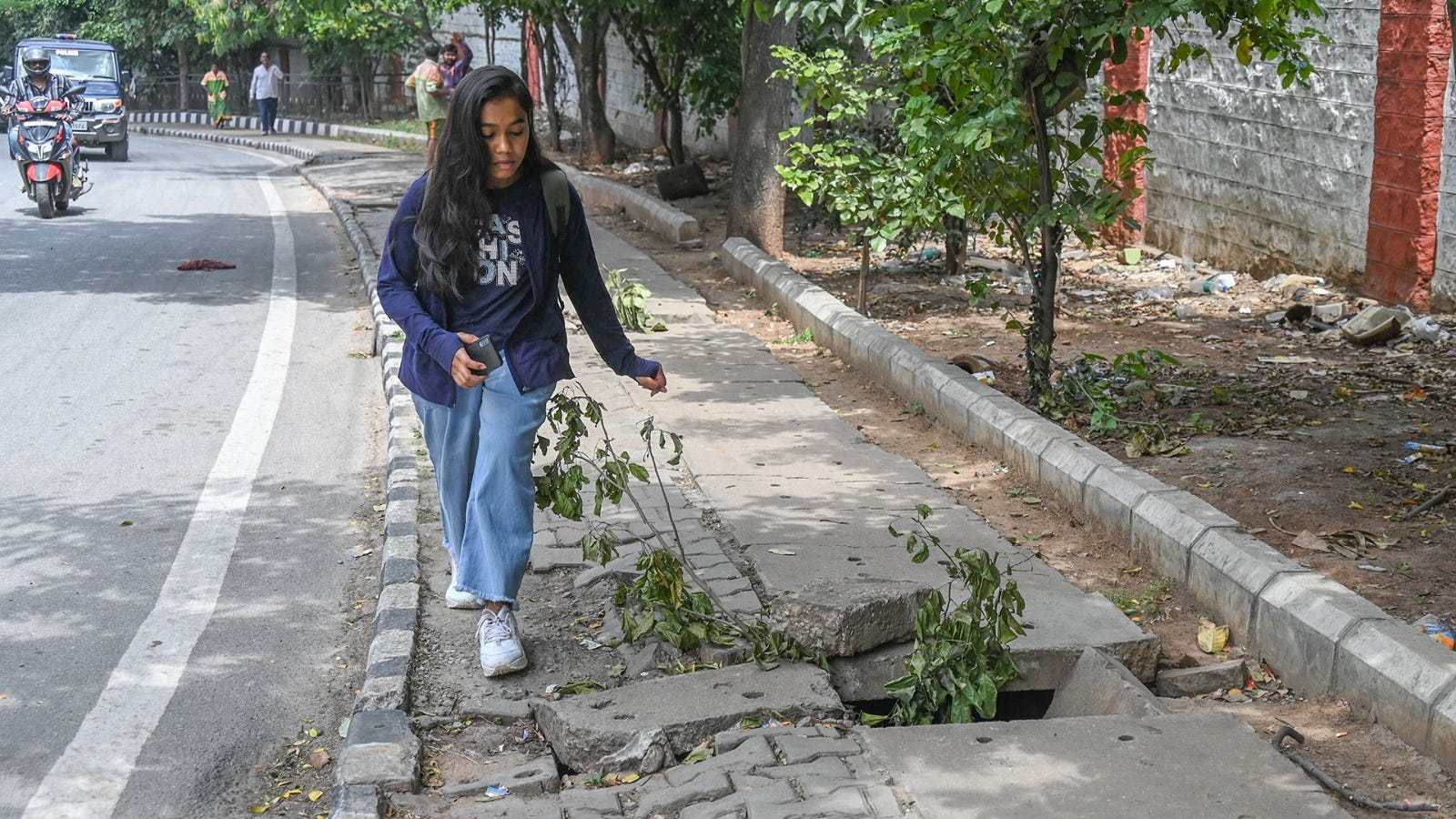
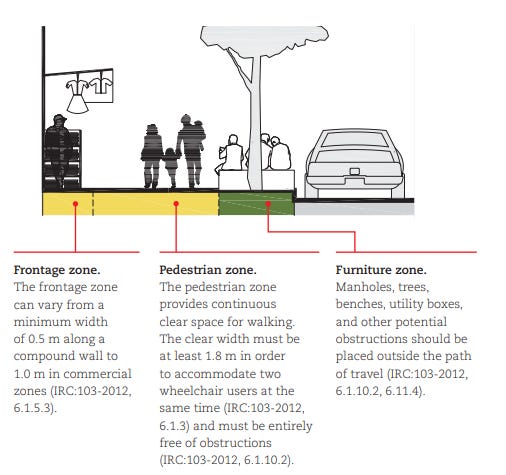
Where footpaths exist, they’re often too narrow for two people to pass comfortably. Indian guidelines recommend at least 1.8 metres of clear width, and most don’t come close. They’re interrupted by utility poles, open manholes, construction debris, and vendor stalls. They end abruptly, dumping pedestrians onto the road. And in many places, cars and two-wheelers treat sidewalks as free parking.
The Bombay High Court in 2018 remarked that walking on well-maintained footpaths in Mumbai “seems almost like a myth.” The court declared that citizens have a fundamental right to decent footpaths. Not much has changed since.
Bengaluru has earned the grim title of “pedestrian death capital.” Nearly 28% of all road deaths there involve pedestrians with over 200 lives lost annually in this one city alone. In 2024, Bengaluru traffic police fined over 117,000 motorists for parking on pavements and another 17,000 for driving on them. The violations continue regardless.
The pattern repeats and is often worse in Tier-2 and Tier-3 cities. Take Indore, frequently celebrated as India’s cleanest city. Footpaths there are broken, discontinuous, or simply absent across large swaths of the city. The irony is hard to miss. We’ve become excellent at cleaning streets while forgetting to make them walkable.
How Did We Get Here?
The answer lies in decades of urban transport planning guided by what experts call a “cars first” philosophy.
Since liberalisation, car ownership has become a symbol of being well-off. Roads were widened and straightened to move vehicles faster. Junctions became sprawling signal-free interchanges. Flyovers multiplied. In this calculus, pedestrians were an afterthought, or worse, an obstacle to vehicular flow.
The result? Roads that function like highways cutting through populated neighbourhoods. Wide, straight stretches that encourage speeding. Few crossings for long distances. And when authorities do build “pedestrian facilities,” they often mean foot-overbridges requiring people to climb two or more storeys of stairs. These are practically unusable for the elderly, disabled, or anyone carrying a load. Unsurprisingly, people dash across at street level instead.
As one World Bank commentary put it, these bridges exist to whisk pedestrians out of the way of cars, not to genuinely help walkers. The underlying philosophy of keeping vehicles moving at all costs hasn’t change.
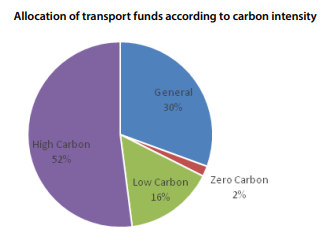
The budgeting tells the same story. Walking and cycling account for 30-40% of trips in Indian cities but historically receive less than 10% of transport funding. Sometimes nothing at all. Grand flyovers attract political support and contractor interest. Footpath improvements don’t make headlines or cut ribbons.
A 2024 survey found that 42% of urban Indian youth associate car ownership with “having made it in life.” Only 8% see walking or cycling as aspirational. When walking is culturally coded as something you do because you can’t afford better, it doesn’t get political champions.
The Hidden Price Tag
This neglect comes with enormous costs that go far beyond the moral weight of lives lost.
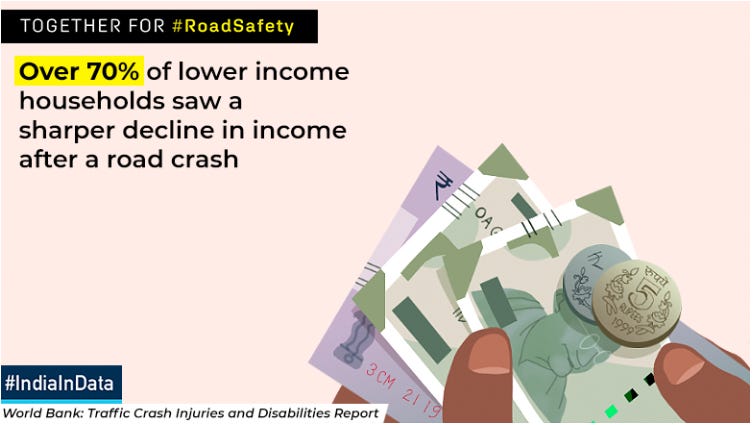
Start with economics. The injuries and deaths from unsafe walking conditions cost India over ₹2 lakh crore in 2020 alone. Even in the year 2025’, Union Minister Nitin Gadkari stated that India loses around 3% of its GDP due to road accidents. Road crashes impose a disproportionate burden on the poor. Over 75% of low-income households in one World Bank survey reported major income drops after a crash. When a family’s breadwinner is killed or disabled while walking to work, the entire household can spiral into poverty.
Then there’s equity. When footpaths are absent or streets feel unsafe, women’s mobility shrinks first. Women avoid going out after dark. Children can’t walk to school. The elderly stay home.
The climate angle is equally compelling. Every trip on foot is zero-emission. When Chennai built 100 km of quality footpaths, studies found that 9-29% of people walking on improved streets had previously used motorised vehicles. That mode shift was estimated to prevent 4,200-12,000 tonnes of CO₂ emissions annually. That’s equal to removing nearly 2,900 cars from the road. Now imagine scaling that nationally.
And here’s something that might surprise you. More people walking actually helps drivers too. A portion of car and two-wheeler trips in cities are under 2-3 km, or short distances that people drive only because walking feels dangerous or unpleasant. If those trips shifted to walking, there’d be fewer vehicles clogging roads. Less congestion means time saved for everyone, including those who genuinely need to drive.
What Would Actually Work?
The good news is that some Indian cities are beginning to move in the right direction.
Chennai was the first to mandate that 60% of transport budgets go to non-motorised transport, or walking and cycling infrastructure. The results are measurable. Pedestrian volumes on improved streets rose by up to 29%. People chose to walk rather than drive for short trips when the infrastructure made it viable.
Pune and Pimpri-Chinchwad followed with similar policies, allocating 50%+ of transport spending to footpaths, cycle tracks, and public transit. In FY 2024-25, Pimpri-Chinchwad directed 56% of its transport budget to sustainable modes.
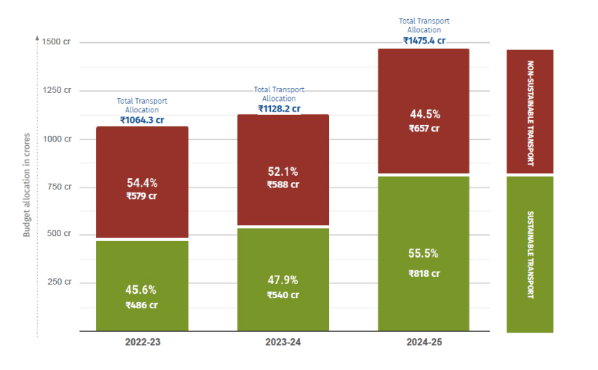
These aren’t magical solutions. They’re choices. Design choices. Budget choices. Political choices.
Punjab recently moved to implement a “Right to Walk” policy, making it mandatory for all road-owning agencies to provide footpaths and pedestrian facilities. The Supreme Court has affirmed that accessible footpaths are part of the right to life under Article 21 of the Constitution. Courts are beginning to treat walkability not as a luxury but as a legal entitlement.
The Reframe That Matters
Perhaps the most important shift required is in how we think about walking itself.
Walking isn’t something people do because they’ve failed to buy a car. It’s the foundation of every transport system. Every metro rider walks to the station. Every bus passenger walks to the stop. Even car owners become pedestrians the moment they step out of their vehicles.
No city can function if walking doesn’t work.
The economics favour this too. A kilometre of quality sidewalk costs a few crores. A kilometre of elevated highway costs hundreds of crores. The returns from pedestrian infrastructure in lives saved, health improved, emissions avoided, productivity preserved, far exceed the investment.
And let’s be clear about who actually uses Indian streets. Millions of people who walk to work daily aren’t a fringe minority asking for special treatment. They’re the majority. The largest user group on our roads. The ones who’ve been systematically pushed to the margins, and forced onto carriageways, asked to climb overbridges, expected to dodge traffic as if their lives were expendable.
The question isn’t whether India can afford to build walkable cities. It’s whether we can afford to keep treating our largest road users as invisible.
Until next time, ReadOn!
What I appreciate is how this connects the data to the everyday humiliation of walking in Indian cities — footpaths that vanish, poles in the middle, two-wheelers on pavements, and the constant calculation of risk. We’ve normalised a level of chaos that would be considered ungovernable elsewhere.