
When the Lab Orbits the Earth
The editor of this article was considering "Drugs in Space" as an alternate title...
At ReadOn, we don’t just report the markets. We help you understand what truly drives them, so your next decision isn’t just informed, it’s intelligent.
For most of the twentieth century, getting a kilogram of cargo into orbit cost roughly $10,000. That price tag meant space was reserved for governments, defence agencies, and the occasional billionaire’s vanity project. Then SpaceX’s reusable Falcon 9 changed the arithmetic, bringing that cost down to around $2,500 per kilogram, a 75% reduction, with Starship threatening to push it lower still.
As Varda Space Industries puts it: “Reusable rockets have lowered the cost of access to space and opened up a range of in-space activities. Now that access to space is cheap, it’s what we do there that counts.” And Low Earth Orbit, they add, is open for business. What is this business? For Varda, one of its many is pharmaceutical processing, and that’s what we’ll look into today.
Why Make Medicines in Space?
Here is a useful fact for context. Bringing a single drug to market costs upward of $2.5 billion, takes over a decade, and fails more than 90% of the time. The culprits are familiar: poor solubility, inconsistent particle sizes, imperfect protein structures, and the sheer complexity of human biology. Researchers have spent decades battling these problems on Earth, with mixed results.
But what if the problem wasn’t the molecule, but gravity itself?
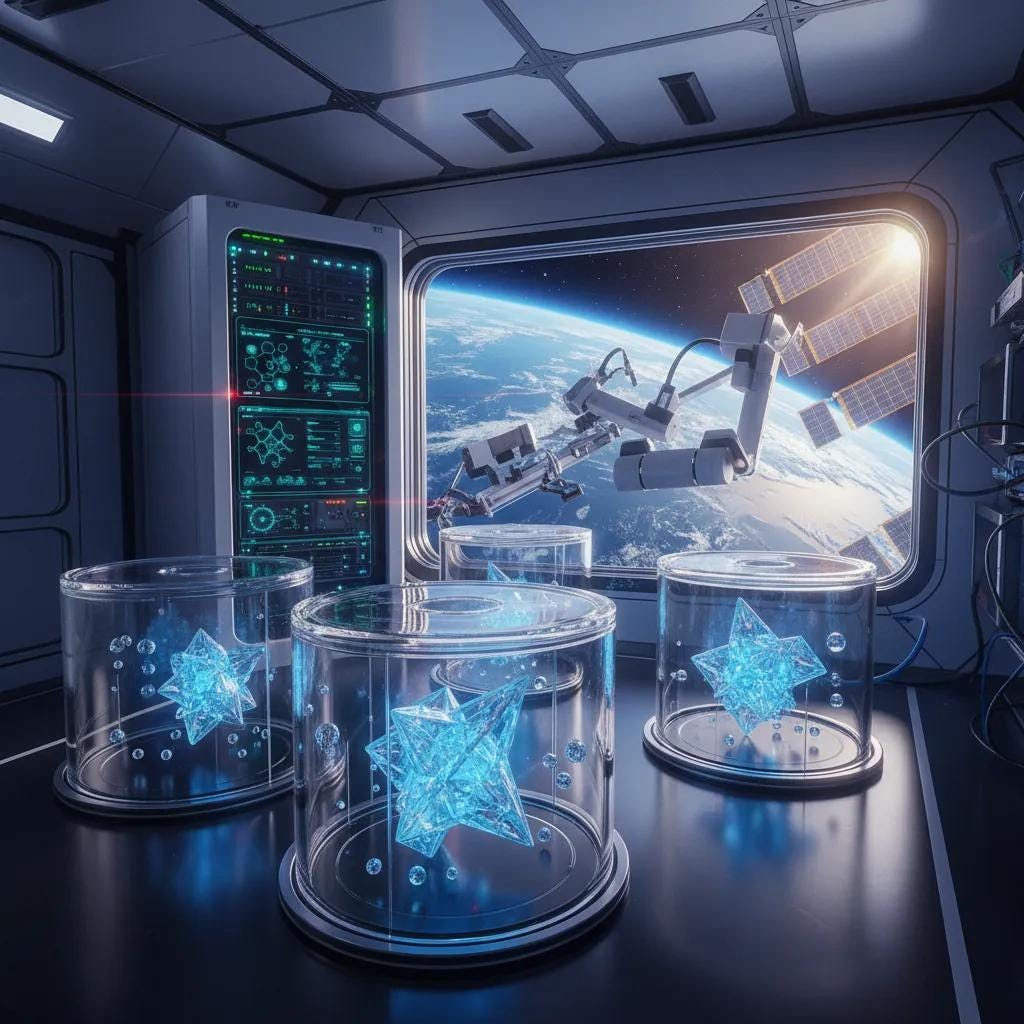
In microgravity, the physics of crystal formation changes entirely. On Earth, solutions separate by density and solid particles sink or rise. This makes growing perfectly ordered protein crystals (the building blocks of many modern medicines) notoriously difficult. In space, that interference disappears. Crystals grown in microgravity have an 80% or better chance of being superior to their Earth-grown counterparts, according to Prof. Anne Wilson of Butler University, who ran crystal-growth experiments in orbit in 2022. They come out more uniform, structurally precise, and often larger, which are easier to analyse, and easier to optimise.
This matters enormously for one specific class of drugs called biologics. These are large, complex molecules like proteins, antibodies, monoclonal antibodies, that treat everything from cancer to autoimmune diseases. They’re among the most expensive medicines in the world, partly because manufacturing them on Earth is so imprecise. Microgravity doesn’t just help scientists study them better. It can help redesign how patients receive them.
Merck used the International Space Station to experiment with its blockbuster cancer drug Keytruda (pembrolizumab). On Earth, Keytruda is delivered intravenously, which is a time-consuming hospital procedure. Space-grown crystals produced smaller, more uniform particles that improved viscosity enough to potentially deliver the drug by injection at home. That’s not just a convenience upgrade. For a drug that costs tens of thousands of dollars per treatment cycle, a cheaper delivery mechanism could expand access to millions of patients globally.
The NIH’s Tissue Chips in Space programme goes further still, sending miniature organ-on-chip systems to the ISS to study how diseases progress and how drugs act on tissue, free from the distortions of gravity-driven cell settling. And microgravity’s ability to accelerate cellular aging at the molecular level gives researchers a rare window into age-related diseases that would take decades to study on Earth.
Who Else Is in This Business?
The most dramatic proof of concept came from a metre-wide capsule that landed in the Utah desert in February 2024. Varda Space Industries’ W-1 mission had spent eight months in orbit aboard a SpaceX Falcon 9, manufacturing a small batch of Ritonavir (an antiviral used in HIV and COVID-19 treatment) in a 27-hour automated test run. It was the first time a pharmaceutical drug had been commercially manufactured in space and returned to Earth.
Varda’s co-founder estimates the initial mission cost around $12 million, with a target of dropping that to roughly $2 million per mission as spacecraft become more reusable and turnaround times shrink. That trajectory matters. Once permission economics reach a certain threshold, in-space manufacturing stops being a scientific experiment and starts being a viable supply chain.
UK-based BioOrbit, founded by Dr. Katie King, is taking a different angle. It’s focused not on discovering new drugs but on turning existing ones into forms patients can use at home, using microgravity crystallisation to redesign drug delivery. Japanese biotech Carna Biosciences grew MAP2K7 protein crystals in space, revealing structural details invisible to Earth-based labs. Meanwhile, over 500 protein crystallisation experiments have now taken place aboard the ISS, making it the station’s single largest research category.
The ISS itself, operated by five space agencies including NASA, ESA, and JAXA, has hosted life sciences research for over two decades. But what’s shifted recently is the entry of private capital which allows purpose-built automated platforms that don’t require an astronaut to run the experiment.
The India Angle
India occupies a curious position in this story. It is simultaneously one of the world’s largest pharmaceutical powers and one of the fastest-growing space economies, yet has not yet meaningfully connected the two.
On the pharma side, India is the world’s largest supplier of generic medicines by volume, supplying over 20% of global generics. On the space side, the story is accelerating faster than most people realise. In October 2024, ISRO and the Department of Biotechnology signed an MoU specifically to collaborate on space biotechnology, with applications in microgravity research, biomanufacturing, and health risks like cancer and bone loss.
In June 2025, Indian astronaut Group Captain Shubhanshu Shukla spent 18 days aboard the International Space Station under the Axiom-4 mission, conducting experiments on muscle atrophy and microbial behaviour in microgravity conditions. It was India’s first human presence on the ISS, and its scientific payload, while modest, established a template for future in-orbit experimentation.
Then, on May 3, 2026, Bengaluru-based startup GalaxEye launched Mission Drishti, the world’s first OptoSAR satellite, combining optical and radar imaging into a single 190-kg privately built spacecraft, launched on a SpaceX Falcon 9. Mission Drishti is not a pharma mission. But it signals something important. India’s private space sector has matured enough that a Bengaluru startup can independently build, test, and launch the world’s first satellite of its kind. The infrastructure, the regulatory openness through IN-SPACe, the partnerships with ISRO’s facilities, all of it is falling into place.
Space pharma requires the same scaffolding. Private launch access, orbital platforms, automated retrieval systems, and regulatory frameworks for in-space manufacturing. India has most of the first ingredient, is developing the second through Gaganyaan and the planned Bharatiya Antariksha Station, and has barely started on the third and fourth.
The Takeaway
India is not close to making drugs in space. It has a roadmap to orbit and a pharma industry that could theoretically benefit enormously from it. However, the bridge between the two hasn’t been built yet. What’s encouraging is that the ISRO-DBT MoU exists, that Indian scientists are increasingly running microgravity experiments abroad, and that Mission Drishti’s success signals a private sector capable of genuine frontier innovation.
The drugs made in space today are proof-of-concept batches, not commercial supply chains. But Ritonavir in 2024 looked the same way, until it didn’t. The costs are falling, the science is hardening, and the companies are getting serious. For a country that feeds the world’s generic medicine cabinet, the question of whether India has a role in the next generation of drug manufacturing isn’t hypothetical. It’s just early.
Very early.
Until these two industries mature and join, ReadOn!