
Urbanisation: A Governance Time Bomb
The word looks pretty in concalls, but is it really doing us any good?
At ReadOn, we don’t just report the markets. We help you understand what truly drives them, so your next decision isn’t just informed, it’s intelligent.
Urbanisation is the one thesis nobody fights. Ask any analyst why they are bullish on India and it appears within two minutes, sometimes disguised, sometimes upfront, but always there.
Real estate needs it for housing demand. Banks need it for credit growth. Consumer goods companies need it for premiumisation. The logic is clean. More people in cities means more non-agricultural income, more formal employment, more GDP. India’s cities contribute 60% of GDP while occupying just 3% of the land.
The economics are not wrong. From early river civilisations to modern metros, human progress has depended on clustering. It reduces interaction costs, enables specialisation and builds infrastructure that is otherwise impossible to sustain in dispersed settlements. As per the latest Economic Survey, doubling a city’s size boosts productivity by 12% in India. Larger, denser cities enable better worker-job matching, accelerate knowledge spillovers, and allow sharing of specialised inputs. Density, when it works, is productive by design. So India might not be called an urban economy, but it is one in every other sense of the word.
But is the quality of that urbanisation matching its scale?
We arrived at that question through some very specific data. Globally, a 1 percentage point increase in urbanisation is associated with a 3.9% rise in GDP per capita. In India, that figure is just 1.7%, less than half the global benchmark. India is urbanising, but it is leaving more than half the economic dividend on the table.
Let’s find out why.
What We Are Actually Counting
Before examining why, it is worth asking whether we are even measuring the problem correctly.
India’s Census classifies a settlement as urban only when it crosses three thresholds simultaneously: population above 5,000, at least 75% of male employment in non-agricultural sectors, and density above 400 persons per square kilometre.
This definition made sense when India’s economy had a cleaner rural-urban divide. But, with the current explosion of peri-urban settlements, the ruralisation of industry, or the millions who live functionally urban lives, without ever crossing a municipal boundary, does it serve the purpose now?
The Janagraha Foundation, a Bengaluru-based civic organisation, applied satellite-based spatial analysis and found India was already 63% urban against the Census figure of 31%.
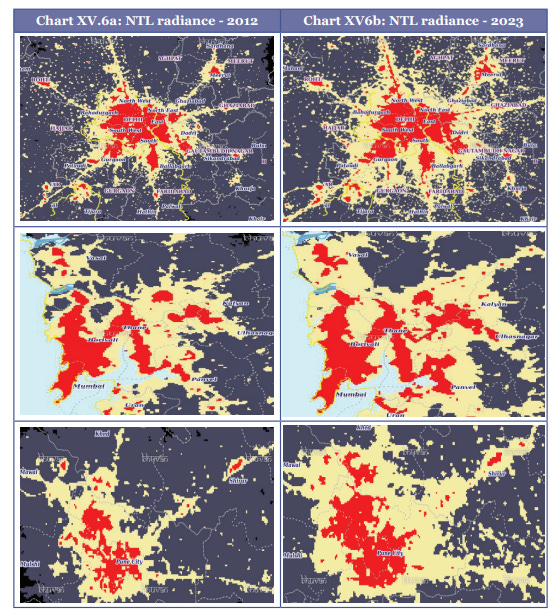
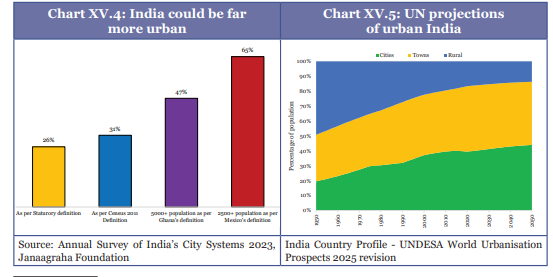
That is not a small gap. It is the size of several large countries, and every person living inside it is receiving rural-tier governance for an urban-tier life.
The People the Policy Doesn’t See
That undercounted urban population has a face: the urban poor.
Not the rural poor, who have MGNREGA, PM Kisan, and an entire architecture of welfare built around them. Not the urban rich, who have long exited public systems and built private alternatives. But think of the migrant construction worker living in a resettlement colony on the edge of Mumbai, or the street vendor in Delhi who pays a water tanker more than he pays for food. They sit in a specific vacuum. They are too urban to qualify for rural welfare, too poor to afford private options, and too disorganised to demand better public services. They build India’s cities, clean them, and keep them running. And they are also its sharpest evidence of low-quality urbanisation.
The starkest way to put this in perspective, would not be through a dataset, but through a single city and two images.
Look at the first image.
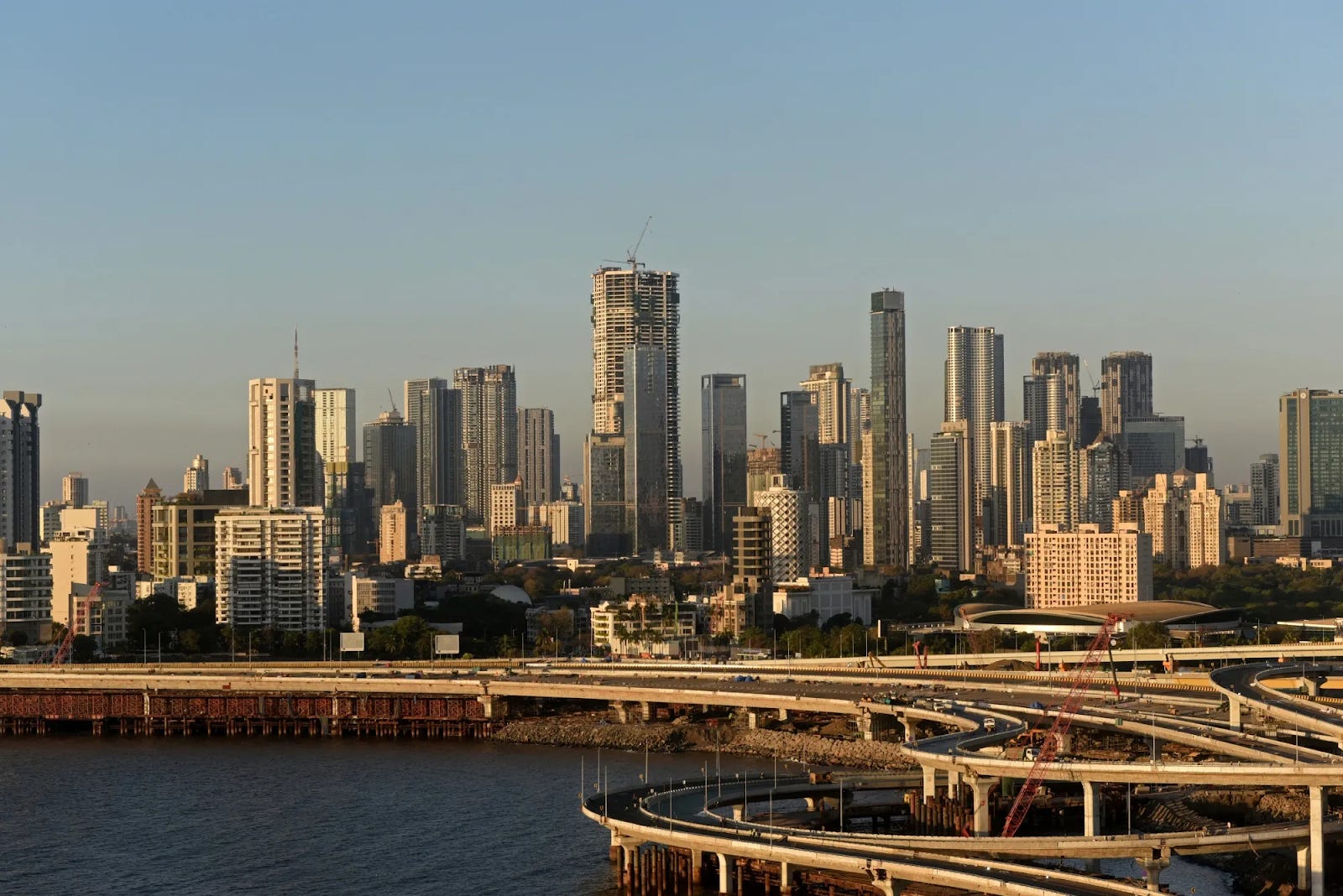
This is South Mumbai. It has functioning drainage, heritage-grade footpaths, century-old institutional infrastructure maintained to a standard that marks it as a global city precinct.
Now look at the second.
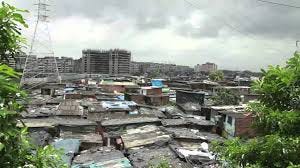
This is M-East Ward, just 25 kilometres away, with localities like Govandi, Mankhurd, Deonar housing over 800,000 people. Public infrastructure here consists of broken sewage lines, chronic water shortages, roads that flood every monsoon, and a public health system that residents describe as effectively absent.
Two places. One city. Numerous contrasting features. But there’s something that connects them. It’s the BMC, Asia’s richest municipal corporation. Both these regions are governed by the same municipal body. Yet, they experience radically different outcomes. And this is not a Mumbai story. It is what low-quality urbanisation looks like at its most visible.
The poverty data confirms it. Between FY12 and FY23, urban poverty declined by just 26.3 percentage points, compared to a 36.5 pp decline in rural areas. India’s cities, the engines of its growth story, are delivering less inclusive growth than its villages. And by mid-century, with urban population projected to cross 50% from 31% today, the compounding cost of this quality gap becomes almost too large to calculate. A gap that policy has consistently failed to close, not for lack of resources, but for lack of accountability.
The Governance Failure
India’s cities are asked to do more than they are built to handle. As more people arrive, the infrastructure meant to serve them like roads, schools, hospitals, water, has not kept pace. The result is a drag on the very productivity that urbanisation is supposed to create.
The numbers are stark. Nearly 33% of Grade 8 students cannot read a Grade 2 text after eight years of schooling. This is a failure concentrated almost entirely in government schools. Urban families have almost abandoned public education. Government school enrolment in major cities is under 9%. Two in five required urban health centres do not exist. Of those that do, a third of the posts sit vacant. India’s out-of-pocket health spending (what people pay from their own pockets), is higher than Indonesia, Ghana, Brazil, and the Philippines. Even among the poorest, nearly half end up paying for private healthcare, not by choice, but because the public option has become unreliable.
The reason this persists is not money. It is politics. The urban poor cannot organise pressure for better services. Daily survival leaves no bandwidth for civic demands. The middle class and rich have simply left. They have private schools, private hospitals, private water. They have no stake in whether public systems work. So public systems do not get fixed. Roads do, because everyone uses roads. Urban health and sanitation in poor neighbourhoods have no such audience.
This is structurally enforced. City governments in India raise less than 0.6% of GDP in their own revenues against 1-3% in comparable countries. The 74th Constitutional Amendment, passed in 1992, promised to hand 18 urban functions like health, education, poverty, and more to city bodies.
More than three decades have passed since. The money to execute those functions was never transferred.
Indian cities are responsible for problems they were never funded to solve. An unskilled Delhi worker can lose up to ₹19,600 a year just to traffic. Across four metros, congestion costs a total $22 billion a year. And affordable housing near job areas has fallen from 52% of urban supply in 2018 to just 17% today.
The Takeaway
India’s urbanisation story is not structurally strong… Yet.
So, celebrating the theme might be premature. Cities that cannot absorb migrants productively, weaken the very migration incentive that powers the growth thesis. The dividend from people coming together in clusters stays locked when density produces informality instead of productivity.
The policy responses so far reveal the problem more than they solve them. Ayushman Bharat’s health insurance expansion is genuinely popular, and rightly so. But as state budgets get drawn toward purchasing private hospital capacity, the already underfunded primary healthcare system hollows out further. Insurance is filling a void the public system should occupy. The Smart Cities Mission tells a similar story. A decade-long programme that spent ₹1.64 lakh crore, formally shut down in March 2025, and by its own reckoning saw 80% of its funding concentrated in areas serving just 9% of city populations. Only 18 of 100 cities completed all their projects. These are not failed ideas. They are well-intentioned interventions that kept arriving at the wrong layer of the problem: the surface, not the structure.
The solution to this problem is known. Property tax reform. FSI liberalisation. 24/7 urban PHCs. Municipal bond markets. Outcome-linked fiscal transfers. The Economic Survey 2026 even proposes a ₹1 lakh crore Urban Challenge Fund structured around bankable projects. But the constraints are political. Quality of urbanisation does not win elections the way metro inaugurations do. It does not photograph as well as a highway length milestone.
The Economic Survey closes its urbanisation chapter, borrowing from Elinor Ostrom and Indian economist D.R. Gadgil. According to them, shared spaces depend as much on norms, trust, and collective behaviour as on formal rules. They also mentioned that development outcomes are shaped by institutions and social organisation, not investment alone. India’s cities can work better. But only if planning, finance, and governance align around people-centred outcomes, turning urbanisation from a number India cites into a quality India delivers.
That is the project. The 1.7% vs 3.9% gap is the distance between where India is and where it could be.
One way to get there, would be to ReadOn!
We treat urbanization as an inevitability, but without municipal reform, it may pose a concentration of risk. The gap between our $15 trn GDP ambition and the reality of urban flooding and broken infrastructure is the most critical bottleneck for the next decade.