
Three days
The war will hurt their oil, but the Gulf Nations are more worried about running out of water.
At ReadOn, we don’t just report the markets. We help you understand what truly drives them, so your next decision isn’t just informed, it’s intelligent.
Three days. That’s how long the human body survives without water. It’s also how long Qatar estimates it would last if its desalination infrastructure were destroyed.
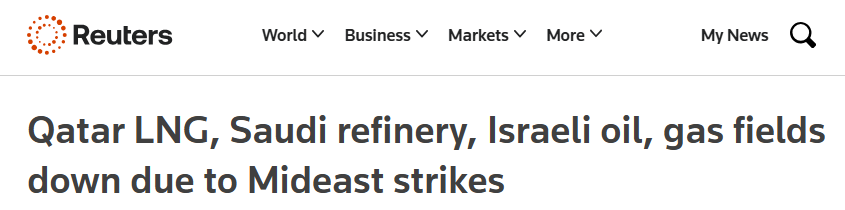
Most of us saw the headlines on 2nd March. Iranian drones, Ras Tanura, oil at $82. The world did what it always does. It panicked, priced it in, and reached for the oil crisis playbook it’s been rehearsing since 1973. Analysts have models for it. Futures markets price it in. Governments have strategic petroleum reserves for exactly this moment.
But there is a more vulnerable commodity sitting in the current conflict’s crosshairs. One that has no futures market. No strategic reserve treaty. And no global institution managing its disruption.
It is water. And in a region where modern statehood was built on a single technological fix for its absence, a strike on water infrastructure would create a biological crisis.
The Gulf Built Its Future on Seawater
To understand why water changes everything here, you need to understand what Saudi Arabia, and the Gulf, actually are.
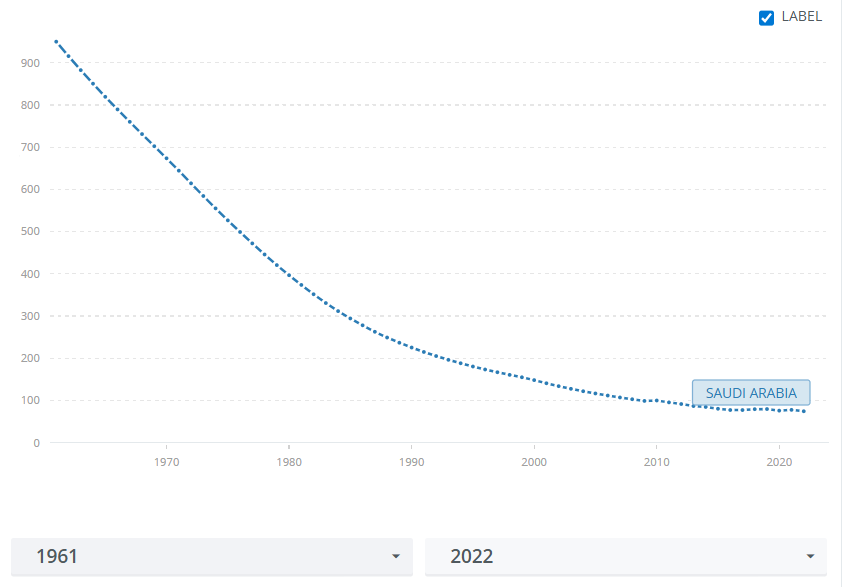
The country gets about 100 millimetres of rainfall a year. Parts of the Rub’ al Khali (the largest continuous sand desert in the world) go years without any at all. There are no permanent rivers. The underground aquifers that took thousands of years to fill have been largely drained over the past few decades. By UN definitions, a country enters “absolute water scarcity” when its renewable freshwater supply drops below 1,000 cubic metres per person per year. Saudi Arabia is sitting at roughly 70-80.
So how does a country with 37 million people, several of the world’s most modern cities, and ambitions to host the World Cup function? It boils, or more precisely, pressurises, the sea.
Gulf states took their oil revenues and built desalination plants.
These are enormous industrial complexes that strip salt from seawater and turn it into something you can drink, cook with, and run a hospital on. The region’s monarchies are often described as petro-states, but they’ve become what scholars now call “saltwater kingdoms”, or global superpowers in the production of human-made fresh water drawn from the sea.
Eight of the world’s ten largest desalination plants are in the Arabian Peninsula. The countries of the Arabian Peninsula hold about 60% of global water desalination capacity. Roughly 100 million people in the Gulf rely on desalination for their water. Without these plants, almost nobody would be able to live in Kuwait, Qatar, and the UAE, or much of Saudi Arabia, including Riyadh.
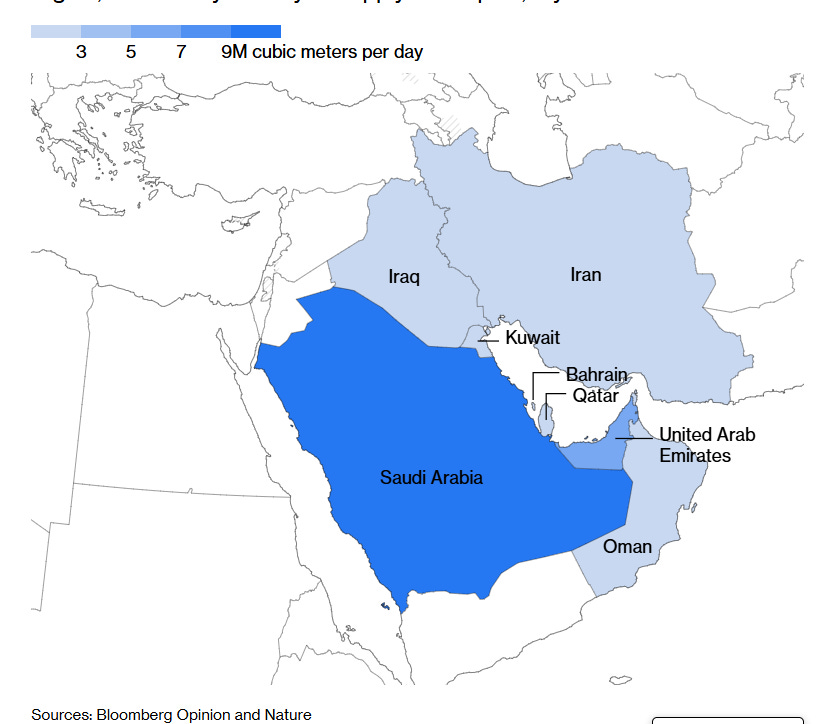
Kuwait gets around 90% of its drinking water from desalination. Oman, 86%. Saudi Arabia, 70%. Qatar and Bahrain are effectively 100% dependent once you set aside their minimal groundwater reserves. For small states like Qatar and Bahrain, strategic water stocks could be depleted in days if their desalination plants were destroyed. Qatar’s prime minister, Mohammed bin Abdulrahman bin Jassim Al Thani once said publicly that his country could run out of potable water in just three days if its infrastructure were hit. This is why Qatar has since built 15 emergency water reservoirs as a war buffer.
The single most important piece of civilian infrastructure in the region is Saudi Arabia’s Jubail desalination plant on the Persian Gulf coast. It supplies over 90% of Riyadh’s drinking water through a single pipeline stretching 500 kilometres inland. A 2008 US diplomatic telegram, later made public, put it plainly. If the Jubail plant or its pipeline were seriously damaged, Riyadh “would have to evacuate within a week.“ It added that “the current structure of the Saudi government could not exist without the Jubail Desalination Plant.” When that telegram was written, Riyadh had five million people. Today it has eight and a half million.
And water here is for more than just drinking. Gulf-wide water consumption runs at 560 litres per person per day, more than three times the global average of 180 litres. Hospitals need sterile water. Air conditioning systems run on chilled water loops. Petrochemical plants consume water at an industrial scale.
The Soft Target Iran Hasn’t Struck… Yet
The distance from the Iranian coast to Jubail and Ras Al-Khair is approximately 150 to 300 kilometres across the Persian Gulf. That’s comfortably within the range of Iran’s cheapest and most abundant weapon systems. Since the conflict began on February 28, Iran has launched more than 500 ballistic missiles and over 2,000 drones. Its Shahed-136 drone costs between $20,000 and $50,000 a unit. The plants sit on open coastlines, and they are fixed, large, and visible. This isn’t a targeting challenge. It’s a targeting choice.
And Iran has already been circling. Iranian strikes on March 2 hit Dubai’s Jebel Ali port, about 12 miles from a complex with 43 desalination units producing over 160 billion gallons of water for the city each year. Iran struck a power station in Fujairah that feeds one of the UAE’s largest desalination plants. A drone hit a water reservoir at a power plant in Qatar. In Kuwait, intercepted drone debris started a fire at a desalination facility.
The fact that Iran hasn’t directly targeted desalination plants shows it’s operating with deliberate restraint.
Every day Iran holds back from striking those plants, it’s reminding Saudi Arabia, the UAE, Qatar, and Kuwait, all countries caught uncomfortably between Iranian missiles and Washington’s war, that the escalation ladder has a rung above where things currently stand. That signal costs Iran nothing. It generates more coercive pressure than any conventional military exchange against a US-backed enemy could.
There’s also a threat that doesn’t even require Iran to make a decision. The US-Israel strikes have already targeted Iranian nuclear facilities. Regional leaders have warned that strikes on Iran’s nuclear facilities could contaminate Gulf waters used by desalination plants, and analysts estimate contaminated atmospheric plumes could reach GCC countries in as little as 15 hours. Desalination plants pull directly from coastal seawater. You don’t need to aim at a plant if you’ve already poisoned what it drinks from.
In the End, Everyone Is Downstream
The country holding the most powerful water threat in this war cannot keep its own capital’s taps running. Tehran’s reservoirs were at 12% capacity last year. Iran’s president warned publicly that the government might have to evacuate a city of 15 million people if it didn’t rain. The country’s freshwater supply has shrunk by 37% in two decades, its aquifers are collapsing, and the ground beneath urban areas is sinking by up to 30 centimetres a year. And it’s the one threatening to cut off everyone else’s water. That’s a lot of irony for one country or war. It’s a portrait of how completely water crises and water wars have become the same thing.
International law has a clear position on all of this. Article 54 of the 1977 Geneva Protocol I explicitly bans attacking objects essential to civilian survival, and specifically names drinking water installations. The prohibition is crystal clear. But there isn’t any real mechanism to enforce it. The 1991 Gulf War established the modern precedent. Iraqi forces deliberately destroyed Kuwait’s desalination capacity, damaged 800 kilometres of Gulf coastline, and killed an estimated 30,000 seabirds through an oil spill designed partly to contaminate water intake systems. Nobody was prosecuted. No binding framework emerged. The law said one thing. The war did another.
The Takeaway
The sharpest illustration of how fragile water agreements are under political pressure isn’t in the Middle East. It’s closer to home. The Indus Waters Treaty, signed between India and Pakistan in 1960, survived six decades of animosity, including four wars and near-constant hostility. It was held up globally as the gold standard of water diplomacy, proof that two countries could share something as essential as river water even when they were shooting at each other. Then in April 2025, following the Pahalgam terrorist attack, India suspended it. It was the first time tensions between the two countries had ever disrupted the treaty. Pakistan’s response was clear. Any blocking of river water would be treated as an act of war. The Indus basin supplies about 80% of Pakistan’s irrigated agriculture. It’s a sector worth roughly 25% of their GDP and employing 65% of the labour force. Tens of millions of people whose daily survival depends on those rivers had no vote in either the attack that triggered the suspension or the suspension itself.
That is the pattern this conflict keeps repeating, from the Persian Gulf to South Asia. Water is essential to everyone. It is protected by law. And the moment a conflict gets hot enough, it becomes a pressure point, a signal, a weapon, or a casualty. Regardless of the law, regardless of the treaty, regardless of who depends on it to survive. The people who pay the price are never the ones who made the decision.
Until the water cools down, ReadOn!