
The Empty Seat Problem
The Indian traffic problem is giving a whole new meaning to the word "hot seat"!
At ReadOn, we don’t just report the markets. We help you understand what truly drives them, so your next decision isn’t just informed, it’s intelligent.
You’ve probably seen the notification. Your phone pings with a weather update and there’ warning that it might feel hotter than what’s shown. It’s a bit like the text on your car’s rearview mirror: objects may be closer than they appear. Except here it’s heat, not distance, and the warning is getting harder to ignore.
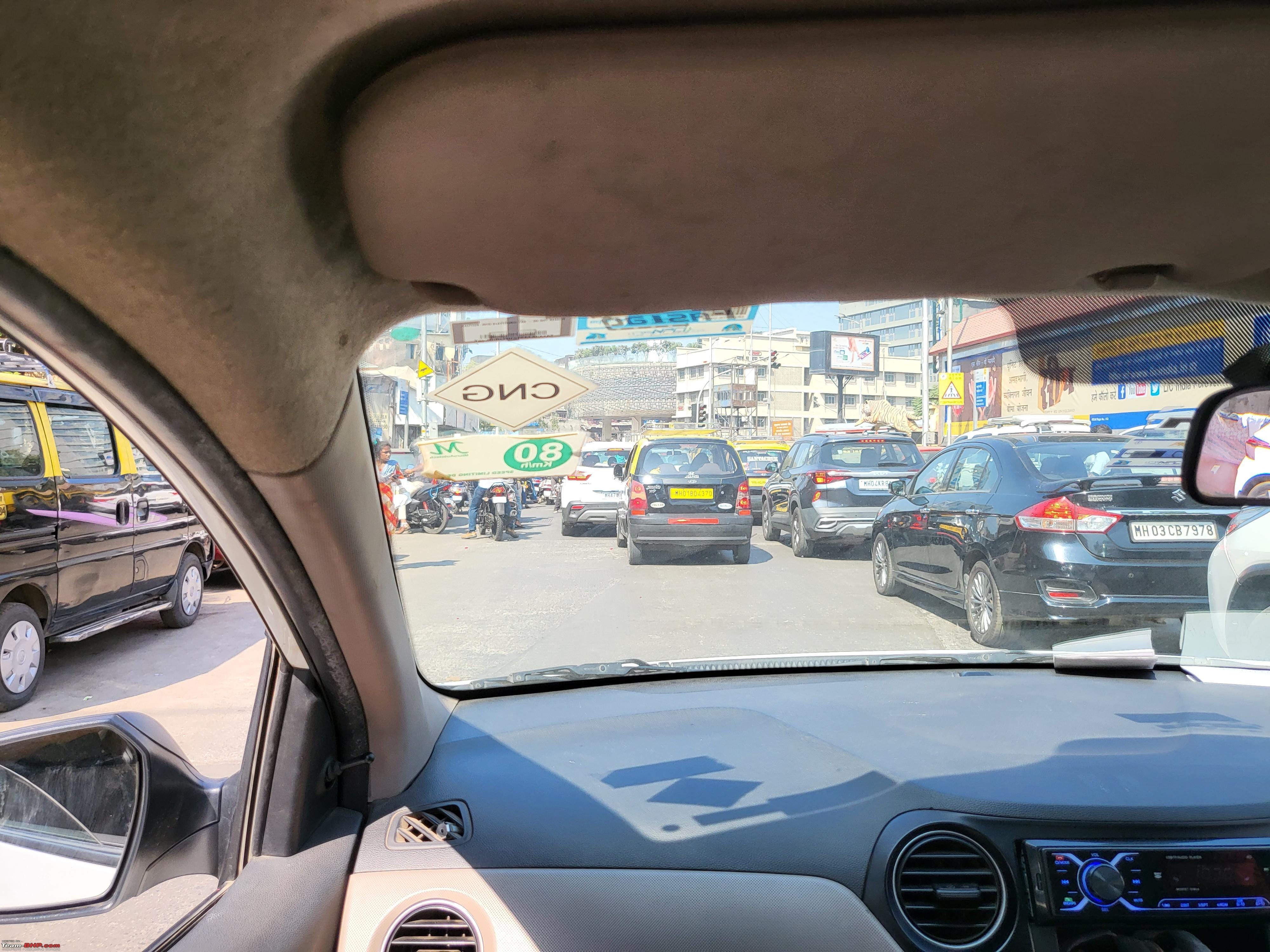
Now picture yourself inside that car, engine running, AC barely keeping up, trapped in traffic going nowhere. If you’ve driven through Bengaluru, Delhi, or Kolkata in the last few weeks, you don’t need to imagine. You’ve lived it. But take a moment, and look left, then look right. Most cars around you have exactly one person in them. The driver. The other three seats are empty. A few of these cars might even be headed for the same destination, but in different cars, and nobody is sharing.
We know that India clearly doesn’t have a shortage of vehicles. If anything, we have a surplus of unused seats. And that gap is making everything worse. The heat, the traffic, the air. Filling this gap of seats through carpooling could be a solution to these problems.
A C-DEP white paper recommends creating a dedicated legal category called “Carpooling Intermediaries” under the Motor Vehicles Act, 1988. Maharashtra’s Draft Aggregator and Carpooling Rules, 2025 has already done this at the state level. Even the Economic Survey of 2024-25 points out that adapting carpooling on a large scale could reduce the number of vehicle trips per day by 7,80,000. This, in turn, would also save around 380 million litres of fuel annually.
So, is carpooling the fix? If so, why isn’t it more widely accepted? Let’s find out!
A Country on Fire
On April 27, 2026, something with no modern precedent happened. Every single one of the world’s top 50 hottest cities, as tracked by AQI.in, was in India. Not one entry from the Middle East. Not one from sub-Saharan Africa. India occupied the entire list, rank 1 to rank 50, with an average peak temperature of 44.7°C across all 50 cities. By May 22, things escalated further. 97 of the world’s 100 hottest cities were Indian, with Balangir in Odisha hitting 48°C and Brahmapuri in Maharashtra recording 47.2°C.
The heat isn’t random. It’s the accumulated product of how India moves. According to a February 2026 white paper by the Centre for Digital Economy Policy Research (C-DEP), road transport accounted for approximately 92% of India’s total transport energy demand in 2021, and nearly 95% of that is met by petrol and diesel. The entire transport sector itself consumes 3.6 million tonnes of oil equivalent (MTOE) of natural gas and 43.4 MTOE of oil products each year, accounting for 12.5 percent of the country’s total energy consumption. The average Indian private car emits 121.3 grams of CO₂ per kilometre. That’s 28% more than the European Union’s 2021 target of 95 g/km. These emissions don’t just pollute; they trap heat at the surface through the greenhouse effect, feeding the very conditions that push that “feels hotter” notification onto your screen every morning.
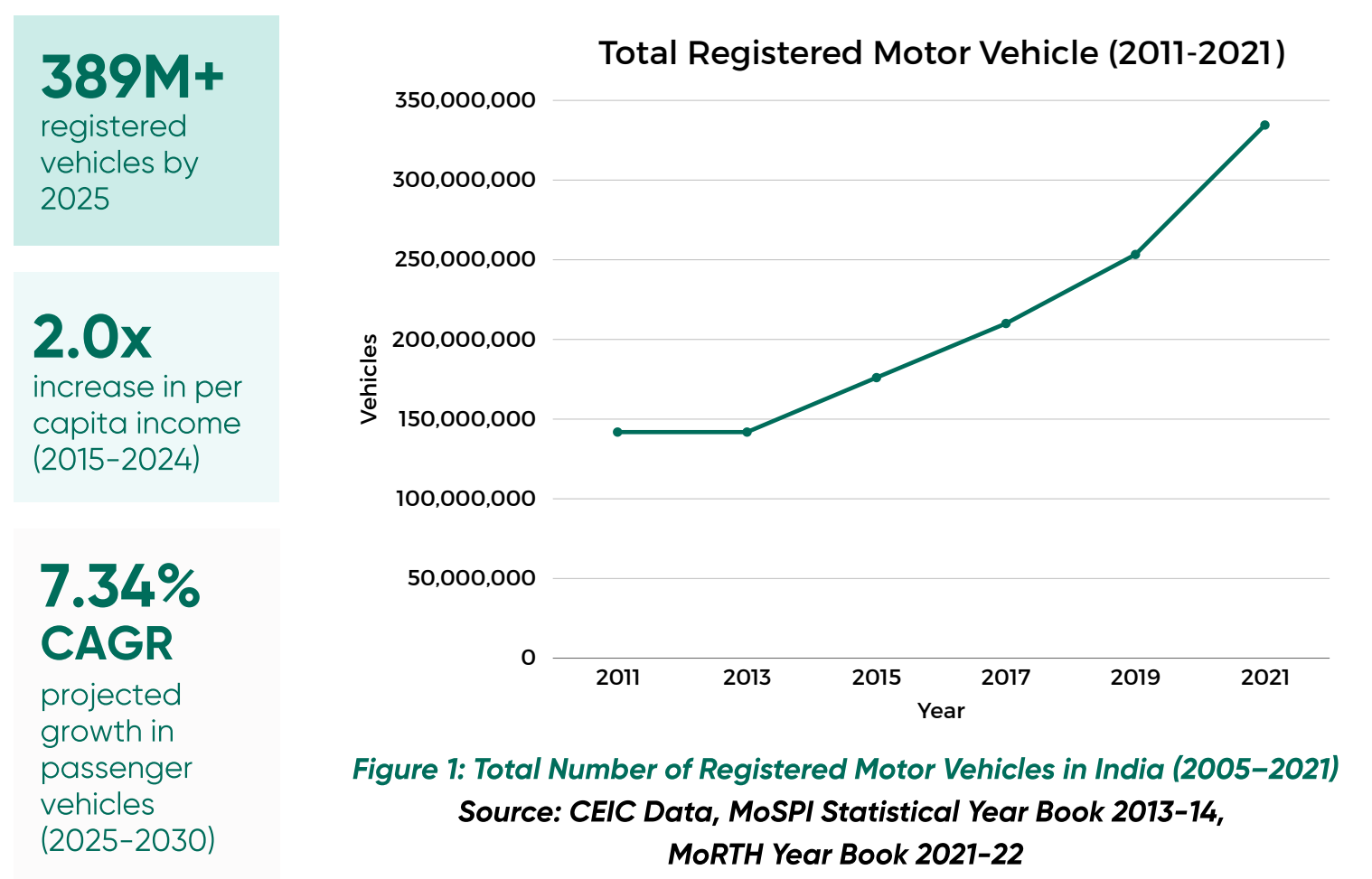
The vehicle count has only amplified the problem. India had 142 million registered vehicles in 2011. By 2025, that number had reached nearly 389 million, almost tripling in 14 years, as rising incomes and cheaper credit turned car ownership from aspiration to expectation.
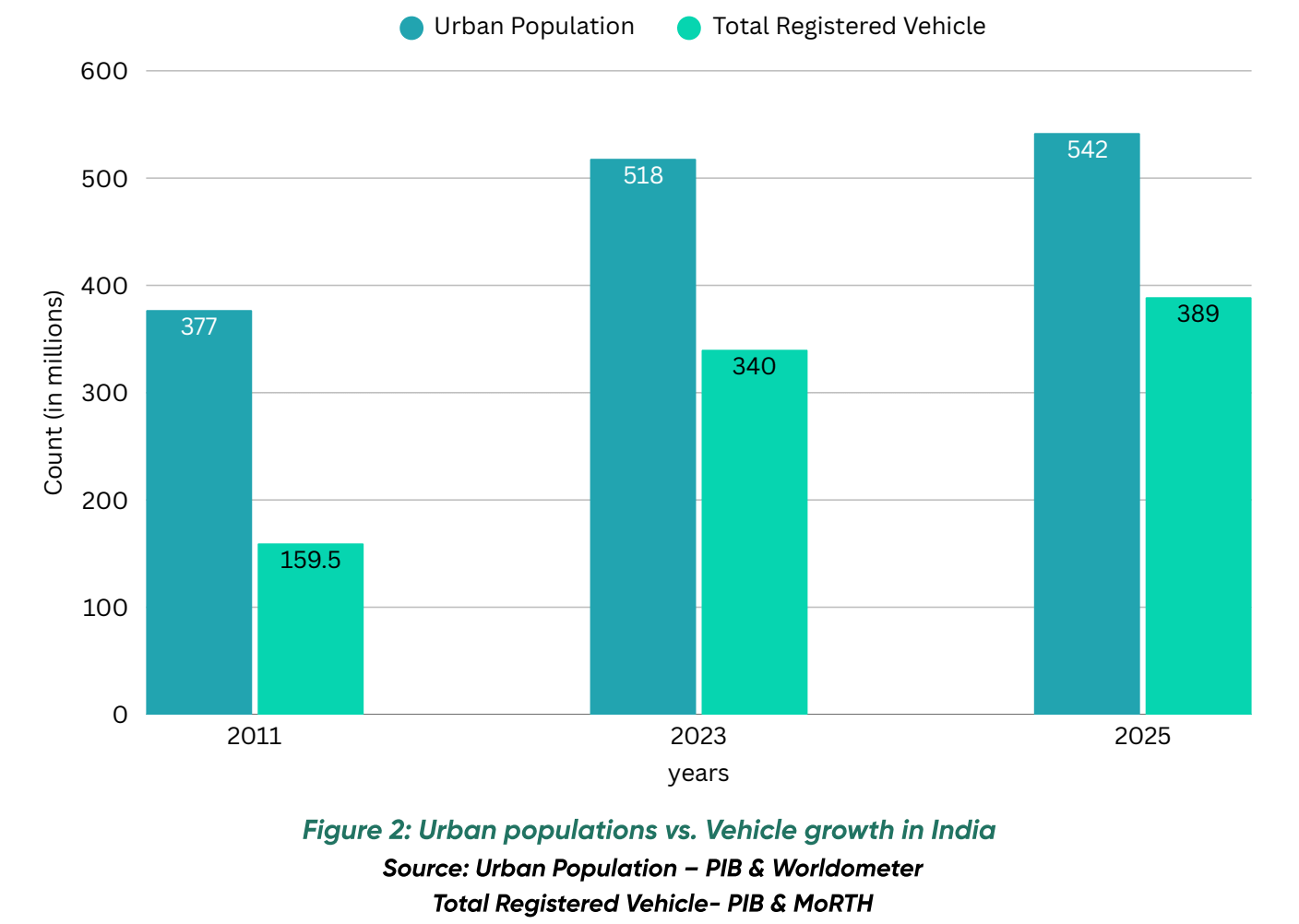
Over the same period, India’s urban population grew 38%, from 377 million to 542 million, pushing more of those vehicles onto roads that were never designed for them.
The result? Indian cities are grinding to a halt. Turns out, more vehicles don’t mean better transportation. According to the TomTom Traffic Index 2023, Bengaluru is one of the world’s most congested city, where drivers spend 168 hours a year stuck in traffic, moving at a peak-hour average of just 16.6 km/h. Kolkata follows with a similarly grim 17 km/h. A joint study by the Transport Corporation of India and IIM Calcutta puts the total cost of this congestion through lost productivity, wasted fuel, excess emissions at over ₹1.4 lakh crore annually, almost 0.5% of GDP. And of the 30 most polluted cities in the world, 19 are Indian.
The Seat Nobody’s Sitting In
Most of this damage comes from cars that are nearly empty.
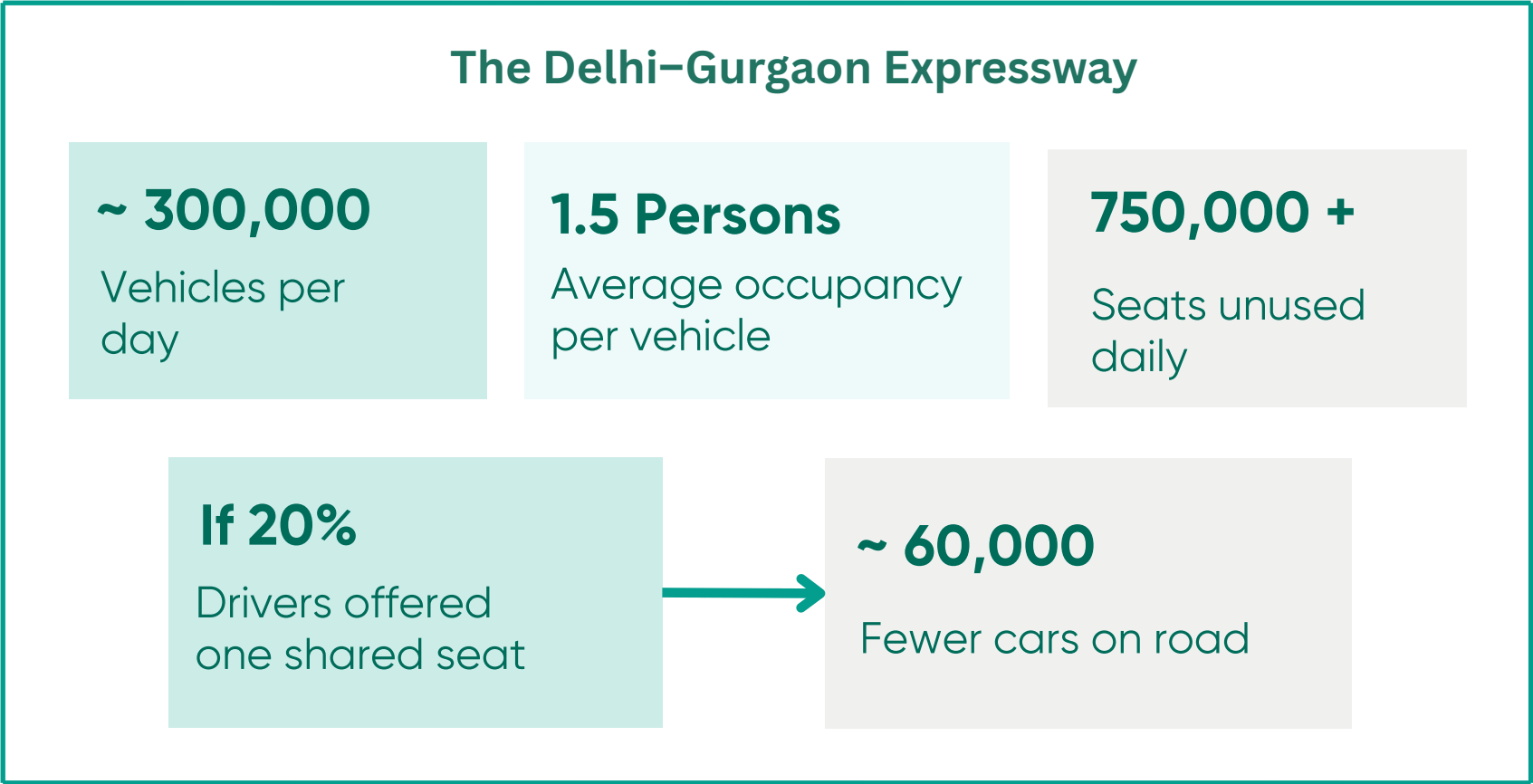
The average occupancy of private cars in India is between 1.2 and 1.5 persons per vehicle. On the Delhi–Gurgaon Expressway alone, which carries 300,000 vehicles daily, that means over 750,000 seats go to waste every single day. If just 20% of those drivers offered one shared seat, roughly 60,000 fewer vehicles would need to be on that road. One corridor. One behavioral shift. 60,000 cars gone.
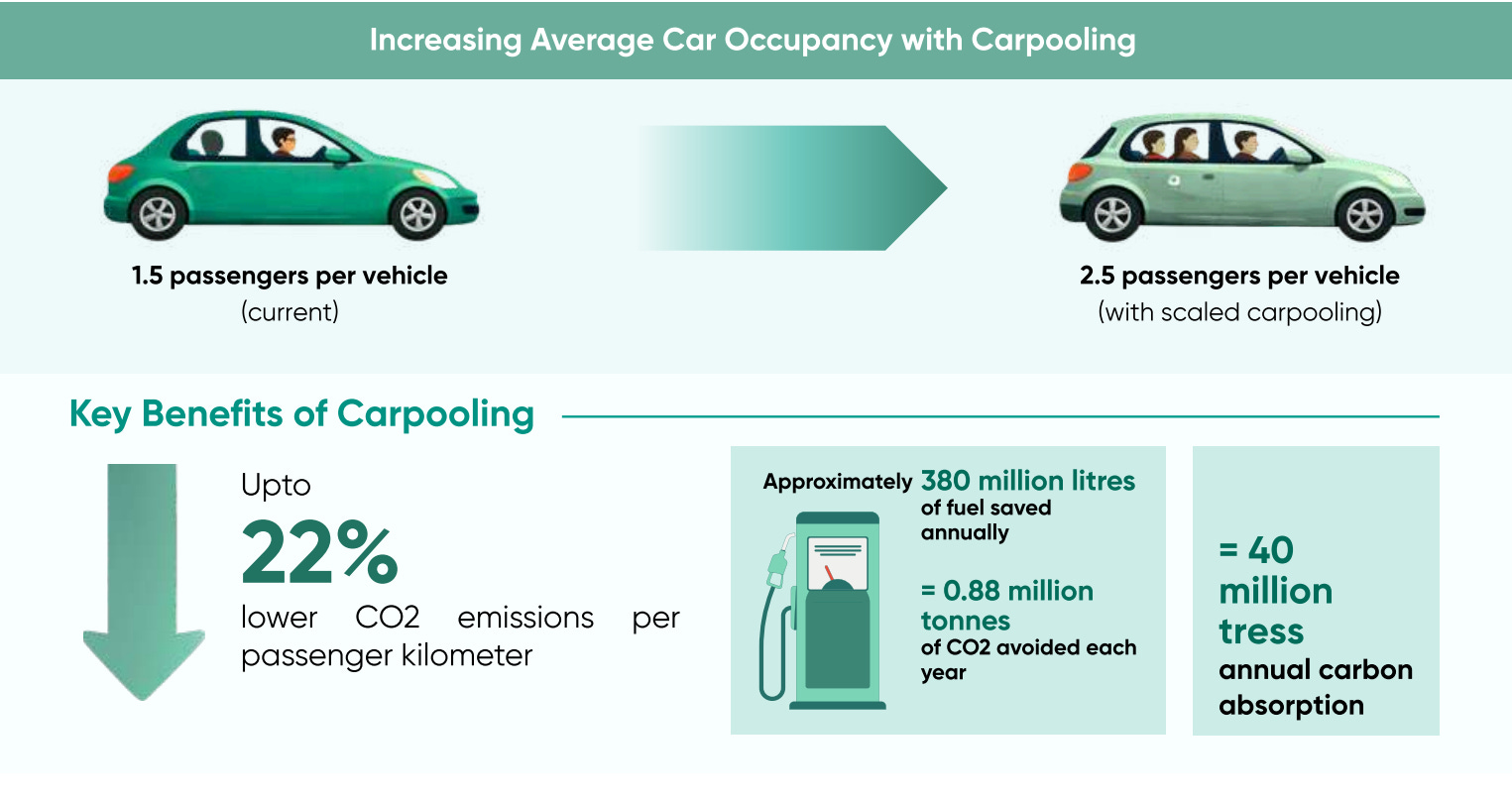
Let’s look at some emissions math. Raise average vehicle occupancy from 1.5 to 2.5 persons (entirely achievable through carpooling) and CO₂ emissions per passenger-kilometre fall by up to 22%. At scale, the Economic Survey 2024-25 estimated carpooling could eliminate 7,80,000 vehicle trips per day, save 380 million litres of fuel annually, and prevent 0.87 million tonnes of CO₂ from entering the atmosphere each year or the equivalent to the carbon absorbed by 40 million trees.
This isn’t theory. In France, BlaBlaCar’s users saved 1.6 million tonnes of CO₂ in 2022 alone. In the UK, Liftshare helped employers eliminate 402 million kilometres of commuter travel, avoiding roughly 300,000 tonnes of carbon. India already has the infrastructure to replicate this, we have our smartphones, expressways, digital payments. The missing piece is willingness and a little policy nudge.
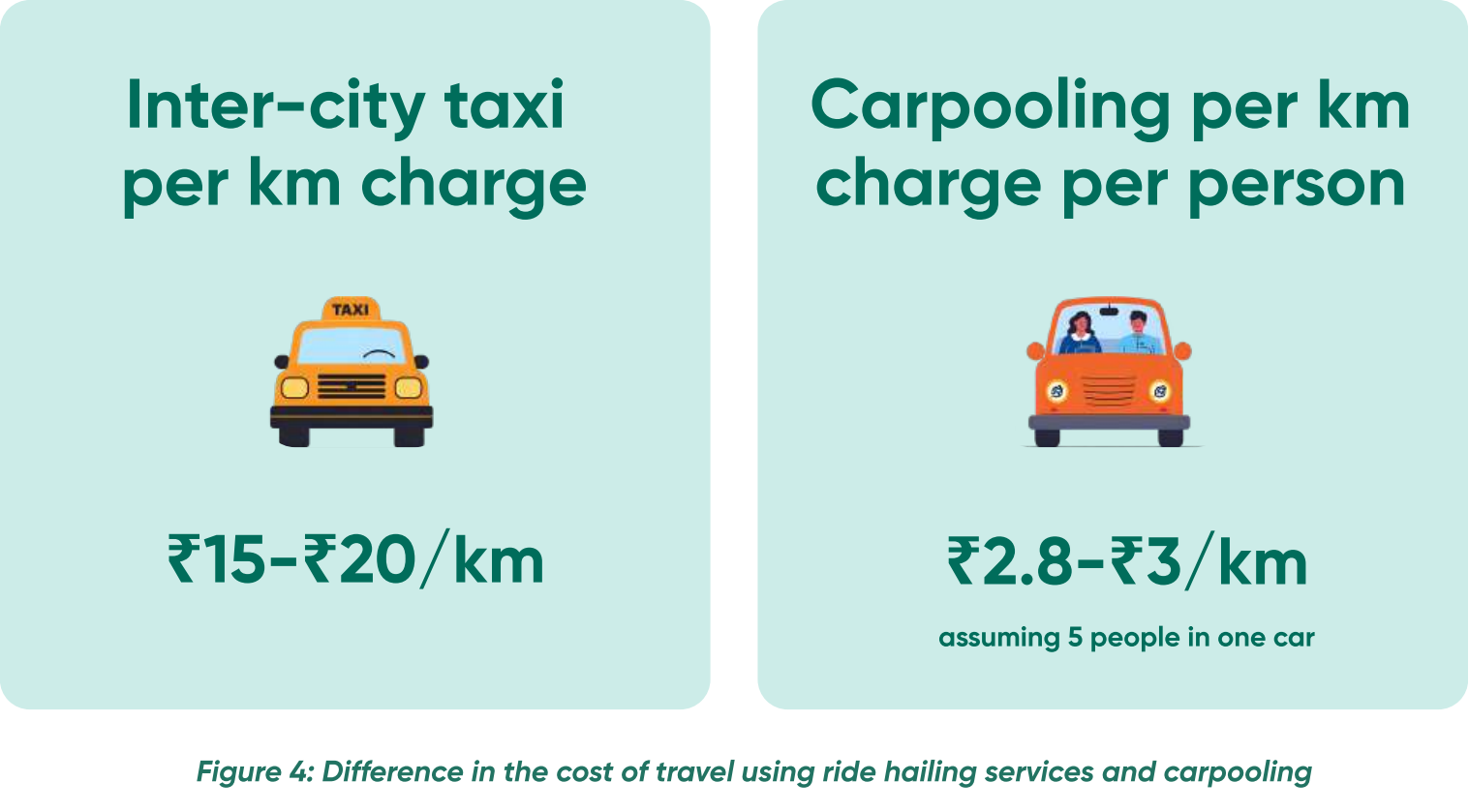
The money case is hard to dismiss too. A dataset of 811,804 confirmed inter-city carpooling trips in Maharashtra in 2024 shows the average seat cost was just over ₹2/km. A solo driver’s actual cost, accounting for fuel, tolls, depreciation, maintenance, and insurance, comes to ₹14–15/km. That’s a gap too large to ignore. A 120 km trip costing ₹1,800 solo becomes ₹360 per person in a full car. Maharashtra already recorded over 1.9 million carpooling passengers in 2024. The demand exists.
Clearing the Way
The biggest obstacle to carpooling in India isn’t technology or demand. It’s a regulatory grey zone.
Right now, carpooling platforms are often treated like commercial ride-hailing aggregators like Ola, Uber, etc., even though they operate on a fundamentally different model. Carpooling is non-commercial and cost-sharing. Nobody profits. But that distinction hasn’t been codified at the national level, which creates legal risk for platforms, discourages new entrants, and pushes informal arrangements entirely off-platform.
As we mentioned in the intro, the C-DEP white paper recommends creating a dedicated legal category called “Carpooling Intermediaries” under the Motor Vehicles Act, 1988. Maharashtra’s Draft Aggregator and Carpooling Rules, 2025 has already done this at the state level. The central government needs to follow. Alongside this, platforms should be allowed to operate under a single national registration, rather than fighting through 28 state-level compliance requirements. Carpooling, by nature, crosses state borders.
The report also recommends allowing 100% cost recovery for driver-users. Meaning fuel, tolls, depreciation, maintenance, and insurance can all be shared, as long as no profit is made. Currently, ambiguity around this threshold deters participation. And on safety, the recommendations are practical rather than bureaucratic: Aadhaar-based driver verification through a centralised API, a women-only matching option, live trip-sharing with trusted contacts, and a 24/7 multilingual helpline. No physical infrastructure required. No new intermediaries.
Then there’s a nudge that costs almost nothing. The Ministry of Road Transport and Highways could print a single line on every vehicle Registration Certificate, Driving Licence, and at NHAI toll plazas. “Carpooling is better for the environment”. It requires a minor update to an existing printing cycle. No campaign budget, no new programme. Just a message placed where every driver already looks.
The Takeaway
India’s roads need fewer, and fuller vehicles.
Every car stuck in that traffic jam was going somewhere anyway. Every empty seat is a choice, not a constraint. The emissions it creates, the congestion it adds, the heat it contributes, these are costs distributed across everyone and borne individually by no one. That’s precisely the kind of problem that a well-placed nudge, a clean policy, and a shared ride can actually solve.
Next time your phone warns you it feels hotter than the thermometer says, look at the car you’re in and the ones next to you. Are they running as many passengers as can fit in a vehicle with half as many wheels? Probably so. And now you know how big a problem it is.
Until the next ride, ReadOn!