
Strange Judges
Who judges some of the world's most pricey bets?

At ReadOn, we don’t just report the markets. We help you understand what truly drives them, so your next decision isn’t just informed, it’s intelligent.
Think back to the last time you lost a bet. Maybe it was on a cricket match, a board game outcome, or who would finish dinner first. At some point, someone always says the same thing: “That’s not what we agreed on.” And when it really matters, when real money is on the line, you need someone else to step in and call it.
That same problem, scaled to almost absurd proportions, is playing out on the internet’s biggest prediction markets.
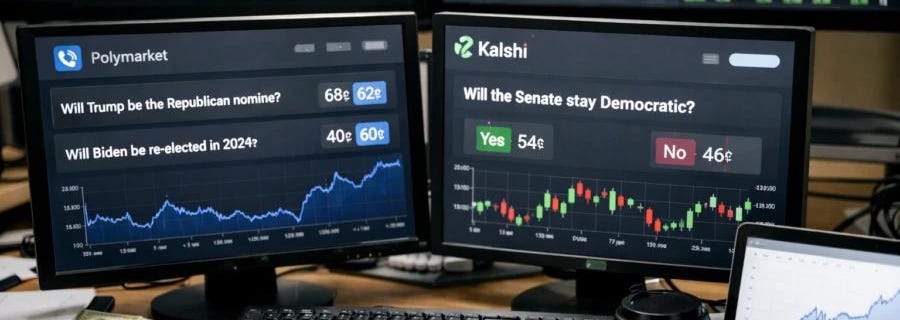
Platforms like Polymarket and Kalshi have turned everyday predictions into a financial sport. You can bet on whether the Fed cuts rates, whether a ceasefire holds, or whether a CEO will resign. The numbers are staggering. Sector trading volume jumped from roughly $16 billion in 2024 to nearly $64 billion in 2025, and in Q1 2026 alone, Polymarket processed $26.2 billion in trades. That’s a 90% jump over the prior quarter. Analysts at Bernstein project total prediction-market volumes could hit $240 billion by the end of 2026. This is no longer niche.
But here’s the thing about prediction markets: real-world events are messy. Cease-fires happen in stages. Politicians submit resignations, then don’t resign. Earnings land with asterisks. When traders disagree on whether a bet has resolved correctly, someone has to play judge. So who exactly is making that call when hundreds of thousands of dollars hang in the balance?
The Crypto Courtroom
Most platforms sort disputes out themselves. Kalshi has an internal enforcement team. Polymarket takes a different route. When traders disagree about how a bet should resolve, the platform outsources the decision to a third-party service called UMA (Universal Market Access). UMA was founded by two former Goldman Sachs traders and is overseen by Risk Labs, a foundation registered in the Cayman Islands. It describes itself as a decentralised oracle protocol. In plain English, UMA is a system for getting anonymous strangers to agree on facts.
The arrangement has regulatory roots. In 2022, Polymarket settled with the U.S. Commodity Futures Trading Commission over allegations it had violated American trading rules. By offloading dispute resolution to a diffuse group of token holders, Polymarket bolstered its claim that it was an offshore platform outside U.S. reach. As the platform’s terms of use now state, Polymarket “is not responsible for any disputes related to the resolution of any Contracts.”
How Does UMA Actually Work?
When a disputed Polymarket bet is escalated, UMA token holders vote on the correct outcome. The more tokens a wallet holds, the more weight its vote carries. Most voters are anonymous. Arguments are aired on Discord, with both sides sharing links to support their position. UMA imposes a financial penalty on those who vote with the minority. It’s a mechanism designed, in theory, to push voters toward the truth.
In practice, the system has uncomfortable quirks. A Wall Street Journal analysis of Polymarket and blockchain data found that at least 60% of active UMA voters could be directly linked to Polymarket accounts over the past year. In more than 300 disputes, at least one UMA voter held a direct financial stake in the outcome of the bet they were judging. The system is also far more concentrated than “decentralised” implies. In most disputes, more than 50% of votes are controlled by just 10 wallets.
One organisation that has drawn particular attention is UMA.rocks, a startup that lets token holders pool their holdings and delegate votes to a committee. It accounts for around 8% of votes in recent disputes. A former committee member, who goes by “Scout” on Discord, was fired after manipulation allegations surfaced. Scout denied wrongdoing but acknowledged he routinely placed bets on disputed contracts while simultaneously voting to resolve those very disputes. His defence was candid, if uncomfortable: voters without skin in the game spend “five minutes max” on research, while those with financial stakes are motivated to find the correct answer.
More than 1,150 Polymarket bets have already triggered disputes in 2026, surpassing the total for all of 2025, according to Betmoar, a trading terminal for Polymarket users. Polymarket founder Shayne Coplan acknowledged at a Harvard Business School event in March that the process was “messy,” promising improvements without providing details. Only 0.2% of contracts ever reach UMA votes, the company notes, but at current trading volumes, even 0.2% represents significant money.
When Bets Start Moving Real Things
The dispute-resolution problem might be tolerable if prediction markets were still a quirky internet corner. They’re not anymore.
Both Kalshi and Polymarket now allow bets on corporate performance like earnings surprises, CEO departures, and product launches. Company and financial markets account for roughly $800 million, or about 1%, of Kalshi’s total trading volume, according to internal platform data. The platforms already host active markets on whether Apple’s Tim Cook, OpenAI’s Sam Altman, or Elon Musk will leave their roles. A sufficiently large position in such a market, especially one resolving through an opaque voting process, creates an obvious incentive to nudge events toward a desired outcome.
The insider-trading cases are already arriving. A U.S. Army soldier was charged with five felonies for using classified intelligence to bet on Polymarket, walking away with roughly $400,000 in profit. OpenAI reportedly fired an employee for trading on internal information. Kalshi fined and suspended three political candidates who bet on their own races. JPMorgan has since warned all 320,000 of its employees to think carefully before placing bets linked to their work. Federal lawmakers have introduced the Public Integrity in Financial Prediction Markets Act of 2026 to ban politicians and government staff from betting on government decisions. Minnesota has gone further, banning both platforms outright. A move the CFTC is fighting in court.
The Takeaway
Prediction markets are genuinely useful. Their crowd-sourced probability estimates on elections, interest rates, and geopolitical events have repeatedly beaten expert forecasts. But the same architecture that makes them powerful, the anonymity, token-weighted voting, and offshore incorporation, also makes them easy to game. A platform that lets anonymous token holders resolve disputes in which they hold a financial stake is not a neutral courtroom. It’s a jury where the foreman holds the winning ticket.
When the stakes were a few hundred dollars, none of this mattered much. Now that Polymarket and Kalshi together process over $25 billion a month and are placing bets on how your favourite company’s next earnings call will go, the strangeness of the judges is no longer a footnote. It’s the whole story.
Until the next bet, ReadOn!