
South Africa's Car Troubles
You either die a hero or you live long enough to see yourself become the villain.
At ReadOn, we don’t just report the markets. We help you understand what truly drives them, so your next decision isn’t just informed, it’s intelligent.
India knows what it’s like to be on the receiving end of an import tsunami. For decades, Chinese goods flooded Indian markets, squeezing domestic manufacturers and triggering endless protectionist debates. Indian steelmakers complained about cheap Chinese steel. Indian toy manufacturers couldn’t compete with Shenzhen’s factories. The problem was always the same. Unfair competition, dumping, domestic industry under threat.
Now, the tables have turned. And India’s the one doing the overwhelming.
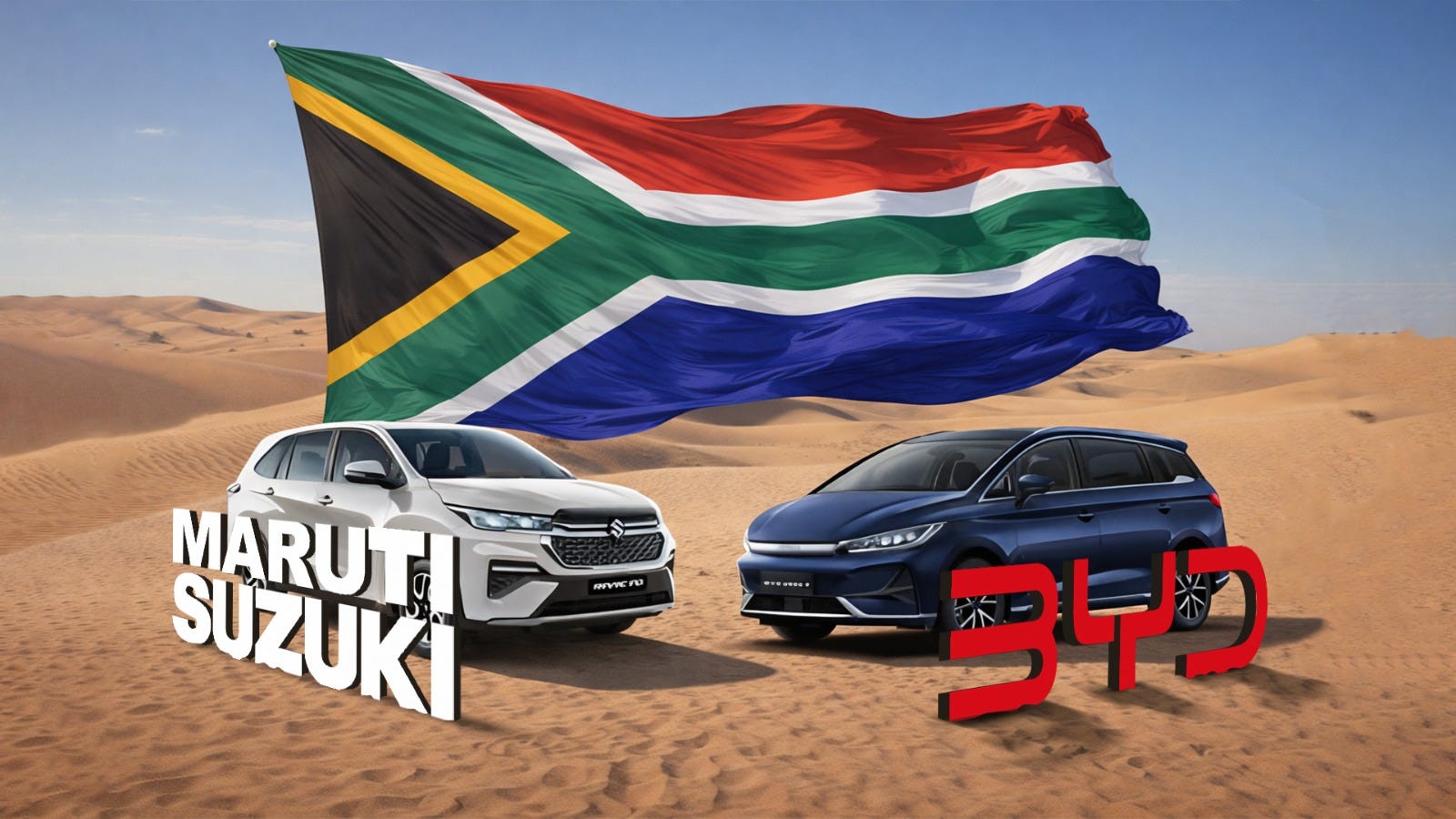
In January 2026, South Africa’s Department of Trade, Industry and Competition announced it was considering tariffs of up to 50% on vehicles imported from China and India. Not 10%. Not 20%. Fifty percent, or double the current 25% duty. The reason? Over the past four years, vehicle imports from China surged 368% while imports from India jumped 135%. In 2024 alone, Chinese vehicles accounted for 53% of South Africa’s total vehicle imports, while Indian vehicles made up 22%.
That means three out of every four imported cars rolling into South Africa now come from either China or India. And only 37% of vehicles sold in South Africa are actually produced locally. For a country with a $27 billion automotive industry and deep manufacturing roots, that’s an existential crisis.
Let’s see where Africa’s auto industry is headed on Indian and Chinese wheels.
How Did Imports Take Over?
South Africa’s automotive industry was once dominated by giants like Volkswagen, Toyota, BMW, and Mercedes-Benz. These companies had local assembly plants, employed thousands, and exported vehicles globally, including to the United States under the African Growth and Opportunity Act (AGOA). But two things changed that equation.
Price and speed.
Chinese and Indian carmakers cracked the entry-level segment. Chery sold 46,887 vehicles in South Africa in 2025. BYD, which only entered the South African market in 2023, is already planning to nearly increase its dealership network.
On the Indian side, 49% of all passenger vehicles sold in South Africa in the first five months of 2025 were imports from India. That includes Maruti Suzuki-built vehicles sold under Toyota badges like the Starlet, Vitz, and Urban Cruiser. In fact, 84% of Japanese-branded light vehicles sold in South Africa in 2024 were imported from India, while only 10% were built in Japan.
India and China share some advantages. Lower labor costs, established manufacturing ecosystems, and aggressive pricing. South African consumers get cheaper cars. South African manufacturers get squeezed out. It’s the classic trade-off, and right now, the balance has tipped entirely toward imports.
What’s China Doing in Africa?
China isn’t just selling cars to Africa. It’s building an entire automotive supply chain across the continent.
From January to May 2025, Chinese car exports to Africa reached 222,000 units, a 67% year-on-year increase. May alone saw 58,000 units exported, up 104% year-on-year. Nearly half of the 14 Chinese automotive brands currently active in South Africa launched only in 2024.
Why Africa? Because Europe and the United States have closed their doors. The EU slapped hefty duties on Chinese EVs. The US imposed 100% tariffs. Africa, meanwhile, remains wide open, and hungry for affordable cars. Chinese companies invested $143 billion into foreign EV and battery ventures between 2014 and 2025, and in 2025, for the first time, 75% of Chinese investment in raw materials went to Africa.
China isn’t just chasing customers. It’s chasing cobalt in Congo, lithium deposits, and manufacturing locations with lower costs and fewer trade barriers. Africa is the new frontier.
Where Does India Fit In?
Unlike China, which leads with electric vehicles and hybrids, India’s strength is in affordable internal combustion engine (ICE) vehicles and robust SUVs built for rough terrain.
Mahindra signed a Memorandum of Understanding with South Africa’s Industrial Development Corporation in February 2025 to assess the feasibility of a CKD plant. The company already celebrated its 25,000th locally assembled “Pikup” in February 2025. Tata Motors, through a partnership with Motus Holdings, launched the Harrier, Curvv, Punch, and Tiago in South Africa in 2025 and plans to expand from 40 dealerships to 60 by 2026.
But it’s not just Indian brands. India exported over 800,000 vehicles in 2025, and more than half were vehicles built in India for foreign brands. Toyota, Nissan, Suzuki manufacture in India and export to South Africa. India has become a global manufacturing hub, leveraging low labor costs, skilled engineers, and government incentives like the Production Linked Incentive (PLI) scheme.
South African policymakers are noticing. When Parks Tau, South Africa’s Minister of Trade, Industry and Competition, addressed Auto Week 2025, he noted that 36% of vehicles sold in South Africa are imported from India and 11% from China. He emphasized the urgency of strengthening domestic manufacturing capacity.
Africa’s Policy Response
South Africa’s proposed 50% tariff is the nuclear option, and the maximum allowed under WTO rules. On components, there’s room to maneuver between 10% and 12% depending on origin.
But South Africa, China, and India are all BRICS members. The bloc emphasizes economic cooperation and reducing dependence on Western financial systems. Imposing tariffs on two fellow BRICS nations could carry broader trade and diplomatic implications, even as Pretoria seeks to protect jobs.
The South African government is also pursuing a carrot-and-stick approach. In early 2025, President Cyril Ramaphosa signed a tax break for new-energy vehicles into law, aiming to attract Chinese EV investment. Three Chinese automakers have already signed non-disclosure agreements with the Automotive Business Council.
The strategy seems to be, “if you can’t beat them, get them to manufacture locally”. Both Chinese and Indian automakers are responding.
Not everyone supports the tariffs, though. The Motor Industry Staff Association (MISA) has vocally opposed the 50% tariff proposal, warning it could jeopardize jobs in the retail motor industry. MISA notes that employment in South Africa’s auto sector grew from 305,000 in 2024 to just under 311,000 by mid-2025. Much of that is driven by Chinese and Indian brands expanding their dealership networks.
The Takeaway
For decades, India complained about being flooded by Chinese imports. Now, India’s doing the flooding, and it’s not just cars. The playbook looks something like this: leverage lower manufacturing costs, target price-sensitive markets, build local assembly plants to avoid tariffs, and expand aggressively before protectionist walls go up.
South Africa’s auto industry is caught in a familiar bind. Consumers want affordable cars. Workers need jobs. The government wants both. Tariffs protect manufacturing but raise prices. Allowing imports keeps cars cheap but kills local production.
The question isn’t whether South Africa will impose tariffs. It’s about how high and how soon it will do so. And whether, by the time the tariffs arrive, Chinese and Indian automakers will have already moved enough manufacturing onshore to sidestep them entirely.
Because India and China aren’t just exporting cars. They’re exporting industrial strategy. And Africa’s learning fast.
Until the next drive, ReadOn!