
Selling Imperfection
What if we told you, your iPhones, iPads, and Macs come "broken" out of the box?
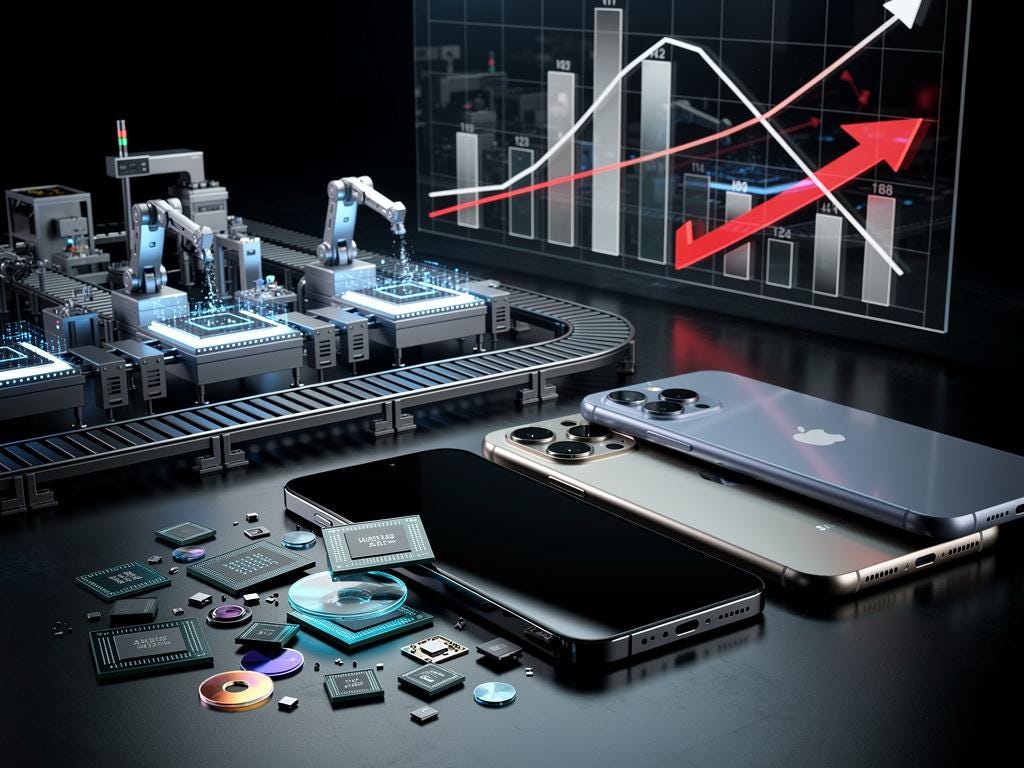
At ReadOn, we don’t just report the markets. We help you understand what truly drives them, so your next decision isn’t just informed, it’s intelligent.
That’s how many iPhones Apple sold in 2021, when pandemic-rattled factories struggled to keep up with demand. That was its best performance in five years. The year after, it sold more. By 2025, the company set an all-time record of 247 million iPhones, generating $416 billion in total revenue. Over the same stretch, it sold tens of millions of Macs, iPads, and AirPods, and even crossed $100 billion from services alone.
When its rivals scrambled, Apple compounded. How?
Part of the answer lies in something Apple has never officially advertised. It has spent years selling imperfect chips, deliberately, profitably, and at scale.
When the World Ran Out of Chips
To understand what Apple pulled off, you need to remember how bad things got.
The global chip shortage that started in 2020 was quite the supply chain catastrophe. At its peak, smartphone production fell roughly 6% in 2021, with major assemblers like Foxconn warning of serious shortfalls for months. Samsung was reportedly staring at a potential 20% drop in Q2 2021 shipments as it scrambled for components. Google restricted its Pixel 5a to just two markets at launch. Xiaomi hiked prices mid-release on the Redmi Note 10 in India, of all places. The number of new phone models launched in the first half of 2021 fell 18% year-on-year.
Apple wasn’t completely immune. Tim Cook warned in 2021 that chip constraints would dent iPhone and iPad sales. But the damage was comparatively minor. Apple actually gained market share during the shortage. The company had a preferential supply agreement with TSMC, its primary chip manufacturer. And it had another trick entirely.
The Art of the Imperfect Chip
Here’s something chip engineers have known for decades but rarely explain to the rest of us: no two chips off a production line are exactly alike.
When TSMC etches silicon wafers for Apple, it produces hundreds of chips per wafer. Some perform at peak specifications. Others have tiny flaws like a malfunctioning graphics core, a power-hungry transistor that drains a battery faster than it should. Traditionally, these chips would be discarded or sold off cheaply. The industry calls the sorting process “binning”, or grouping chips by performance, much like hotels charging different rates for the same building depending on which floor your room is on, or diamonds priced by clarity.
Apple, however, figured out it could do something far more interesting with its rejects.
According to a Wall Street Journal analysis of nearly 200 Apple documentation pages, since 2021, Apple has sold six of its A-series chips, each with one fewer GPU core, inside a cheaper device, after the fully functional version first appeared in a more expensive iPhone. The mechanics are elegantly simple: a defective graphics core can be disabled, leaving a chip that works perfectly well, just not at the absolute top of its range.
The iPhone 17e uses chips that didn’t qualify for the iPhone 17. The iPhone Air runs on chips that wouldn’t meet specs for the 17 Pro. And Apple’s new $599 MacBook Neo, its first entry-level laptop, is powered by an A18 Pro with a 5-core graphics processor, one fewer core than the version inside the iPhone 16 Pro. What would have been scrap became a product category.
The strategy actually dates back to Apple’s very first custom chip. The A4, which powered the original iPad, was also slotted into the iPhone 4 and later the second-generation Apple TV. Chips that drew too much power for a smartphone battery worked fine in a TV box plugged into a wall outlet. Something similar happened with the S7 chips, which ended up in the second-generation HomePod rather than the Apple Watch they were originally designed for.
What began as a salvage operation has become, in the words of supply-chain analysts, a cornerstone of Apple’s design strategy. A precise instrument for segmenting its product lineup without wasting a single silicon wafer.
Apple Isn’t Alone in This
Apple isn’t the only company that figured this out. Nvidia runs a similar playbook. When chips come off its production lines, the best performers go into data centre GPUs where computing speed is everything. Chips with slight imperfections become gaming cards. Even chips with more significant defects find homes in automotive systems. In Q3 2025, Nvidia’s data centre revenue alone hit $30.8 billion, a figure analysts attribute partly to how efficiently the company converts its chip output into a tiered product range.
Intel and AMD have practiced versions of binning for years. The basic logic is identical: don’t discard what fails the hardest test; find a product where it passes.
For Apple, though, the advantage cuts sharper. When Apple bought processors from Samsung or Intel, it had no say in what came off the line. Now, having commissioned TSMC to produce full silicon wafers, Apple owns every chip on that wafer, perfect or not.
The India Angle
Here’s where India enters the picture, and where the story gets interesting.
Apple assembled roughly 55 million iPhones in India in 2025, a 53% jump from 36 million the previous year, putting India at approximately 25% of Apple’s total global iPhone output. Foxconn and Tata Electronics now operate five assembly facilities across Tamil Nadu and Karnataka. iPhone exports from India crossed $17.4 billion in the 12 months ending March 2025, up nearly 60% year-on-year. These are genuinely transformative numbers.
But they come with an important nuance.
India’s iPhone factories are assembly operations. The chips, like the A18 Pros, the binned and imperfect ones still come from TSMC’s fabs in Taiwan. India plugs in at the final stage, fitting screens, batteries, and components into a finished device. The chip strategy that gives Apple its resilience is entirely upstream of anything happening in Hosur or Sriperumbudur.
That said, binning does shape what lands on Indian assembly lines in a meaningful way. When Apple launches a lower-cost product like the 17e, the iPhone Air, eventually the MacBook Neo, these are built around chips that didn’t qualify for premium models. They are Apple’s volume products by design. And volume products are exactly what scale-hungry Indian factories are built to produce. India’s 5-8% higher manufacturing costs compared to China are more easily absorbed on high-volume, lower-margin devices than on the Pro models, where every dollar of cost matters.
There’s a longer game here too. Apple CEO Tim Cook has acknowledged that chip shortages are now preventing the company from meeting customer demand for iPhones and increasingly for Macs. TSMC, Apple’s sole supplier of advanced chips, is itself struggling to meet soaring demand for AI silicon. The MacBook Neo has been so popular that Apple burned through its stockpile of binned chips and placed fresh orders for new A18 Pro silicon just to keep the Neo’s production lines running.
In other words, Apple made imperfection so desirable that it ran out of it.
Until the next perfect imperfection, ReadOn!