
Nuclear Coercion
Iran has the stage now, and the world's watching.
At ReadOn, we don’t just report the markets. We help you understand what truly drives them, so your next decision isn’t just informed, it’s intelligent.
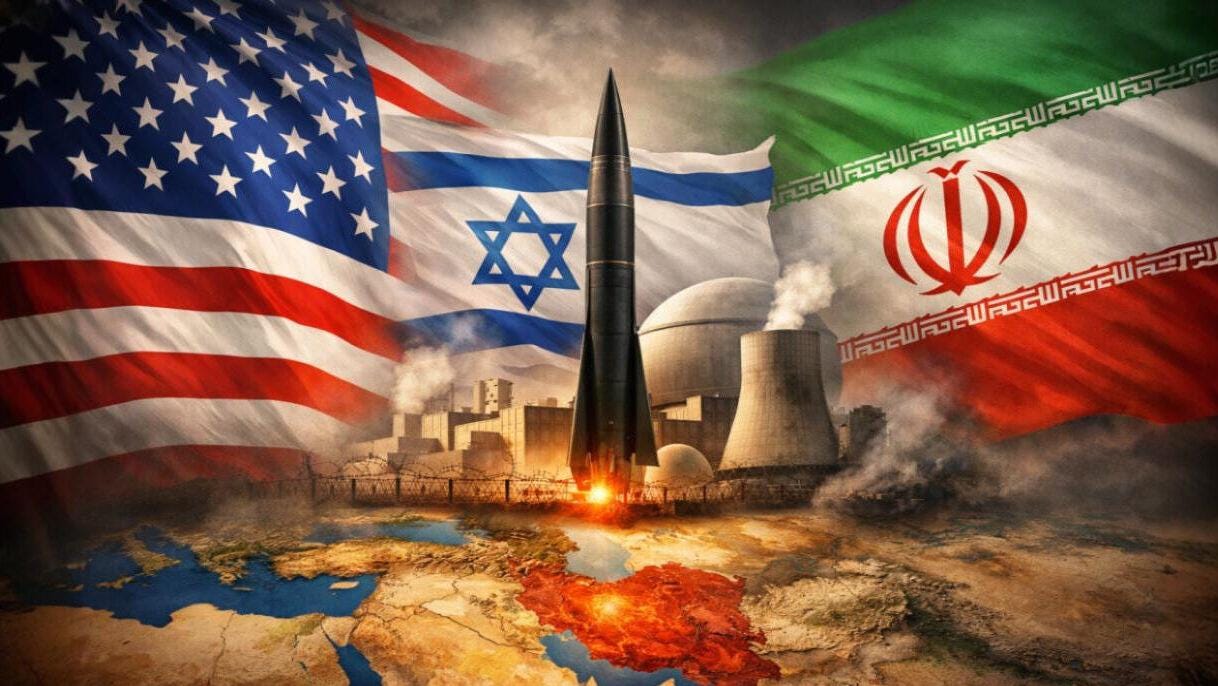
On February 28, 2026, US and Israeli jets struck Iran again. Not for the first time. Eight months earlier, in June 2025, a similar 12-day war had already done serious damage: $200–270 billion worth of infrastructure damage, according to security firm Global Guardian. Iran fired over 550 ballistic missiles and 1,000 suicide drones. Israel suffered 28 deaths and roughly $6 billion in economic burden in the first 20 days. Iran lost over 1,060 people, nine top nuclear scientists, and the bulk of its conventional military leadership.
But the real target wasn’t soldiers. It was uranium.
Israel’s Operation Rising Lion and the US’s follow-up Operation Midnight Hammer, pulverised Iran’s three key nuclear sites: Fordow, Natanz, and Isfahan. The Pentagon claimed the strikes set Iran’s program back by one to two years. The Institute for Science and International Security said the centrifuge enrichment program had been “effectively destroyed.”
And Iran’s currency? The rial went from 800,000 per dollar pre-war to over 1.6 million by early 2026. Inflation crossed 100%. The IMF estimates Iran’s economy will shrink 6.1% in 2026.
By any rational reading, Iran has been broken. The logical move would be to fold. Sign a deal. Promise never to build a bomb.
Instead, the opposite is happening. Iran has refused to surrender its enriched uranium stockpile, with enough material, the IAEA says, for about 10 warheads. Its newly installed Supreme Leader, Mojtaba Khamenei, has vowed to guard nuclear technology like the country’s borders. The April 2026 nuclear talks in Islamabad collapsed after 21 hours.
For 23 years, Iran has officially said its nuclear program is for energy, citing a 2003 fatwa from the (now-assassinated) Ayatollah Ali Khamenei. But the punishment for not having a bomb just got very expensive. To understand why Iran might change its mind, we need to rewind.
How the world tried to put the nuclear genie back
In 1958, Irish Foreign Minister Frank Aiken stood before the UN General Assembly and warned that the great powers had built “the military resources to destroy themselves and to destroy us all.” A decade of diplomacy later, his lobbying produced the Nuclear Non-Proliferation Treaty (NPT) of 1968.
The deal was simple: only five countries (the US, Soviet Union, UK, France, and China) would be allowed to keep nuclear weapons. Everyone else would forgo them in exchange for help with civilian nuclear energy. The five would, in turn, work toward disarmament.
By 2000, most of the world had signed up. Brazil and Argentina dismantled their programmes. Switzerland gave up. South Africa actually built six warheads and then destroyed them in 1989-90 before Nelson Mandela took office. Sweden eventually joined NATO instead.
The disarmament logic was straightforward. Bombs are expensive, sanctions are crippling, and Western security guarantees are cheaper. Why pay to be hated when you can sit under America’s umbrella for free?
But the umbrella had holes
India never bought it. In 1974, less than a decade after China went nuclear next door, India tested its first device, the “Smiling Buddha”, and called the NPT a system of “nuclear apartheid.” In 1988, Rajiv Gandhi told the UN it was as biased as believing “colonialism is a civilizing mission.”
Today, only four nuclear-armed states sit outside the NPT. India, Pakistan, Israel (which still won’t confirm it has bombs) and North Korea (which exited in 2003). Every one of them got rewarded for refusing to play along.
When India and Pakistan openly tested in 1998, the US imposed sanctions. Those sanctions were lifted within days of 9/11 because Washington suddenly needed Pakistan against the Taliban and India against China. North Korea got sanctioned, then it quietly courted; today Kim Jong Un is shipping weapons to Russia and Trump publicly talks about their “great relationship.” Israel has never signed the NPT and enjoys an unbroken US veto at the UN.
The pattern is brutal but obvious. If you have a bomb, you eventually get respect.
What happens if you don’t?
Compare that with Iraq and Libya. Saddam Hussein had a nuclear programme decades ago but had abandoned it long before 2003, when the US invaded anyway. Muammar Gaddafi voluntarily surrendered Libya’s nuclear programme in 2003 and was dragged through the streets and killed in 2011. Ukraine inherited the third-largest nuclear stockpile in the world from the Soviet collapse, gave it up in 1994 in exchange for a written “security assurance” from the US, UK, and Russia, and lost Crimea in 2014 and Donbas in 2022.
Bill Clinton, who signed that piece of paper, admitted in 2023, “None of them believe that Russia would have pulled this stunt if Ukraine still had their weapons.”
The architect of Pakistan’s bomb, Abdul Qadeer Khan, who also sold enrichment technology to Iran, Libya, and North Korea and was pardoned the day after confessing on TV, put it more simply in a 2011 Newsweek essay: “Had Iraq and Libya been nuclear powers, they wouldn’t have been destroyed in the way we have seen recently.”
The only way to protect yourself from getting hit by a big stick, it seems, is to get a bigger stick.
What Iran sees in the mirror
Now sit in Tehran’s shoes. Your air defences are gone. Your generals are dead. Your currency is in free fall. The Strait of Hormuz blockade is costing both sides money but Trump claims you’re losing $500 million a day. The country that pulled out of your 2015 nuclear deal (the Joint Comprehensive Plan of Action), has bombed you twice and threatened to send you “back to the stone ages.”
On the other hand, you can see Pakistan being courted, India being celebrated, North Korea being praised, and Israel being defended.
And about a dozen other countries like Saudi Arabia, Turkey, Egypt, South Korea, Japan are now openly debating the same question. South Korean polls show support for an independent nuclear weapon at record highs. In Japan, the only country to have suffered an atomic attack, the subject is no longer taboo.
That’s a dozen latent nuclear states watching to see how this Iran story ends. If Iran caves, they’ll conclude diplomacy works. If Iran builds a bomb and survives, like North Korea did, they’ll conclude the bomb works.
The Takeaway
The original NPT bargain rested on a promise. Give up your bombs, and we’ll keep you safe. For 60 years, the US guaranteed that promise. Trump has now broken it twice, first by tearing up the 2015 JCPOA Iran had signed with Obama, then by bombing Iran in the middle of fresh nuclear negotiations.
The world’s coercive logic is shifting. For 30 years after the Cold War, the message to middle powers was to stay non-nuclear and prosper. The new message, drawn from Ukraine, Libya, and now Iran, is the opposite: stay non-nuclear and stay vulnerable.
For investors and policy-watchers, this matters beyond Tehran. A world with more nuclear states (possibly Saudi, Turkish, even South Korean ones), means higher defence spending, weaker NPT enforcement, more fragile oil markets, and more brittle alliances. India, sitting next door to two nuclear neighbours, has every reason to pay close attention.
Rajiv Gandhi once warned that taking comfort in mutual destruction was “dangerous complacency.” He may turn out to have been the last serious voice for disarmament.
Because right now, the world is teaching a very different lesson. The countries that built bombs got respect. The country that gave one up got invaded. The country that never built one is getting bombed.
If you were sitting in Tehran, what would you do?
Until you figure that out, ReadOn!