
Making EVs? Ask China!
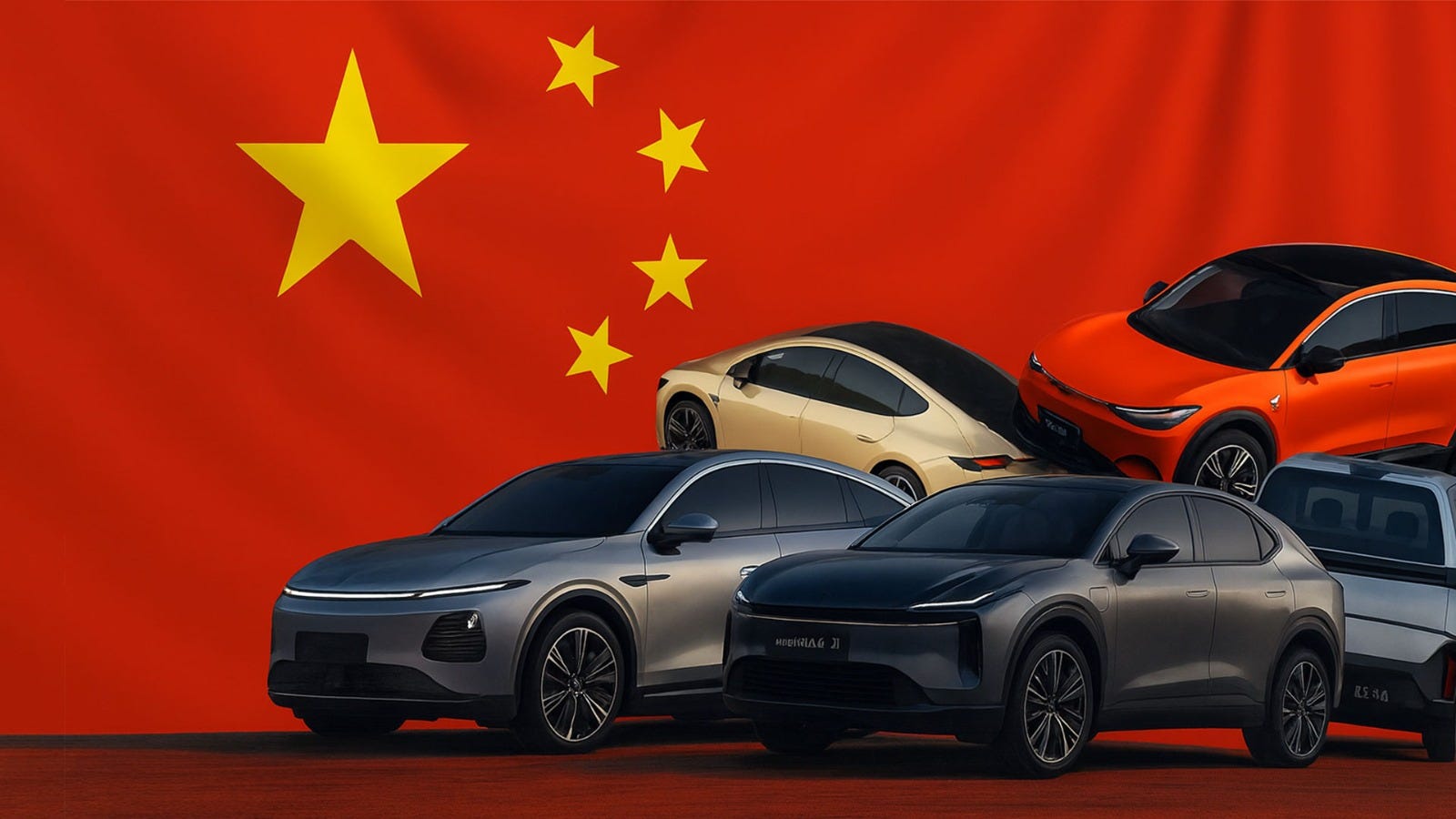
Breaking a 130 year tradition, China has beat Europe as the global standard for automobile manufacture. What's China's secret?
At ReadOn, we don’t just report the markets. We help you understand what truly drives them, so your next decision isn’t just informed, it’s intelligent.
There’s a ritual at every major car company’s R&D center. Engineers buy competitor cars, strip them down to the bare metal, and study every wire, circuit, and bolt. It’s called benchmarking. Think of it as legally spying on your competitors.
For decades, these teardown bays were full of BMWs, Mercedes, and Toyotas. But today, if you walk into Tata Motors’ facility in Pune or Mahindra’s development center, you’ll see something different. Chinese cars. The Xiaomi SU7. The BYD Seal. The Zeekr 7X.
An Indian carmaker’s CEO told Mint off the record: “We can match Europeans in technology, and at lower prices too. But now we benchmark against Chinese cars.”
For the first time in 130 years of automotive history, the global quality benchmark isn’t coming from Germany, Japan, or America. It’s coming from China. China’s influence is especially strong in electric vehicles.
Today, we take a look at how China overtook the global automotive standards race. We’ll see what China did right, and what’s going wrong. We will also take a look at what Indian brands are doing about the changing standards in the automobile industry.
Let’s get started.
How did China get here?
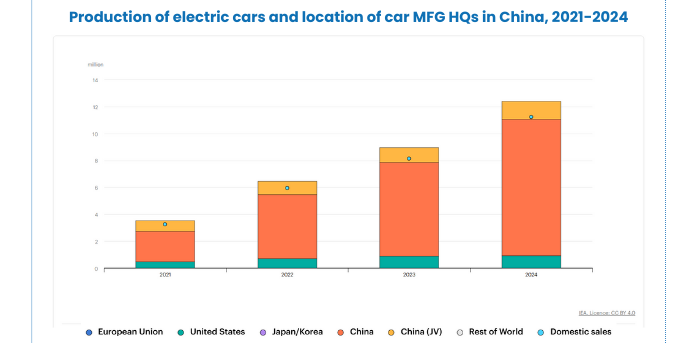
China’s speed can be seen in how quickly its EV production has scaled. From 2021 to 2024, Chinese OEMs contribution to domestic production has gone from 60% to 80%. China’s global reach is growing too. In 2024, 1.73 crore electric cars were produced worldwide. Out of this, China alone contributed with 1.24 crore electric cars!
Reuters reported an interesting experience about how quickly Chinese automakers adapt. In October 2023, Chinese automobile company Chery was preparing to launch its Omoda 5 SUV in Europe. But the car was designed for China’s smooth roads, not Europe’s narrow, winding streets and rough surfaces. So, Chery flew its engineers and suppliers to a test track in China. Six weeks later, the European-spec Omoda 5 started shipping to dealers.
Chinese companies also build fewer prototypes. They run computer simulations instead of real-world tests and launch the car. Then they keep improving it based on customer feedback.
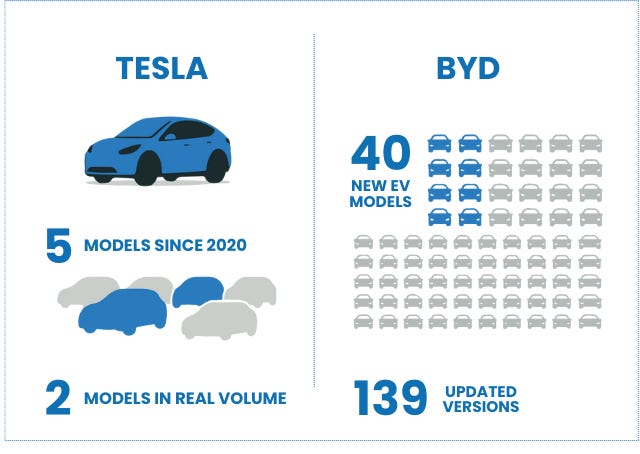
And what’s the impact of this speed? Since 2020, when Tesla launched its Model Y, the company has designed 5 models in total. Only 2 sell in real volume though. Meanwhile, BYD launched 40 all-new vehicles plus 139 updated versions
The average Chinese electric car on sale today is 1.6 years old. Foreign brand cars in China? 5.4 years old.
But speed alone doesn’t explain China’s rise. There’s something else at work. Let’s find out what.
Why is China Faster?
Chinese automobile manufacturers also solve for time by changing how factories operate. BYD’s Shenzhen Headquarters shows how Chinese automakers change infrastructure for optimal timelines. The company’s 76 lakh square feet factory premises are basically small cities. The factories and employee residences both coexist in the same premises.
The logic is simple: eliminate commute time, eliminate distractions, maximize work hours. Employees work six days a week, twelve hours a day. Founder Wang Chuanfu also mostly lives in employee housing himself.
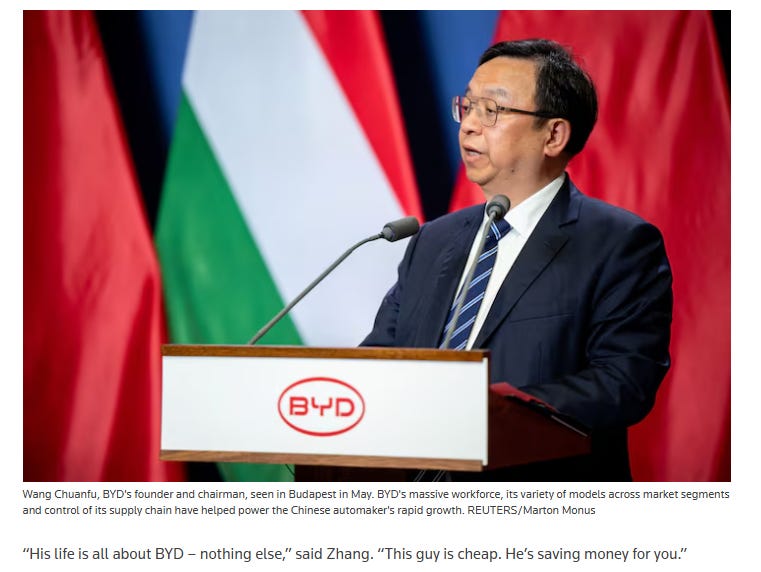
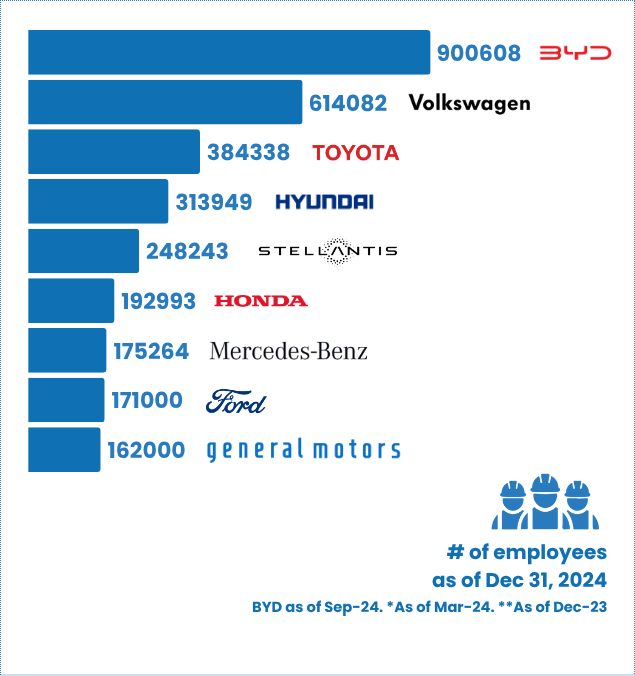
The workforce scale is staggering. BYD employs 900,000 people. That’s almost as many as Toyota and Volkswagen combined. Out of these, BYD hired 200,000 new employees between August and October 2024. That’s more than General Motors’ entire global workforce.
BYD isn’t focusing on just better engineering. It’s throwing more engineering hours at problems, faster. When you have engineers living on campus working 72-hour weeks, timelines get very tight.
On top of simply brute forcing more hours into the development of a car, China does two more things that has helped it become the new standard across global automotive markets.
1. Software First, Metal Later
Traditional carmakers design the physical car first. What size? What engine? What shape? Then they figure out the software and electronics.
Chinese carmakers flip this. They design the software first. What do customers want on their screens? What features make life easier? Then they build the metal box around those answers.
Many Chinese carmakers come from the consumer electronics industries that think in software and user interfaces first. Xiaomi made smartphones before cars.
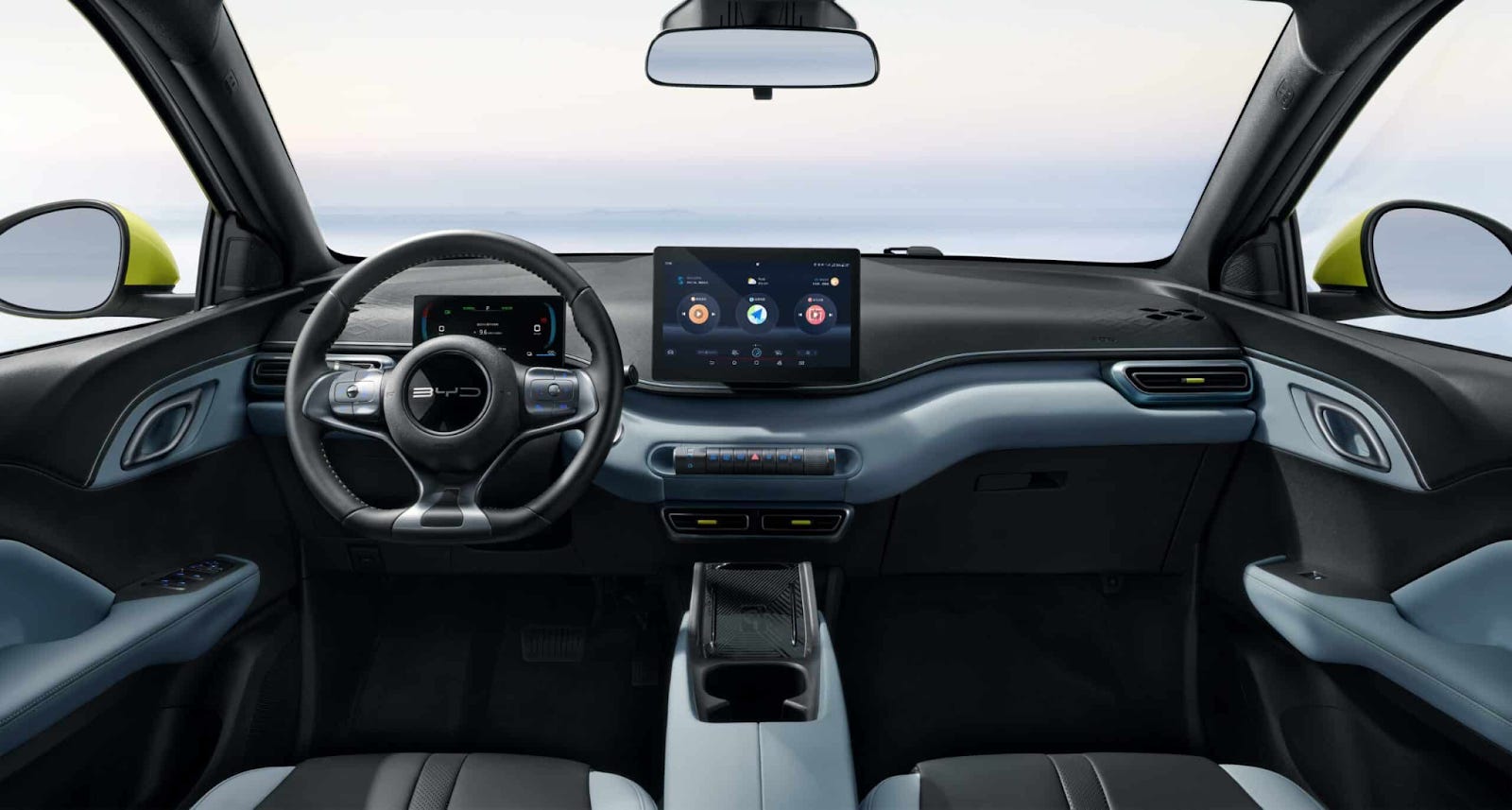
As a result, Chinese cars get multiple screens, facial recognition, gesture controls, karaoke apps, advanced driver assistance, and suspension that automatically adjusts to road conditions. All standard features.
2. Making Everything Themselves
“If you want something done right, do it yourself.” This quote is often attributed to Napoleon Bonaparte. BYD took it to heart. The company makes 75% of its Seal sedan’s parts. Tesla makes 46% of Model 3 parts in-house. Volkswagen’s ID.3? Just 35%.
When you make most parts yourself, you don’t need supplier approvals. You don’t negotiate with vendors. You don’t coordinate shipments. You decide and do it.
This is expensive upfront. More factories, more employees, more equipment. But at scale, it’s faster and cheaper. Fewer approval chains mean changes that take Western carmakers months happen in weeks.
Where China Stands Today
The scoreboard is brutal.
In China, from 2020 to 2024:
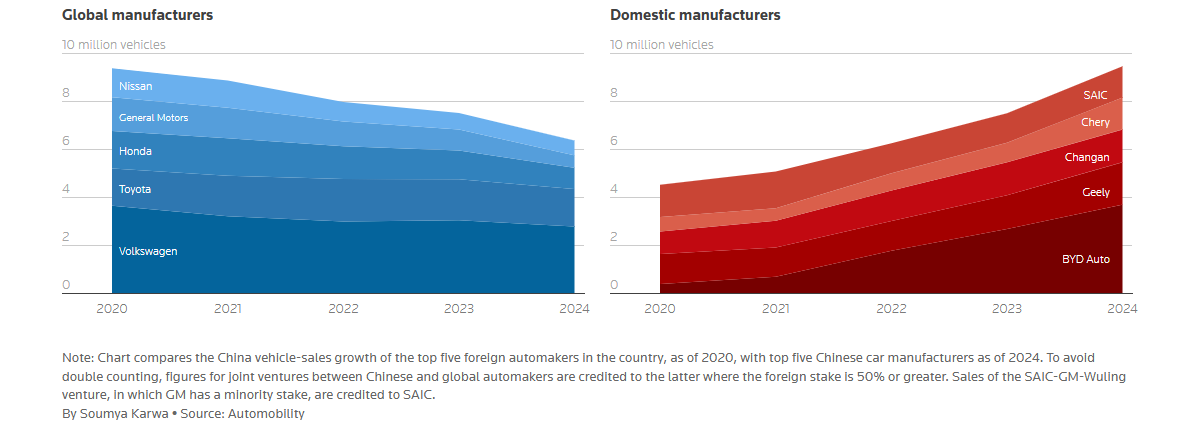
Top 5 foreign carmakers (VW, Toyota, Honda, GM, Nissan): Sales dropped from 9.4 million to 6.4 million units
Top 5 Chinese carmakers: Sales jumped from 4.6 million to 9.5 million units
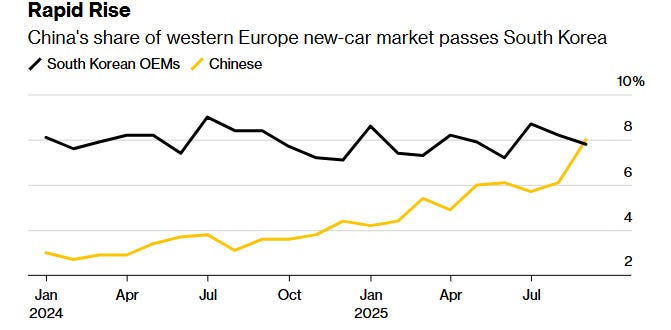
The takeover isn’t limited to China. In September 2024, Chinese cars outsold Korean brands in Western Europe for the first time ever. Of 500,000 Chinese cars sold in Western Europe by September, 30% went to British buyers.
BYD has overtaken Tesla as the world’s largest EV manufacturer. But there’s a problem lurking beneath this success: massive overcapacity.
China’s car factories can build 54 million vehicles per year. Last year they made 27.5 million. That’s barely half. Of 169 carmakers operating in China, 93 have less than 0.1% market share. Most lose money.
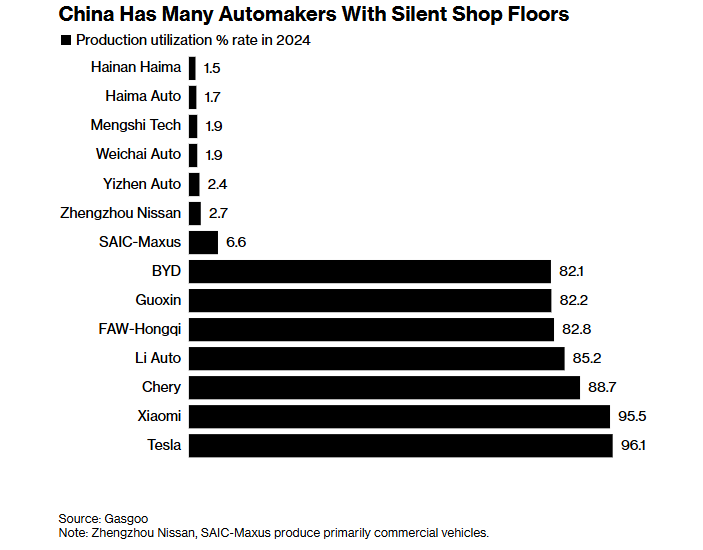
This overcapacity has triggered a brutal price war at home. The Chinese Communist Party has told manufacturers to stop undercutting each other, fearing “involution”, or competition so intense it becomes self-defeating.
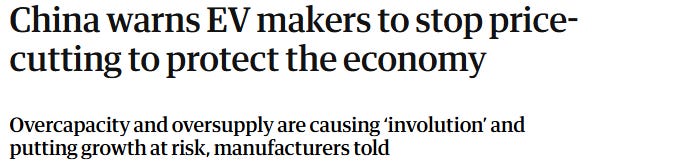
When domestic markets are going through a price war, and international markets provide better prices. exporting makes more sense. But dumping accusations are piling up. The Chinese government is getting nervous. From January 2026, companies will need export licenses to ship finished vehicles abroad.
(The overcapacity problem and China’s internal price wars deserve their own deep dive—let us know if you want a separate piece on how Chinese carmakers are cannibalizing each other at home while conquering abroad.)
The US has imposed 100% tariffs on Chinese EVs. Europe charges 17% to 38% depending on the brand. But tariffs haven’t stopped the march. Chinese brands are building factories in Europe—Chery took over a closed Nissan plant in Barcelona.
Despite this overcapacity issue, the Chinese automotive industry is one that has gotten a lot of things right. So much so, that the Indian industry wants to recreate this success by taking a few pages out of the Chinese playbook.
Where India Stands
Tata Motors’ technology chief Sven Patuschka openly acknowledges that Chinese carmakers’ “consumer-centric design and user experience” now feature prominently in their benchmarking studies. The presence has grown organically in recent years.
Even India’s commercial vehicle makers are watching closely. Ashok Leyland’s CTO N. Saravanan points to Chinese OEMs’ software-defined vehicles as areas worth studying, particularly as more connected features enter Indian trucks and buses.
But acknowledging the shift and matching the execution are different things.
Indian carmakers still largely follow traditional development cycles. New vehicle development takes three to four years, closer to the European model than the Chinese 18-month sprint. The difference shows up in product freshness. While Chinese brands refresh models constantly, Indian brands tend toward longer product cycles.
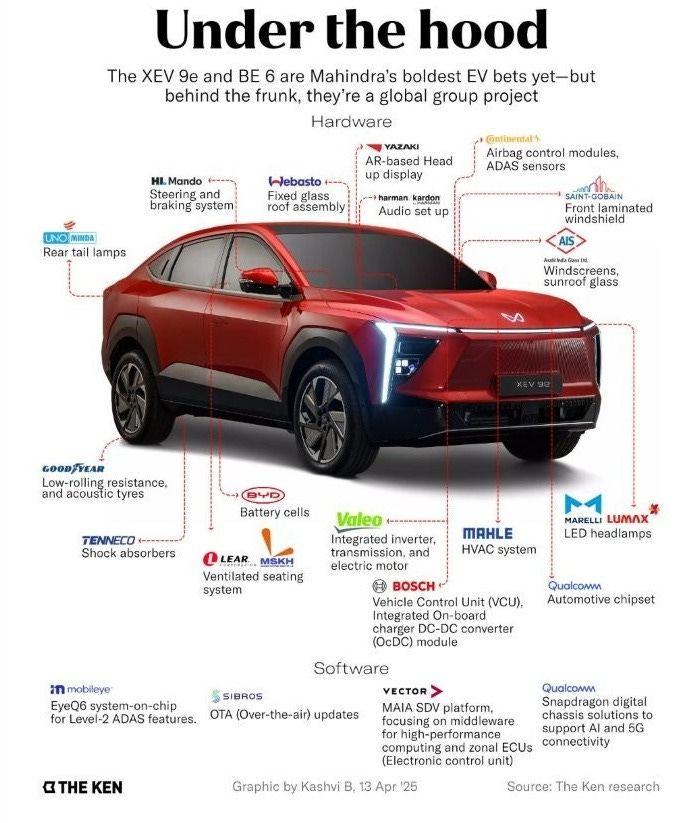
The supplier ecosystem is different too. Indian carmakers depend heavily on external suppliers for components, unlike BYD’s 75% in-house production. This means more coordination, more approval chains, longer lead times for changes. Meanwhile, you can see from the image below, how Mahindra’s new EVs are basically an outsourcing exercise.
Yet some advantages exist. The similarities between Indian and Chinese market conditions work in India’s favor—similar price sensitivity, similar preference for features. What works in Shenzhen might also work in Mumbai.
Indian companies are also less capital-constrained than a decade ago. Tata Motors and Mahindra both have the financial muscle to invest in faster development processes if they choose to. The question is whether they will.
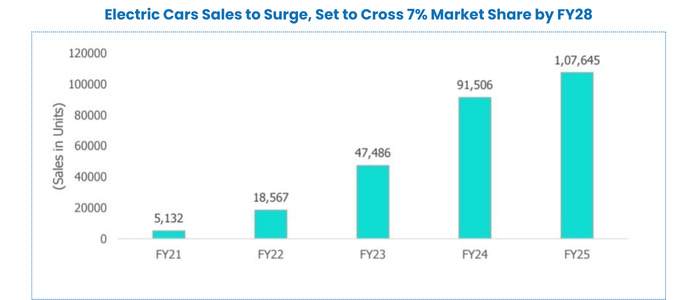
So far, growth has been strong. Electric car penetration in India has grown 20x from FY21 to FY25. Electric cars are set to cross 7% market share by FY28 too. But growth alone won’t be enough, Indian companies need to achieve and improve efficiency going forward.
What’s Next?
Chinese brands haven’t made a serious push into India yet, partly due to political tensions post-2020. But they’re circling. BYD has announced plans for Indian manufacturing. MG (owned by China’s SAIC) is already here and selling well. If trade barriers drop or Chinese companies set up serious local operations, Indian brands will face the same competitive pressure that crushed VW and Toyota in China.
The window to learn and adapt is closing. Indian carmakers are studying those Chinese cars in their teardown bays, trying to understand what makes them tick. The critical question is whether they’ll actually change how they work, or just admire the competition’s engineering from a distance.
Like every other article, this misses. If you want to know the real answer, read Henry Ford's "My Life and Work." One sentence in the book has the "secret." Or, eventually or maybe soon I will explain it all here.