
India’s Digital Addiction
Sort of weird to be reading about this on a screen, huh?

At ReadOn, we don’t just report the markets. We help you understand what truly drives them, so your next decision isn’t just informed, it’s intelligent.
In 2014, roughly 251 million Indians had internet access. A decade later, that number stands at 970 million. India leapfrogged into a hyper-connected future where 85% of households now own a smartphone.
When rural teenagers scroll through Instagram and grandmothers in Tier-3 towns make UPI payments you know the Digital India dream, in many ways, came true.
But there’s a problem. The same device that unlocks education, jobs, and civic participation has become an obsession for millions of young Indians.
The Economic Survey 2025-26 calls digital addiction a silent drag on learning, mental health, and economic output. This isn’t just some moral panic from technophobes or some ranting parents. It’s the Indian finance ministry waving a red flag.
The Numbers Don’t Lie
Consider this data point from the ASER 2024 survey: 89.1% of rural Indian teenagers between 14 and 16 now have smartphone access at home. Now, that sounds like progress. Until, you learn that among these users, only half primarily use the phone for education, and around 75% use it for social media.
Yes, those numbers overlap. Many teenagers use their phones for both. But the direction of travel is clear.
Some 35 crore Indians are on social media. Another 40-45 crore stream videos. And in the 15-29 age bracket, mobile and internet usage is described as “nearly universal.”
The issue isn’t access anymore. It’s what happens after access.
What Is Digital Addiction Anyway?
Let’s be clear about definitions here. Spending six hours a day on your phone doesn’t automatically make you an addict. The Economic Survey defines digital addiction as “persistent, excessive, or compulsive” device use that causes distress and impairs normal life. Think of withdrawal symptoms when the phone isn’t around. Cravings. Loss of interest in everything else. Continued use despite knowing it’s harmful.
The World Health Organization officially recognised Gaming Disorder in 2018, describing it as impaired control over gaming, prioritising games over other activities, and continuing despite negative consequences. The criteria are strict. Global estimates suggest only 0.3-1% of gamers meet the clinical threshold for gaming disorder.
But even if the truly “addicted” population is a small percentage, in a country of 1.4 billion people, that’s still a lot of individuals. And the broader pool of heavy users experiencing significant harm? Much larger still.
The Economic Toll
This is where the conversation shifts from public health to public policy. The Economic Survey explicitly warns that unchecked screen use imposes “real economic costs” through lost productivity. Students scrolling instead of studying, employees distracted by apps. Over years, that compounds into diminished human capital.
Then there’s the direct financial damage. Compulsive gamers often spend heavily on in-app purchases and loot boxes. Some slide into online gambling. A problem serious enough that India passed the Online Gaming (Regulation) Act 2025 specifically to curb wagering-based games. Cyberscams are another problem; screen-addicted users are more likely to be defrauded, which can devastate family finances.
The macro picture is sobering. India’s demographic dividend, that large number of young, working-age citizens supposed to power economic growth, depends on productive workers. If large cohorts deliver less output per person, that dividend becomes a liability. The Survey warns of indirect losses through reduced employability, lower productivity, and diminished lifetime earnings. Add healthcare costs for treating associated mental health conditions, and you’re looking at a potential drag on GDP growth.
The Mind Under Siege
The mental health correlations are clear. The Economic Survey notes that social media addiction in young adults is “strongly associated with anxiety, depression, low self-esteem and cyberbullying stress.” Addictive gaming links to sleep disruption, aggression, and social withdrawal.
Sleep is often the first casualty. Late-night scrolling or gaming creates “sleep debt”, a chronic fatigue that spirals into mood instability and irritability. Parents bring children to clinics complaining that their kids “wake up without energy” or “cannot focus”. The cognitive effects are measurable. Children deal with diminished concentration, memory lapses, and slower processing. Neuroscientists warn that early overexposure to highly stimulating media can alter developing brain circuits, particularly in areas governing attention and impulse control.
This creates a vicious cycle. Tired, anxious youth retreat further into digital escapes, which worsens sleep and mood, which drives more screen time.
The Loneliness Amplifier
Here’s a fascinating finding from the Survey. Facebook’s Social Connectedness Index measures how densely people in a region are friends with each other online. Using this index researchers found a striking pattern. States where online social ties are strongly rooted in local communities like Bihar and Uttar Pradesh, have extremely low suicide rates of 0.7 and 3.9 per 100,000 respectively. States where Facebook networks are more geographically diffused like Kerala and Tamil Nadu have much higher rates of 30.6 and 25.3.
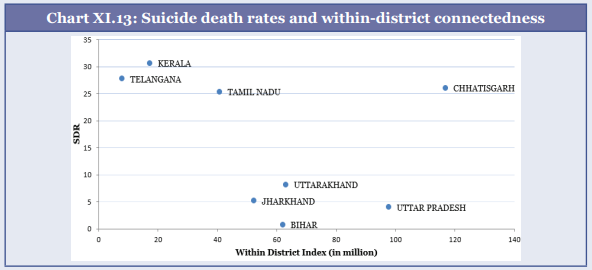
The implication? When your online “friends” are spread across the country rather than down the street, face-to-face community bonds may be weaker. And those bonds matter enormously for mental health. Digital addiction doesn’t occur in a vacuum, its harms are amplified where offline social capital is thin. When screens replace neighbourhood gatherings, sports clubs, and family dinners, loneliness stings more.
Global Experiments
India isn’t alone in this. Australia recently passed legislation banning under-16s from social media entirely, with enforcement beginning December 2025. South Korea has enforced gaming curfews for minors since 2011, banning computer gaming for children under 16 between midnight and 6 a.m. China imposes some of the strictest rules anywhere. One hour of online gaming for minors, only on weekends and holidays, between 8 and 9 p.m.
The UK has taken a different path, pressing for platform regulation rather than outright bans. The country has mandated age-appropriate design codes, data-sharing requirements for researchers, and a regulator to enforce online safety rules.
Each approach reflects local political economy and cultural attitudes. But the direction is consistent. Governments worldwide are concluding that leaving digital well-being entirely to individual choice isn’t working.
What Is India Doing?
India’s response is still emerging. The CBSE has circulated safe-internet guidelines for schools. Tele-MANAS, the national mental health helpline launched in 2022, has fielded over 32 lakh calls. NIMHANS operates the SHUT Clinic (Service for Healthy Use of Technology). It offers specialised therapy for technology addiction.
On the regulatory front, the Online Gaming (Regulation) Act 2025 bans gambling-style games and imposes design limits. An inter-ministerial committee is examining social media age limits and addictive design practices.
But there’s a significant constraint: data. India lacks comprehensive national surveys on digital addiction prevalence. The Economic Survey itself flags “the absence of national-level data on digital content consumption patterns” as a policy handicap. The upcoming Second National Mental Health Survey is expected to include modules on internet and gaming addiction—a crucial step toward evidence-based interventions.
The Takeaway
India’s digital transformation has been nothing short of revolutionary. A country that once worried about basic connectivity now debates optimal screen-time limits. That’s progress.
But the smartphone that connects a rural teenager to online education also connects them to infinite-scroll algorithms engineered to maximise engagement. The same device that enables a small-town entrepreneur to access markets exposes him to gambling apps designed to exploit psychological vulnerabilities.
India’s demographic dividend depends not just on having young workers, but on having healthy, focused, productive ones. The smartphone paradox is real. The same technology that unlocks opportunity can, without guardrails, undermine the very human capital it was supposed to develop.
Solving that paradox won’t be easy. But recognising it, as the Economic Survey has now done, is the necessary first step.
Maybe take a little break from this screen, and then, ReadOn!