
India’s Black Gold
If coal gasification works, the black rock will become India's diamond in the rough.
At ReadOn, we don’t just report the markets. We help you understand what truly drives them, so your next decision isn’t just informed, it’s intelligent.
India has a gas problem. No, not the kind that antacids fix. The kind that causes panic in the 33.3 crore households with an LPG connection. The kind that leaves them scrambling for cooking cylinders. The kind that causes restaurants to shut down because they can’t get LPG.
The Strait of Hormuz is a narrow waterway through which 20% of the world’s LPG flows. It is effectively closed due to escalating West Asian tensions. For India, which imports 60% of its LPG with 90% of those imports passing through this chokepoint, it’s a nightmare scenario. If we do a little math, 90% of 60% is 54%. So, more than half of India’s normal LPG availability is directly exposed if the strait remains shut.
But it gets worse. Gas isn’t just about the cylinder in your kitchen. It’s the raw material for fertilizers as well. Urea and ammonia that keep India’s farms productive use LPG. India already imports around 25% of its urea requirements. If the gas crisis deepens, fertilizer production tanks, food prices spike, and suddenly, inconvenient cooking arrangements turn into a threat to food security.
The government has responded by boosting domestic LPG production by 28% through emergency refinery directives, but that’s a band-aid on a structural problem. India imports 82% of its crude oil and 45% of its natural gas. Every time there’s a Gulf crisis, we’re held hostage.
Enter syngas, the unglamorous solution that could turn India’s biggest fossil fuel asset into energy security.
What Exactly Is Syngas?
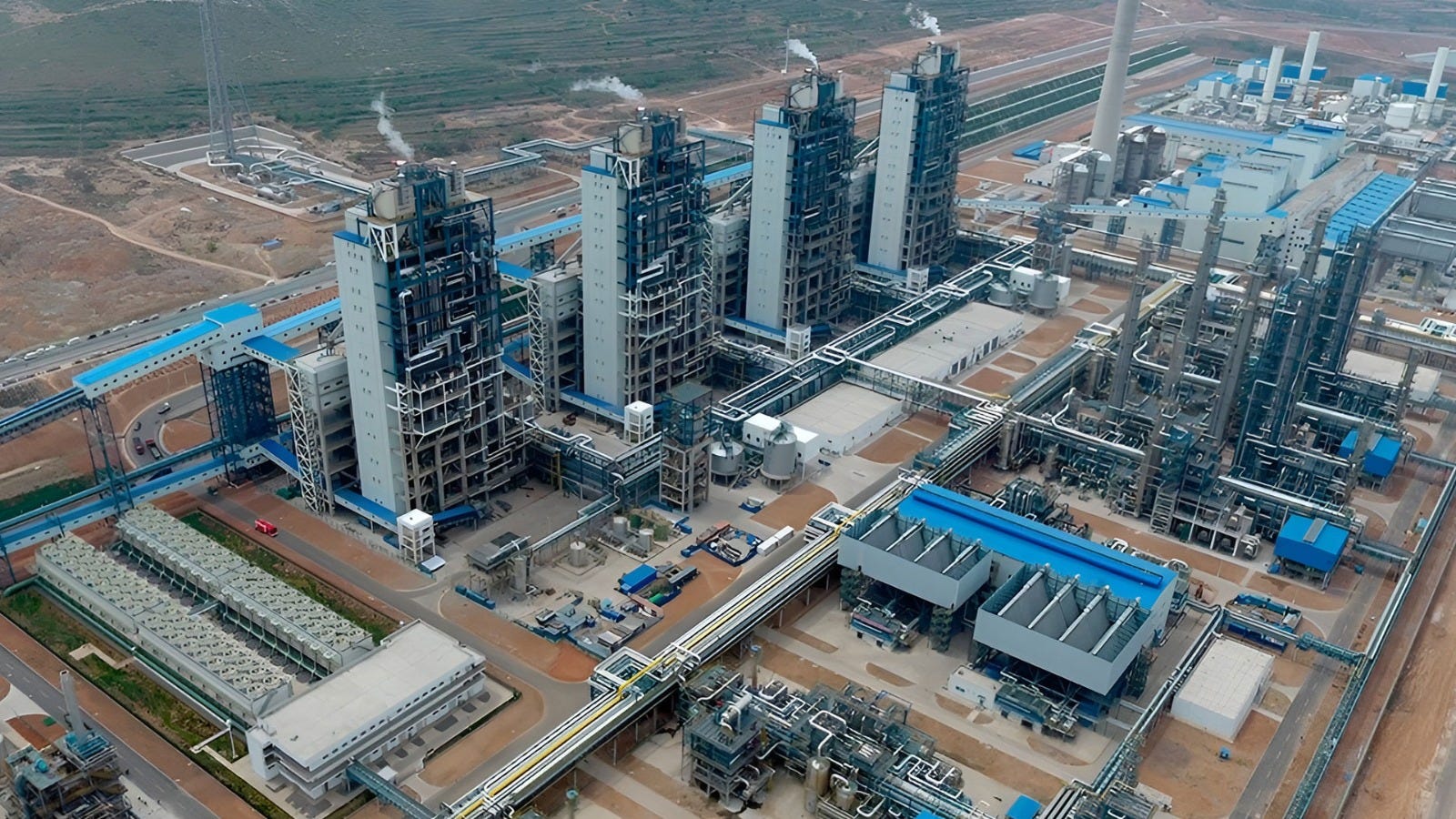
Syngas, or synthesis gas, is what you get when you partially burn coal (or other carbon feedstocks) with controlled amounts of oxygen and steam. The result? A gaseous cocktail of hydrogen, carbon monoxide, carbon dioxide, and methane.
Think of it as coal’s second life. Instead of just burning coal for power, which is dirty, inefficient, and planet-cooking, you convert it into a versatile gas that can become almost anything from methanol to ammonia, from urea to diesel, and even hydrogen.
The magic happens in a gasification plant. Coal goes in one end, gets heated to temperatures between 550°C and 1,600°C depending on the technology, and out comes syngas. (Is side se aalu dalo, us side se sona nikalo?) This syngas then gets cleaned, separated, and converted into whatever chemicals or fuels you need.
India has the world’s fifth-largest stockpile with over 400 billion tonnes of coal reserves. We’re sitting on the raw material but barely using it intelligently.
How Can Syngas Help India?
Let’s talk numbers. India currently imports around 90% of its methanol requirements. Methanol is a fuel that can be blended with petrol. The government’s NITI Aayog Methanol Economy Program targets 15% methanol blending in gasoline, which could cut oil imports by 15%. Methanol is also a raw material for plastics, and a building block for dozens of industrial chemicals.
Blending 20% DME (Di-methyl Ether, a methanol derivative) into LPG could save ₹6,000 crore annually while reducing each cylinder cost by ₹50-100.
Coal gasification could also revolutionize fertilizer production. Instead of importing natural gas to make ammonia, we’d use domestic coal. More predictable costs, less import dependency.
But there’s a bigger strategic play here. Look at China. They’ve been doing this at scale for decades. China uses 400 million tonnes of coal annually for gasification, producing 90% of its ammonia and 70% of its methanol through this route. When global gas prices spiked or supply chains choked, China’s chemical industry barely flinched.
India’s government has set a target: 100 million tonnes of coal gasification capacity by 2030, requiring investments north of ₹4 lakh crore. If successful, this could create a ₹60,000-90,000 crore annual economy through import substitution alone.
So Why Hasn’t This Happened Already?
If coal gasification is so great, why isn’t India already doing it at scale? Three reasons: technology, economics, and coal quality.
First, the technology. Global gasification tech was designed for low-ash coal (under 30% ash content). Indian coal routinely has high ash. That ash clogs up gasifiers, reduces efficiency, and makes the whole process messier. India needs customized technology, and developing that takes time and money.
Second, economics. Each gasification complex costs ₹10,000-25,000 crore depending on scale. That’s massive capital intensity. The government announced an ₹8,500 crore incentive scheme in 2024 and is offering a 50% rebate on revenue share for coal blocks used for gasification, but private players remain cautious.
Third, environmental concerns. Coal gasification is cleaner than burning coal directly. You can capture CO₂ more easily, recover sulfur as a saleable product. It’s still working with coal, though. It uses massive amounts of water, and lifecycle emissions remain high unless paired with carbon capture technology.
Despite these challenges, a handful of Indian companies like Jindal Steel & Power (JSPL), Coal India (CIL), GAIL India, NTPC, and NLC India are already in the game or gearing up.
Most of these projects are slated to commission by FY29, meaning we’re still 3-4 years away from meaningful production.
The Takeaway
Honestly, syngas won’t solve everything, but it’s one piece of a larger puzzle.
Coal gasification makes sense for India because we have abundant coal and structural import dependency. But it’s capital-heavy, technologically challenging, and won’t happen overnight. The government’s 2030 target of 100 million tonnes requires 15-20 large gasification complexes. Right now, we have barely a handful operational or under construction.
The bigger question is, “Should we bet everything on coal gasification?” Probably not.
India needs a diversified energy strategy. Piped natural gas for urban areas. Electric induction cooktops powered by solar. Compressed biogas plants (the government is setting up 195 of them). Methanol blending. All of these reduce import dependency in different ways.
But when LPG cylinders are selling in the black market for ₹6,500 and the Strait of Hormuz remains a geopolitical flashpoint, coal gasification suddenly looks less like an environmental compromise and more like strategic necessity.
China figured this out decades ago. India’s finally catching up. Will we move fast enough before the next crisis hits?
Until we find out, ReadOn!