
From Dividend to Deficit
The world is aging, are the markets ready?

At ReadOn, we don’t just report the markets. We help you understand what truly drives them, so your next decision isn’t just informed, it’s intelligent.
1.9. That’s India’s Total Fertility Rate in 2024, according to the Sample Registration System Statistical Report released by the Registrar General of India.
For context, 2.1 is the replacement level. That’s the number of children a woman needs to have, on average, for a generation to replace itself.
India just slipped under it. For the first time ever.
Umm, what?
Yeah. The country everyone still associates with a “demographic dividend” just posted a fertility number that looks more like Europe than the emerging market growth story we’ve been sold for two decades.
The Dividend Everyone’s Been Cashing In
Here’s the concept you’ve probably heard a hundred times without anyone really explaining it. A “demographic dividend” is what happens when a country’s working-age population (15 to 59, roughly) grows faster than its dependents, meaning kids and the elderly.
More workers relative to dependents means more producers, more consumers, and theoretically, faster growth. It’s the story behind Japan’s postwar boom, China’s manufacturing rise, and now, India’s pitch to the world.
And the numbers back it up. Around 66.4% of India’s population currently sits in that productive working age bracket, up from 64% a decade ago, as per an SRS report. India’s median age is a youthful 29.2 years. The country’s population touched 1.46 billion in 2025, the highest in the world.
Sounds like a slam dunk, right?
Here’s the thing. Looking only at the size of the workforce is a one-dimensional view. It tells you how many people can work today. It says nothing about who’s going to replace them tomorrow.
India’s population hasn’t stopped growing. It’s still growing. But the growth rate has been decelerating for years, and the fertility number is the reason why. Better healthcare has meant fewer infant deaths, down to 24 per 1,000 live births in 2024 from 30 in 2019. That means families no longer need to have extra children as insurance against child mortality. Layer on top of that rising education, more women working, later marriages, and the simple, unglamorous fact that raising a child in an Indian city has gotten expensive.
Put both numbers together, and you get the twist. A record share of working-age Indians today, paired with a shrinking pipeline of children to eventually take their place. The dividend doesn’t disappear overnight. But the generation cashing it in now will, one day, become the dependents, with fewer young workers underneath them to fund the transition.
Not Just India’s Problem
Now this part might make you feel a little better (or worse, depending on how you look at it). India isn’t the outlier here. It’s late to a party that’s already in full swing globally.
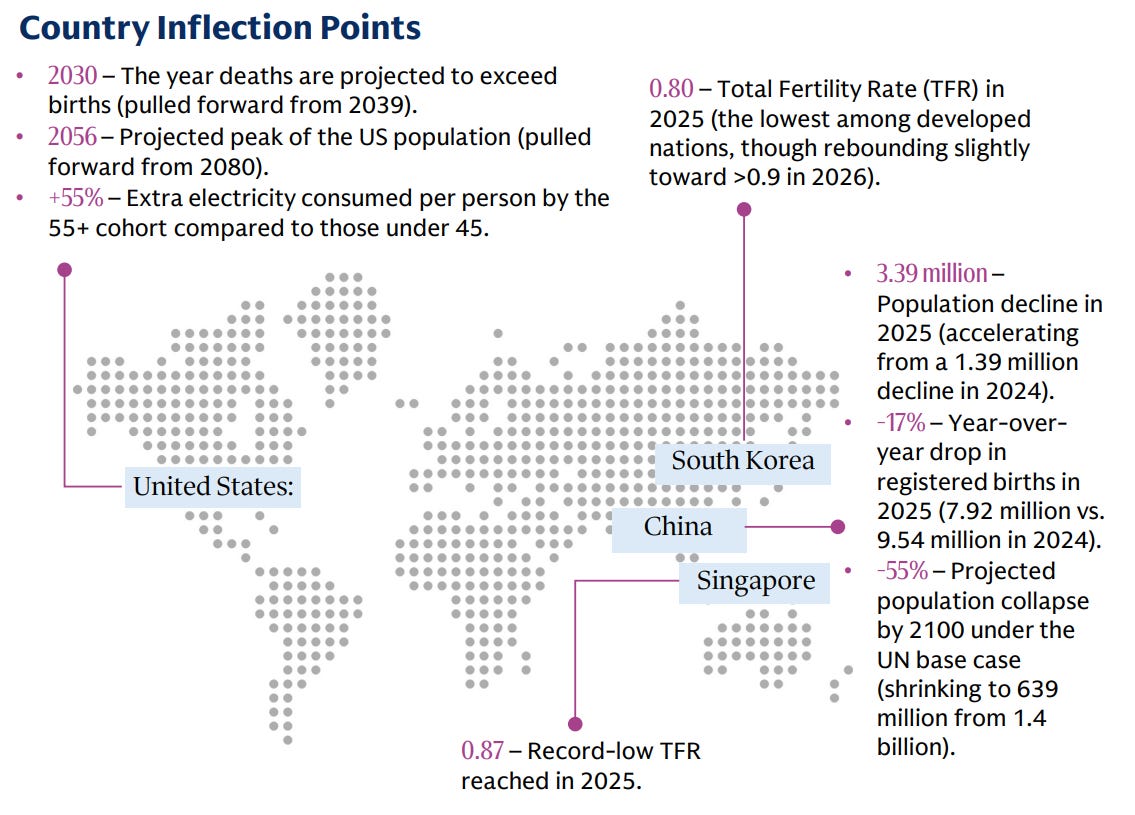
South Korea’s fertility rate hit 0.80 in 2025, the lowest among developed nations. Singapore posted a record low of 0.87 the same year. China’s population shrank by 3.39 million in 2025, with registered births falling 17% year on year. The UN now expects the number of people over 65 globally to double from 800 million to 1.6 billion by 2050, while the world’s under-19 population has already peaked and is now declining.
The reasons echo what’s happening in India, just further along the curve. Rising education and workforce participation among women. The cost of raising children climbing faster than incomes. Delayed marriage. Urbanisation breaking down the old joint-family economics where more hands meant more income. Better contraception and reproductive choice. None of this is a single cause. It’s a slow accumulation of social and economic shifts that, once they take hold, are remarkably hard to reverse. The UN’s own projections for future fertility have consistently been revised down over the last two decades, never up.
So, is India special? Not quite. It’s just fashionably late.
What Happens to Demand When the Mix Shifts
Now let’s take a look at how this impacts real-world economics.
When fewer young people are born, fewer people eventually show up to fill the roles vacated by an aging workforce. That’s not just an HR problem, it’s a demand problem too. The same output now needs to be squeezed out of fewer working hands, which usually means more workload per worker, more automation, or both.
But the more interesting shift is on the spending side. Every age cohort spends differently, and as the population mix changes, so does aggregate demand.
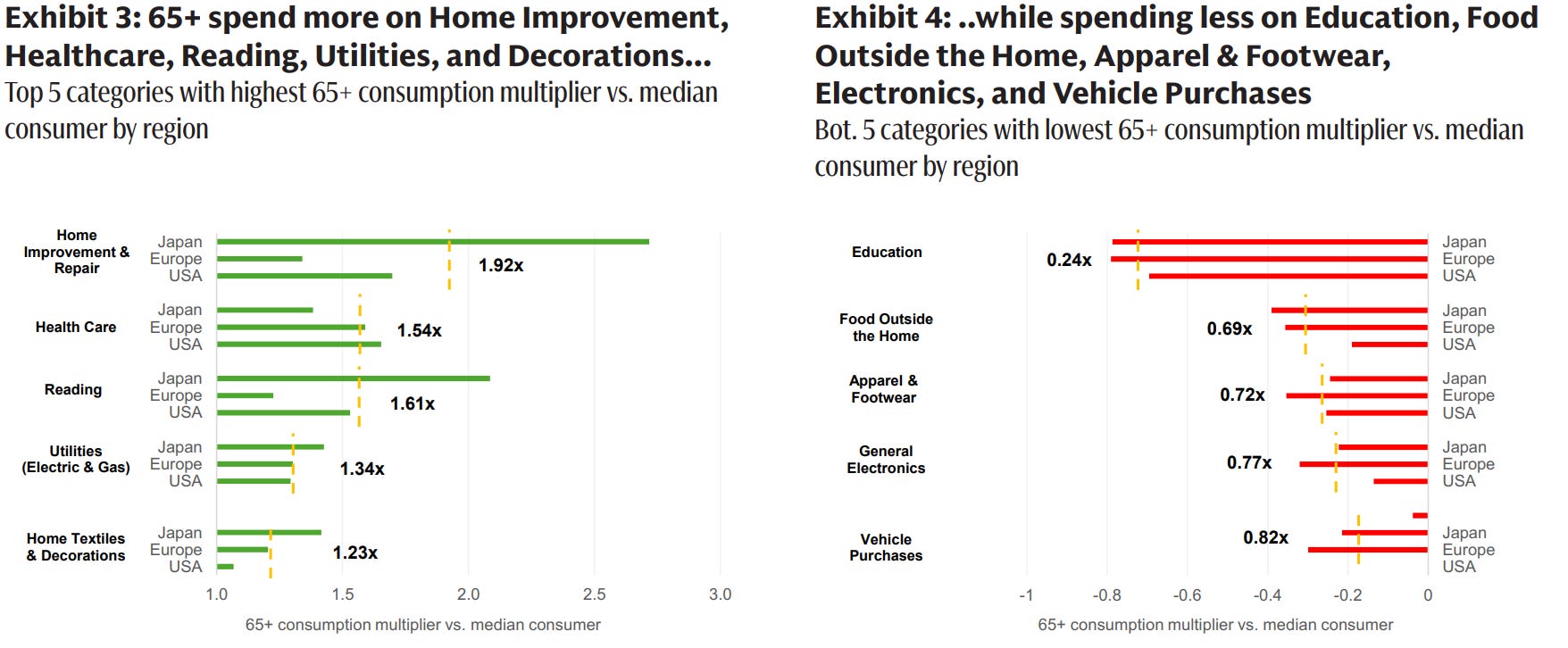
Goldman Sachs research quantifies this rather precisely. The 65+ cohort spends 1.92 times the median consumer on home improvement and repair, 1.61 times on reading, and 1.54 times on healthcare, while spending just 0.24 times the median on education and 0.82 times on vehicle purchases. Older individuals also consume roughly 55% more residential electricity per person than those under 45, largely because they spend more time at home.
Flip that around, and you can see the products and industries staring down a demand headwind: apparel, education, new vehicles, tech hardware, food away from home. And the ones catching a tailwind: pharma, healthcare, utilities, staples retail, home improvement, senior living.
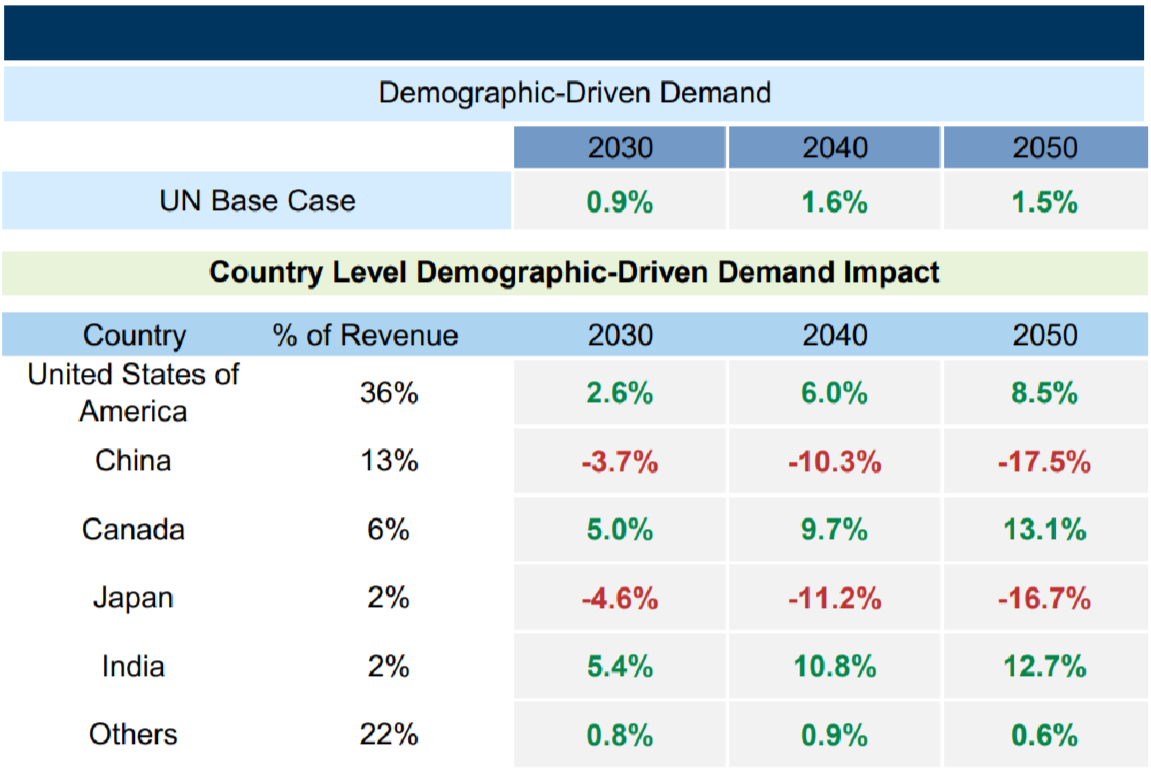
Here’s the India-specific twist, though. In the same Goldman Sachs framework, India shows up as a rare tailwind economy alongside the US, Australia and France, precisely because its population of “peak consumers” (ages 35-55, the group with the highest purchasing power and career maturity) hasn’t peaked yet. India’s projected demographic-driven demand growth for consumer-facing companies is estimated at 5.4% by 2030 and 10.8% by 2040, among the strongest of any large economy, while China and Japan face outright declines.
The catch is that this window doesn’t stay open forever. India’s own old-age dependency ratio, currently around 0.10 (roughly 10 elderly per 100 working-age people), is projected to more than double to 0.22 by 2050 as the fertility slowdown starts compounding. That’s still nowhere near Japan’s ratio of 0.50, but the trajectory only moves in one direction.
The Takeaway
So, should you be worried?
Probably not, at least not yet. This might just be a phase in a longer cycle rather than a one-way ticket to decline. Fertility forecasts have been wrong before, usually on the downside, but demographic transitions have also historically found their own equilibrium once economies adapt, whether through automation, longer working lives, or immigration filling gaps in places that allow it.
What’s genuinely worth watching, though, is how quickly companies and policymakers reposition for a demographic mix that looks nothing like the one they built their playbooks around. The auto industry, retail, education, and healthcare in India are all going to look structurally different in twenty years, not because the economy stops growing, but because the people buying into it will be a different generation entirely.
Will India’s dividend turn into a full paycheck before the bill comes due? That’s the real question this decade needs to answer.
Until we find out, ReadOn!