
Engineering Climatic Doom
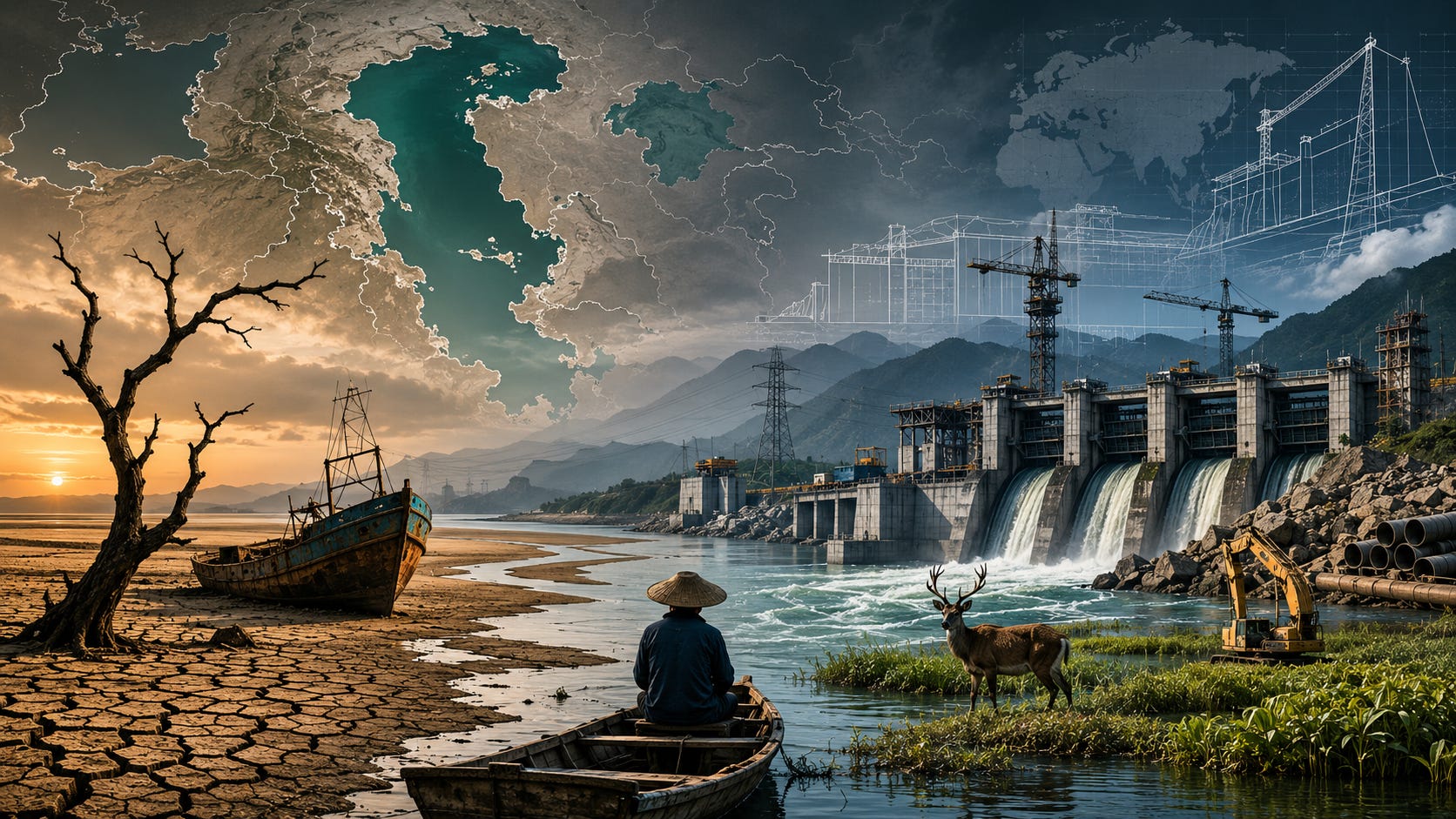
For a species so dependent on water to survive, we sure seem too intent on finding many ways to get rid of it!
At ReadOn, we don’t just report the markets. We help you understand what truly drives them, so your next decision isn’t just informed, it’s intelligent.
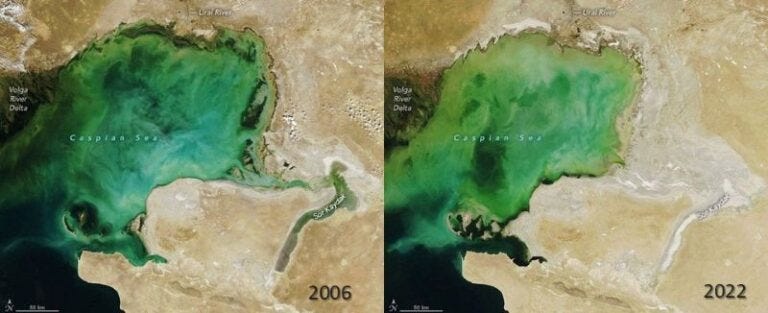
Since the mid-1990s, an area roughly the size of Sicily has vanished from the Caspian Sea. Not metaphorically. About 24,000 square kilometres of Earth’s largest inland water body has simply stopped being water. Levels have dropped nearly two metres. Satellite images now show freshly exposed sandbanks where fishing boats once anchored. Scientists project a further fall of 8-14 metres by 2100 if current trends hold.
Why is this happening? The obvious answer seems to be climate change. Rising temperatures. More evaporation. Less rain. Tidy. Convenient.
Except the data doesn’t cooperate.
A study published in Earth’s Future in June 2026 found that precipitation across the Caspian basin has remained broadly unchanged since the early 1990s. Rainfall over the Volga Basin, which supplies roughly 80% of the sea’s inflow, has actually increased slightly. Climate-driven evaporation accounts for only 37–40% of the observed water loss. The rest is engineering: rivers dammed, canals dug, water systematically redirected away from the sea by five governments across three decades.
India too has a version of this story. It’s called Loktak Lake.
Loktak is the largest freshwater lake in Northeast India. It’s a Ramsar-designated wetland in Manipur and the last wild habitat of the critically endangered sangai deer. Its iconic phumdis, or the floating masses of vegetation and organic matter would descend in dry months, absorb lakebed nutrients, rise with the monsoons, and flush through Myanmar to the Bay of Bengal. This natural cycle kept the water clean and the fishery alive. The Ithai Barrage, built in 1983 across the lake’s main draining outlet to power a hydroelectric project, ended that cycle in one construction phase. Fish populations declined. Over 95% of local residents depended on the lake’s fishery for their livelihood. In June 2025, delayed gate-opening at the barrage caused widespread flooding in Manipur, with the NHPC and state Water Resources Department formally held accountable. The damage accumulates, season by season.
What happened at the Caspian
The Volga River has been fundamentally reshaped by Soviet-era engineering. Dams, reservoirs, irrigation networks, and the Volga-Don Canal, which reroutes water from the Caspian basin to the Black Sea through Russia’s internal waterways, collectively intercept water that once kept the sea stable. Each upstream nation accounts for its own extraction, and no binding mechanism forces anyone to account for the cumulative loss.
The Caspian is also a major economic artery. Offshore oil platforms, shipping lanes connecting Europe and Asia, and regional trade corridors embedded in China’s Belt and Road Initiative all depend on it remaining navigable. Falling water levels threaten ports and increase transport costs across the region, making an environmental crisis become an economic constraint.
The ecological deterioration is already serious. The Caspian hosts over 850 endemic species, including the Caspian seal and multiple sturgeon species that account for 90% of the world’s black caviar. The shallow northern section, ecologically the richest zone, is drying fastest. Rising chlorophyll-a concentrations signal algal blooms. This means that the sea is becoming warmer, shallower, and nutrient-saturated in ways that choke aquatic life. Roughly one million tonnes of oil leak into the sea annually from offshore extraction, a detail almost entirely absent from the climate conversation.
Five nations share the coastline. The Tehran Convention (2003) and the Aktau Convention (2018) provide environmental frameworks. Neither has produced enforceable water allocation rules or transparent monitoring of withdrawals. Governments prefer the climate-change frame. After all, it externalises responsibility. The Aral Sea demonstrated how quickly the trajectory accelerates: once the world’s fourth-largest lake, now largely desert, dismantled entirely by Soviet irrigation engineering. The Caspian hasn’t crossed that threshold, but the direction is not reassuring.
Engineering at scale
The Caspian sits inside a global pattern. There are now approximately 800,000 dams worldwide, and they have cut off 59% of all river systems from their natural flow dynamics. A new construction wave is underway: over 3,700 large and medium hydropower dams are planned or under construction globally, concentrated in the Global South, driven by the clean energy transition.
The ecological costs are real and mounting. Research published in Communications Earth & Environment in 2026 found that over 85% of freshwater species that changed IUCN threat status between 1996 and 2022 shifted toward higher threat categories in dam-influenced areas. Dams block sediment transport, alter water temperature, prevent fish migration, and trigger algal blooms. Rivers evolved around dynamic, seasonal flows. Replace those with managed releases, and the biology built around natural rhythms simply runs out of adaptive room. One dam is a project. Forty dams across a river system is an ecological restructuring, and the accounting for that cumulative effect almost never happens at the scale it should.
The India case
India already has 197 large hydropower plants with over 15,000 MW under active construction as of 2025. The pipeline ahead is far more ambitious. The Central Electricity Authority announced a $77 billion plan to develop 76 gigawatts of hydroelectric capacity from the Brahmaputra basin alone by 2047, spanning twelve sub-basins across eight northeastern states. Arunachal Pradesh would host 52.2 GW of that capacity. It’s a state that borders China and is among India’s most biodiverse.
The strategic case is real. China is building a mega-dam upstream on the Yarlung Zangbo. India needs energy security. Hydropower is renewable. These arguments carry weight for us, not unreasonably.
But the Subansiri Lower Hydroelectric Project in Arunachal Pradesh illustrates the tradeoffs. Nearly complete, it will hold back the Subansiri River for most of each day, releasing water in brief bursts for power generation. Downstream communities in Assam face altered fish ecology, changed groundwater recharge, and unpredictable flood patterns that their farming and fishing economies were never built to absorb.
The infrastructure already in place is also under visible strain. SANDRP’s 2025 dam flood report documented structural damage to three dams in a single monsoon season. The Kaddam dam in Telangana, hasn’t had a removing of accumulated silt, sediment, and fine debris since its 1949 construction. As a result, the dam has lost roughly 37% of its original storage capacity. India has not mandated cumulative environmental impact assessments for river basins where dozens of projects are being approved simultaneously. Planned dam locations across South and East Asia are classified among the world’s highest-risk zones for freshwater biodiversity loss. Basin-level ecological modelling remains largely absent from the clearance process.
The Takeaway
The Caspian Sea’s decline is narrated as a climate story. The data makes it an engineering accountability failure where decades of river diversion dismantled an ecosystem without any government ever owning the cumulative effect.
India is not writing a different story. If anything, it is writing a faster version, in a region that is simultaneously more ecologically fragile, more seismically active, and more geopolitically contested.
Cumulative impact assessments, transparent water accounting, and enforceable ecological flow mandates are not anti-development positions. They are the minimum conditions for ensuring today’s infrastructure does not become tomorrow’s environmental liability. The Caspian’s exposed sandbanks are the invoice for skipping that accounting. India’s northeast is still deciding whether to open the envelope.
Until next time, ReadOn!