
Dry Development
India's development might just be turning it into the worst type of "dry state" ever!

At ReadOn, we don’t just report the markets. We help you understand what truly drives them, so your next decision isn’t just informed, it’s intelligent.
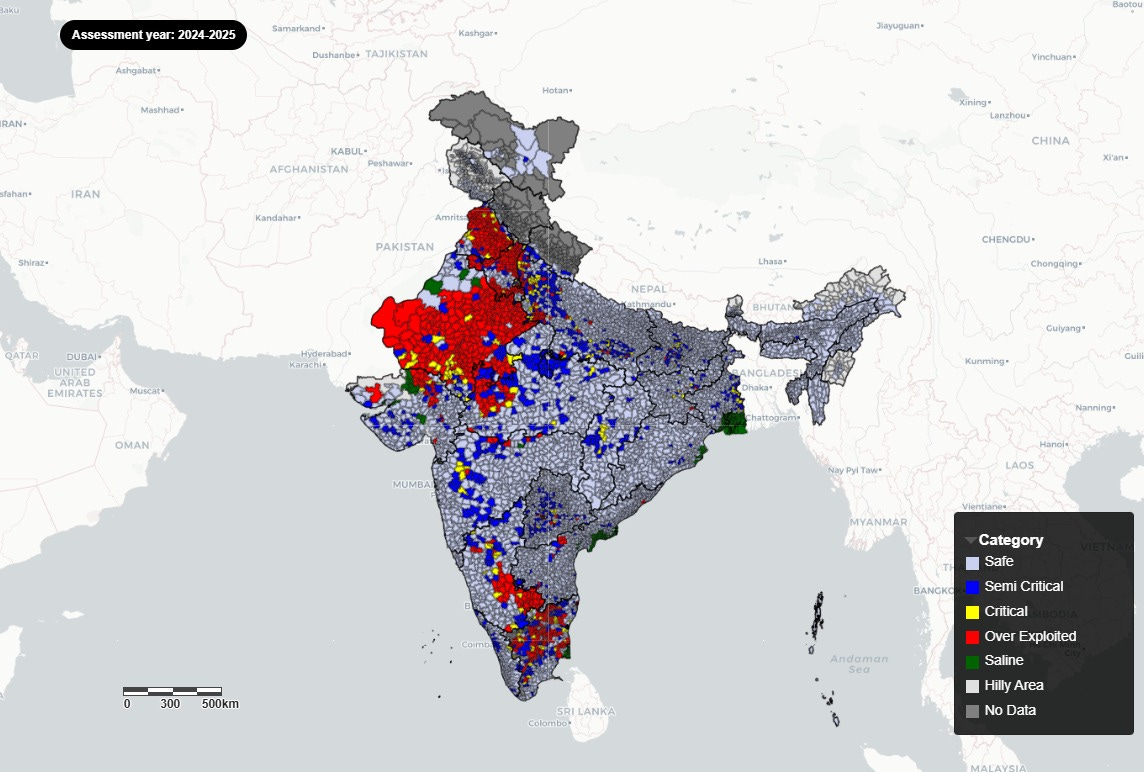
This map shows the state of groundwater available in India. Based on this map, ~10-13% of India’s water resources are over exploited. This means that these regions are using their water resources faster than they are replenished, driving these regions to water shortages. India holds just 4% of the world’s freshwater resources but supports 18% of its population.
Looking at the state of India’s water scarcity, we’d think that development would be more careful about water use. Unfortunately, that doesn’t seem to be the case. At least not as far as data centres and ethanol production are concerned.
On ethanol, our installed production capacity hit nearly 20 billion litres per year by November 2025. That’s a near-tenfold jump from a decade ago. The country hit its 20% blending target five years ahead of schedule. From April 2026, E20 is mandatory at every petrol pump in India. The programme has saved ₹1.44 lakh crore in foreign exchange that would otherwise have gone to crude oil importers.
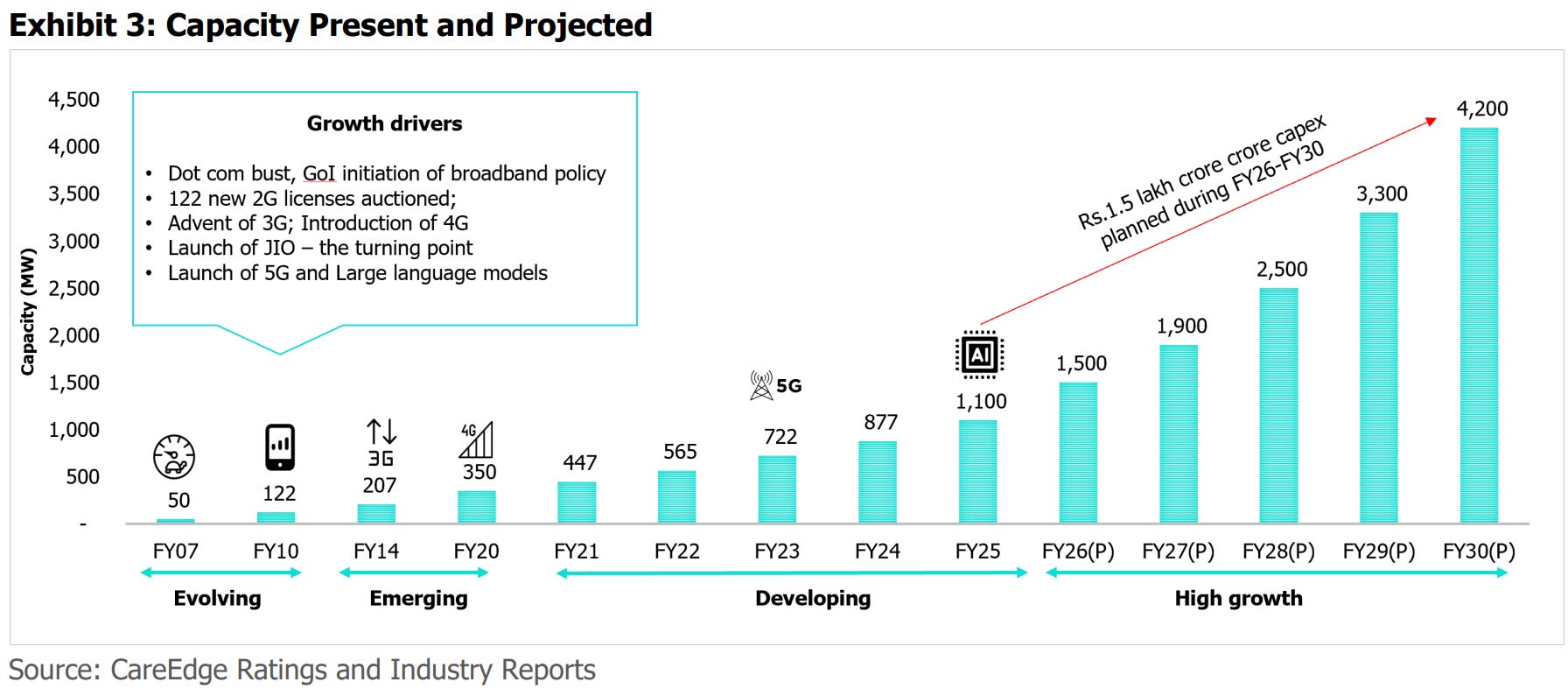
On data centres, India added 440 MW of new capacity in 2025 alone. That’s a 160% year-on-year jump, pushing total operational stock past 1,700 MW. Microsoft committed $17.5 billion to India’s cloud and AI infrastructure, Amazon pledged $35 billion across its India businesses, and Google announced $15 billion for a gigawatt-scale campus in Andhra Pradesh. The sector is valued at $10 billion and could add 0.5-1% to GDP indirectly through productivity gains across banking, e-commerce, and AI services.
Both stories are genuinely impressive. A country building real industrial muscle, reducing dependence on foreign energy and foreign cloud infrastructure at the same time. But India’s data centres consumed roughly 150 billion litres of water in 2025, and ethanol’s water footprint, when you account for the crops that feed it, runs to thousands of litres for every single litre of fuel produced. As both sectors expand, so does their thirst.
India’s growth on global competitiveness looks good, but our water table does not.
Ethanol Catches Fire
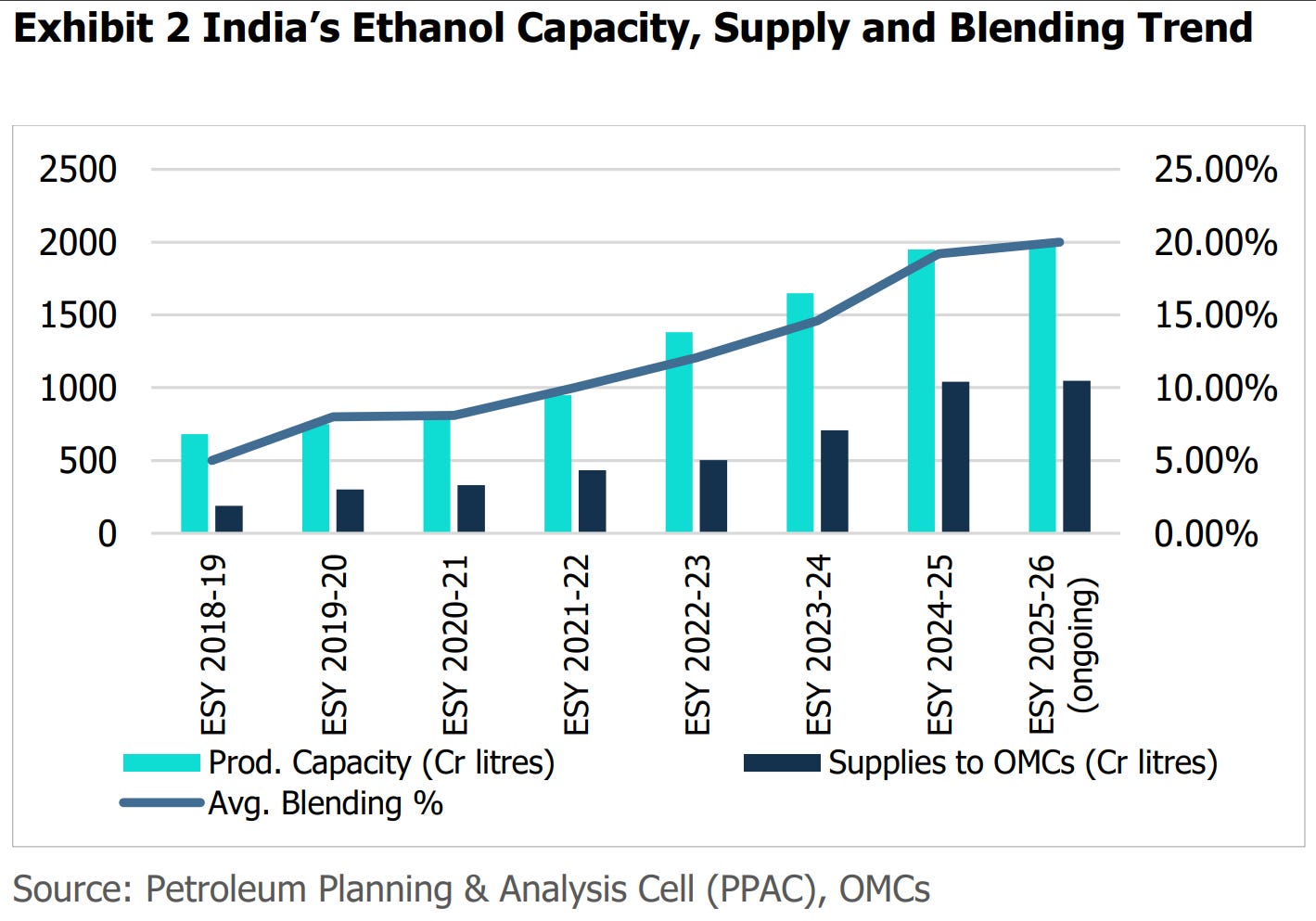
The ethanol story has built over a decade, almost without drama. What started at a 1.53% blend in 2013–14 became mandatory at 20% at every petrol pump across India by April 2026, an achievement five years ahead of schedule. Production capacity grew from around 2 billion litres to nearly 20 billion litres over the same period. Over 245 lakh metric tonnes of crude oil have been substituted. The government is not stopping there.
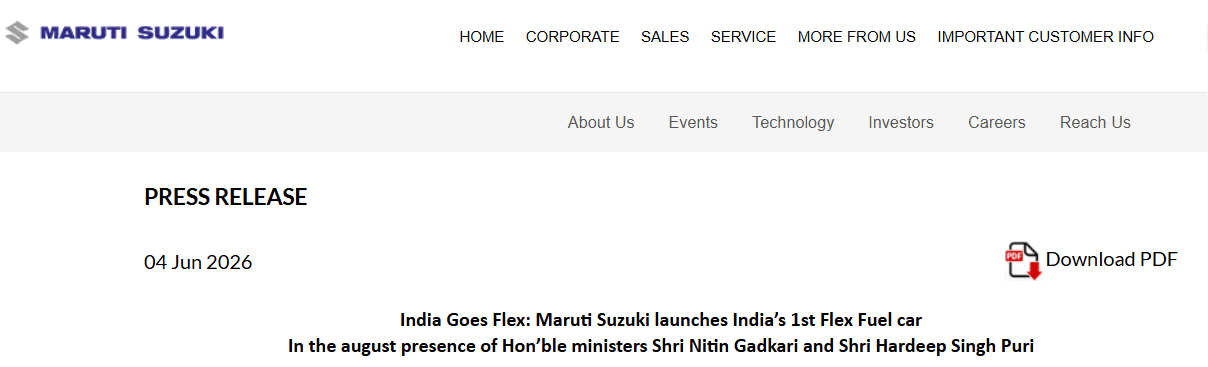
In May 2026, the Bureau of Indian Standards notified fuel specifications for E22, E25, E27, and E30 blends, laying regulatory groundwork for blending well beyond 20%. Tests for E85 and E100 are already underway under the Central Motor Vehicles Rules, with Indian Oil selling E100 at 183 retail outlets. Maruti Suzuki is preparing to launch India’s first mass-market flex-fuel vehicle. The direction is clear. E30 is the next step, E85 is the destination.
The economics make sense, especially after Strait of Hormuz tensions in early 2026 sharpened India’s energy security focus. Industry body GEMA estimates higher blending and flex-fuel vehicles could save India up to ₹2 lakh crore annually in foreign exchange against an oil import bill of ₹22 lakh crore. Current E20 demand runs at around 10.5–11 billion litres per year. Move to E30, and demand rises roughly 50%. Move to E85, and you need a multiple. Every extra litre of ethanol means more crops, more land, and above all, more water.
Food Secretary Sanjeev Chopra has stated that producing one litre of ethanol from rice requires roughly 10,790 litres of water across the full cultivation cycle. Sugarcane requires around 3,630 litres per litre; maize, about 4,670. The grain ethanol industry pushes back, correctly noting that modern distilleries use only 3–5 litres of process water per litre in-plant. Technically valid, practically meaningless: the crops draw their water from irrigation and aquifers long before they reach a distillery. The water is still gone.
India allocated 52 lakh tonnes of rice specifically for ethanol in 2024–25. The 2025–26 target is 90 lakh tonnes. To enable this shift, the government is reducing the share of broken rice distributed through the Public Distribution System from 25% to 10%, diverting the balance to distilleries. This is not just a water trade-off. It is a water-and-food trade-off.
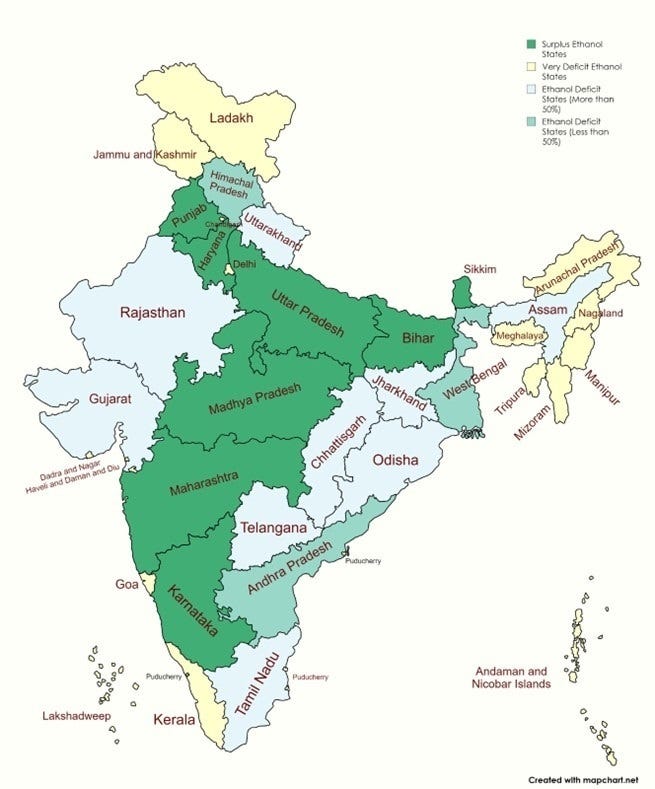
The geography makes it worse. India’s 1,822 crore litre ethanol capacity is concentrated in already water-stressed states. Maharashtra holds 396 crore litres of that capacity, even as Vidarbha and Marathwada face drinking water shortages each summer. Ethanol plants in Uttar Pradesh and Karnataka draw from groundwater reserves already classified as critically depleted. The distilleries are not being built where water is available. They are being built where the crops are, in places that cannot afford to lose another drop.
Data Centre of Attraction
If ethanol’s water problem is rooted in agriculture, the data centre’s is hidden in plain sight, tucked inside cooling towers running 24 hours a day.
A single 100-MW facility consumes roughly 2 million litres of water per day. India’s total operational capacity has crossed 1,520 MW, expected to hit 1.7–2 GW by end-2026 and 4–5 GW by 2030, with AI-accelerated scenarios pushing toward 8–9 GW. Amazon, Microsoft, and Google together committed over $67 billion to India in late 2025. The Union Budget 2026–27 added a tax holiday through 2047 for eligible foreign cloud providers using Indian infrastructure, further sweetening an already generous deal.
India already generates 20% of global data while hosting just 3% of global capacity. Every bank transfer, UPI payment, streaming session, and AI inference call runs through these facilities. The gap between data generated and infrastructure hosted is its own argument for expansion. But the water cost is not abstract. India’s data centres consumed 150 billion litres in 2025 and that figure is projected to more than double to 358 billion litres by 2030, and that is the base case.
The location problem mirrors ethanol’s. Mumbai, Chennai, Hyderabad, and Bengaluru account for the bulk of capacity, while already facing acute water stress. Hyderabad faces a projected deficit of 870 million litres per day by 2027, yet Amazon is expanding there. Bengaluru’s data centres alone consume over 26 million litres annually, even after the city emerged from what locals described as its worst water crisis in five centuries. An S&P Global study forecasts that 60–80% of India’s data centres could face high water stress within this decade.
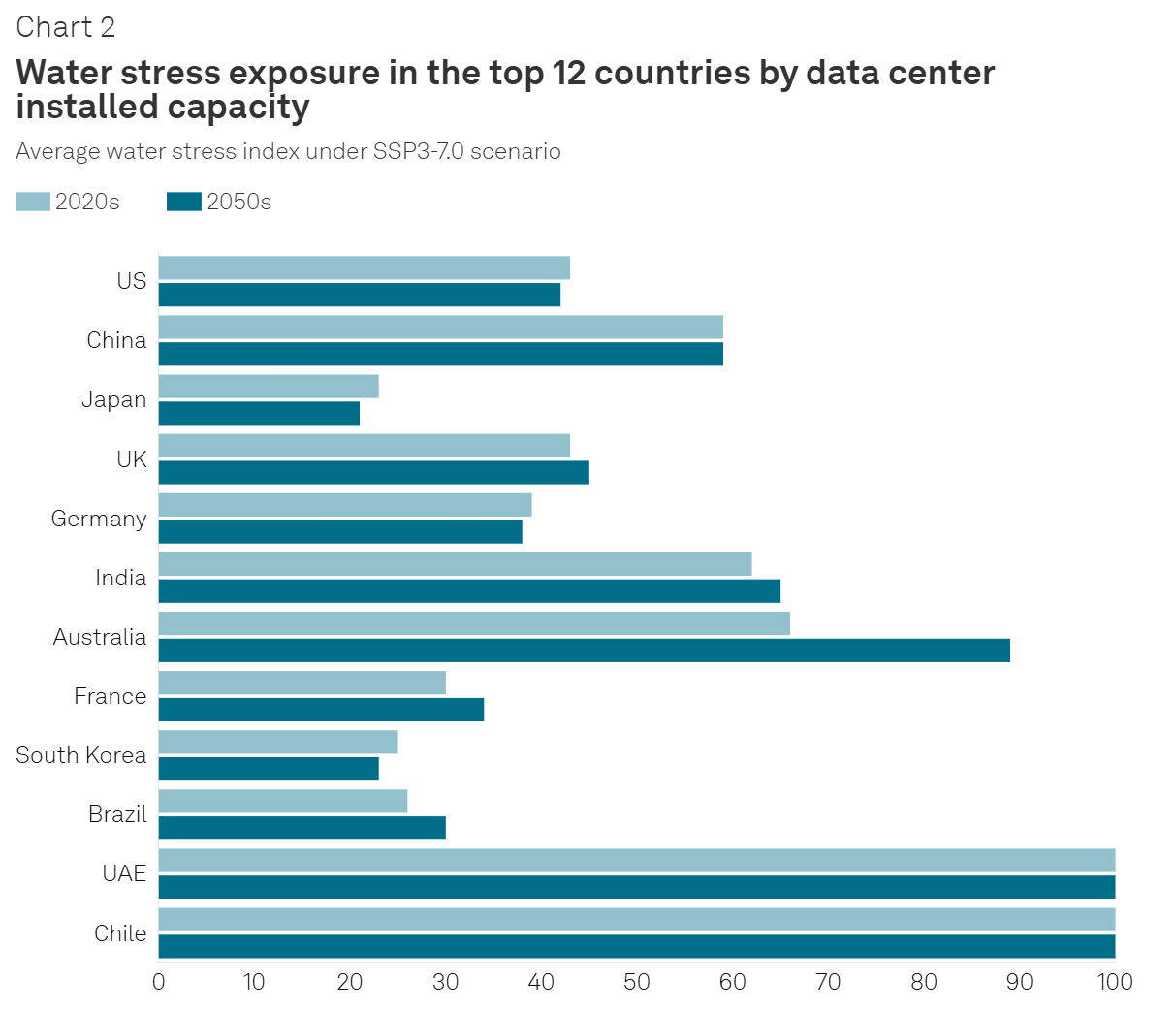
When Google withdrew its $1 billion data centre proposal in Indianapolis in September 2025 after local opposition over water and energy demands, it was a signal. American communities are pushing back. India, by contrast, is moving in the opposite direction, and cutting taxes, reducing friction, and welcoming every project. Which is fine. Right up until the water runs out.
Saving Water
Is India doing anything about this?
Partially. Imperfectly. Far too slowly.
The government is not blind to the crisis. Jal Shakti Abhiyan, Atal Bhujal Yojana, and Jal Jeevan Mission address water supply and groundwater management. The World Water Day Conclave 2026 raised water circularity as a national priority. A National Water Data Policy was issued in 2026. The Central Ground Water Board reports that groundwater recharge improved from 432 to 448.52 billion cubic metres between 2017 and 2025. Progress exists.
But there is a gap between macro water policy and the industries actually drawing the water.
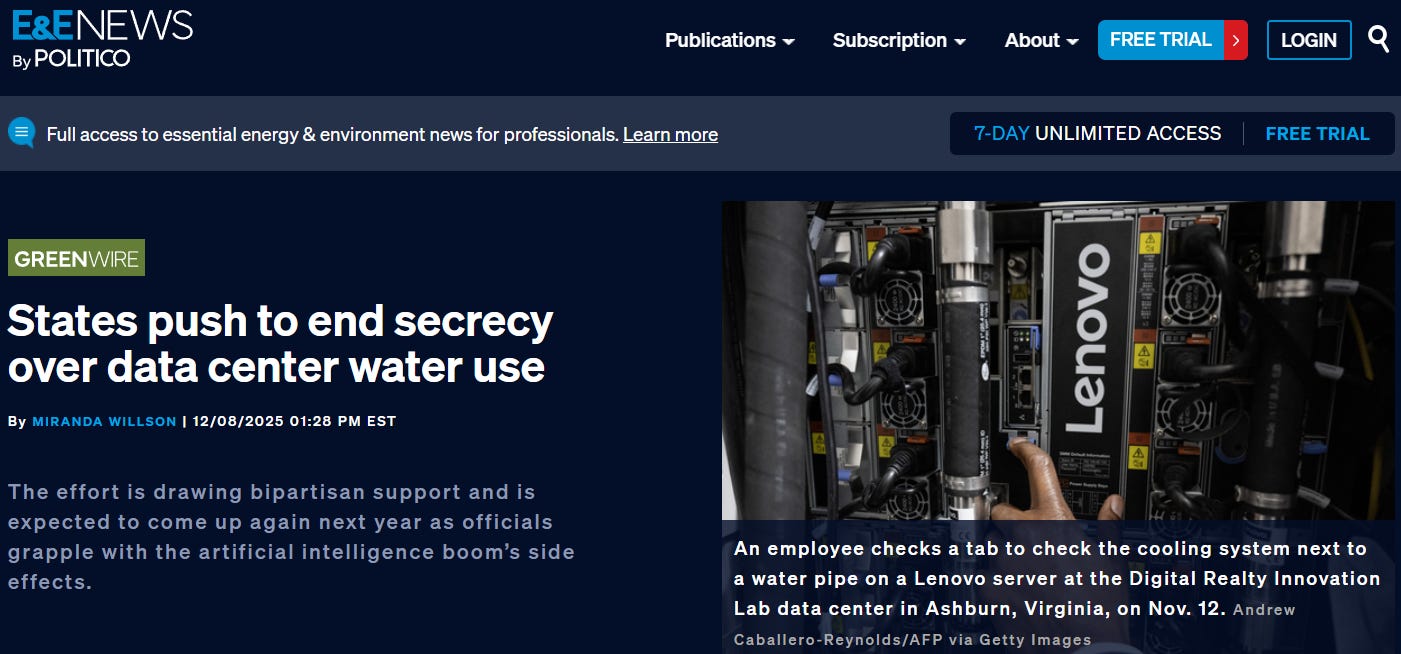
For data centres, there is no mandatory requirement to disclose water consumption. Environmental clearances do not require operators to declare operational water use, as Mongabay-India confirmed when it accessed the clearance documents for the Vizag Mega Data Centre Park, which were entirely silent on the matter. India offers import duty incentives for data centres with power usage efficiency below 1.4, a nudge for energy efficiency with no water equivalent. California is currently legislating mandatory annual water use reporting for every data centre. India is not.
Big Tech offers pledges. Microsoft and Amazon have both committed to becoming “water positive” by 2030. But as experts note, “replenishment” typically means funding conservation projects in different regions. So, a facility consuming millions of litres in water-scarce Mumbai can “offset” it by funding rainwater harvesting in a wetter state. For the sustainability report, the math works. For residents competing for Mumbai’s municipal supply, it is cold comfort.
On ethanol, NITI Aayog’s roadmap recommends shifting to less water-intensive crops like maize. That’s directionally correct, but the same government simultaneously targets 90 lakh tonnes of rice, the most water-intensive feedstock, for ethanol in 2025–26. No regulation requires new ethanol plants to avoid groundwater-stressed districts. The Central Ground Water Authority has been repeatedly criticised for inadequate enforcement and weak transparency. Policy recommends water efficiency; operational decisions routinely do the opposite.
The pattern is consistent. There are no binding mechanisms that force industry to account for water even when it builds, not just when it depletes. The industries get the approvals, the tax breaks, and the headline investments. When the literal water dues come, the natural resources pay the toll.
The Takeaway
India is building ethanol capacity toward E30 and beyond, and data centre capacity toward 5 GW by 2030. It supports 18% of the world’s population on 4% of its freshwater. By 2030, demand is projected to be twice the available supply. That’s a gap NITI Aayog warns could shave 6% off India’s GDP. NASA’s GRACE satellites show that water tables in northwestern India are sinking by 4 centimetres every year.
None of this means India should abandon either programme. Reducing oil imports is a genuine national security argument, one that the Strait of Hormuz crisis of 2026 made viscerally obvious. Digital infrastructure is non-negotiable for economic growth. But “legitimate purpose” has never been a sufficient reason to ignore a resource constraint. The point of industrial policy is to make trade-offs visible and make choices, not to declare two goals national priorities and pretend the constraints do not exist.
Right now, ethanol’s water costs are borne by farmers in Maharashtra, Karnataka, and UP, whose wells are getting harder to draw from each season. Data centres’ water costs are invisible, absorbed by municipalities whose water tables are already in deficit, showing up only when summer shortages bite and no one traces the cause back to the cooling tower down the road.
The responsible version of this story is not “ethanol or data centres.” It is, “if we are going to build both, we need to count the water, set the limits, and stop letting industries that consume a scarce public resource treat it as a free input”.
That is a harder story to put on a scorecard. It is also the only one that will still make sense ten years from now.
Until next time, ReadOn!