
Bespoke Babies
"Character creation menu" just got uncomfortably real!
At ReadOn, we don’t just report the markets. We help you understand what truly drives them, so your next decision isn’t just informed, it’s intelligent.
A New York startup just made a deal that could reshape how Indians think about having children. Nucleus Genomics struck partnerships with Indira IVF (with 160+ fertility clinics across India), and Abu Ghosh Fertility Group in Jordan and Saudi Arabia. The promise? Help couples “optimize” their embryos for health and longevity. The reality? A technology that scientists claim is not even backed by science.
Welcome to the brave new world of “genetic optimization.” And it’s landing in India just as the country’s IVF (In-Vitro Fertilisation) market hits $1.41 billion in 2026, projected to reach $4.9 billion by 2034. India performs over 300,000 IVF cycles annually, and over 1,500 ART (Assisted Reproductive Technology) clinics are registered under the National ART Registry. That’s a lot of hopeful parents. And now they’re being offered something that sounds miraculous but might be nothing more than expensive snake oil.
Who Is Nucleus Genomics?
Let’s start with the who’s who. Nucleus Genomics was founded in 2021 by Kian Sadeghi, a University of Pennsylvania computational biology dropout. He’s a Thiel Fellow, or part of Peter Thiel’s program that pays young people to skip college and build companies instead.
The company has raised more than $32 million from investors including Founders Fund (Peter Thiel’s firm), Seven Seven Six (Alexis Ohanian’s fund), Samsung Next, and Quiet Capital.
Sadeghi’s pitch goes something like this: “Before there’s a heartbeat, there’s DNA.” Give parents complete genetic profiles. Let them choose.
The company doesn’t run tests directly. It partners with Genomic Prediction, an embryo screening company. Parents get standard genetic screening done, then voluntarily upload the data to Nucleus Embryo for “expanded analysis.”
Sadeghi claims it’s not eugenics but “empowering people with information“. American geneticist Eric Turkheimer calls it a “new eugenics company.”
Globally, Nucleus has worked with 25 clinics. Now it’s scaling up.
What Is Genetic Optimization?
Nucleus Genomics launched “Nucleus Embryo” software in June 2025 for $5,999. The pitch? Analyze up to 20 embryos across over 900 hereditary conditions and 40+ traits including cancer risk, heart disease, diabetes, intelligence, longevity, BMI, baldness, eye color, hair color, left-handedness, and mental health.
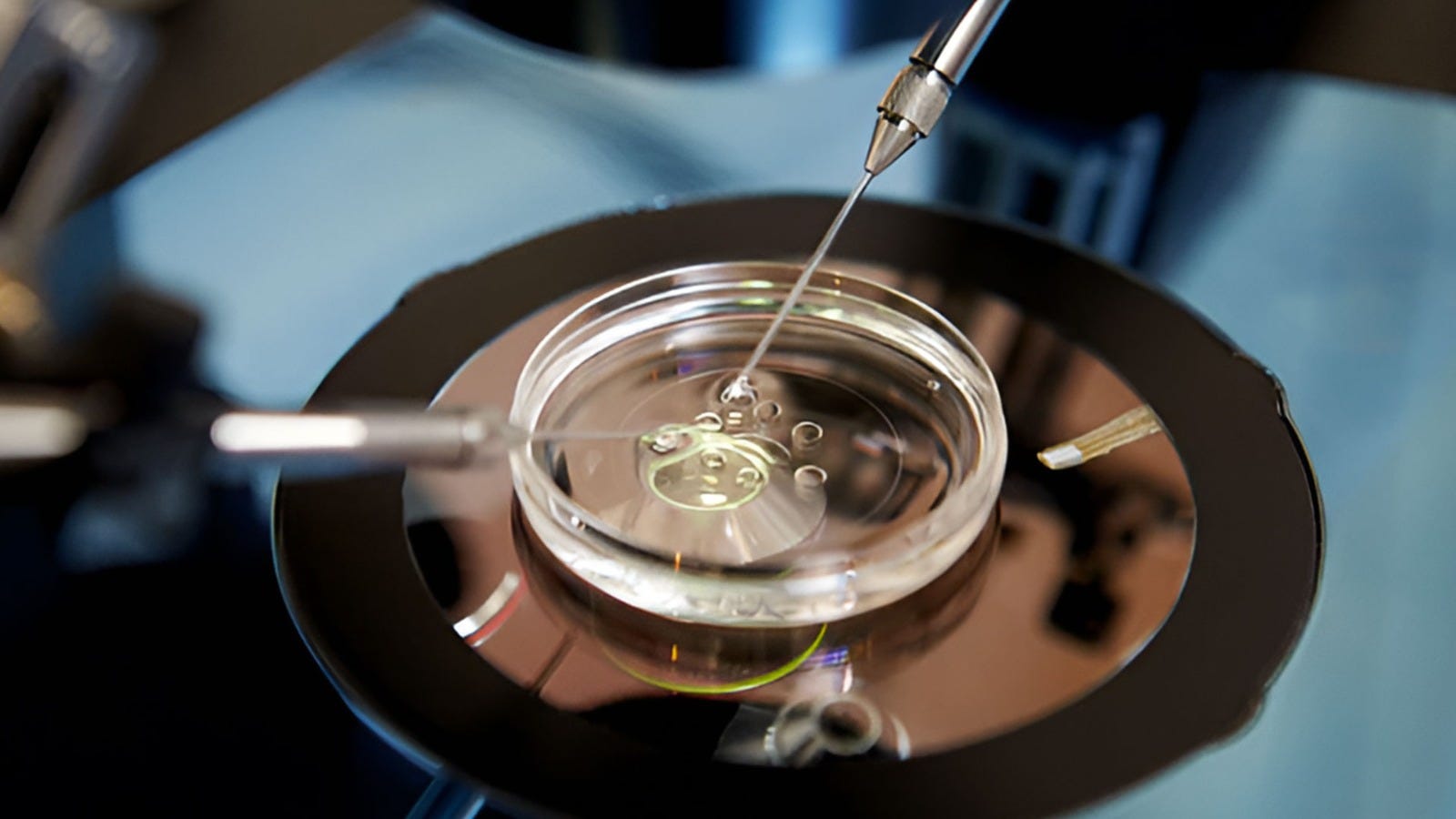
Parents undergoing IVF create multiple embryos. Nucleus tests the DNA of each one and ranks them. The software tells you which embryo has the “best” genetic profile. You pick. Simple, right?
Well… There’s a problem. The science doesn’t support most of these claims.
Traditional preimplantation genetic diagnosis has been around for decades. It works brilliantly for serious hereditary diseases with known genetic causes, like Huntington’s disease, Tay-Sachs disease, cystic fibrosis. These are single gene, clear mutation, life-or-death consequences. Testing for these makes perfect sense.
But intelligence? Longevity? BMI? There are no major genetic markers for these traits. Instead, Nucleus uses something called “polygenic risk scores”, where they combine hundreds of genetic variants with tiny, tiny correlations to complex traits. Bioethicists Arthur Caplan and James Tabery wrote that polygenic risk scores “remain highly dubious” even for straightforward medical conditions like asthma and stroke. Basically, they claim that the “scoring” for these embryos is as useful as the scores you and I got for “recitation skills” in pre-primary school. Not even a little!
And on top of this, most research has been done almost exclusively on people with Western European ancestry. So if you’re Indian, the predictions are even less reliable.
What this means is, that for the not-so-low price of $5,999, you can get… absolutely nothing concrete.
Caplan and Tabery’s verdict? They called it “tone-deaf Silicon Valley marketing trampling over legitimate science.”
What Does Nucleus Plan in India and the Middle East?
Indira IVF performed nearly 42,000 IVF cycles in the last fiscal year and employs more than 3,000 people. That’s a massive distribution network for Nucleus.
Abu Ghosh Fertility Group, based in Amman, Jordan, operates across Saudi Arabia and Jordan, bringing Nucleus into the Middle Eastern market.v
There’s one crucial caveat. In line with national regulations, Nucleus’ offerings in India will exclude trait selection and do not disclose embryo sex. India has strict laws against sex selection due to decades of female foeticide. So no choosing eye color, hair color, or intelligence scores in India. At least not officially.
But the cancer, heart disease, and diabetes screening? That’s allowed. And that’s where the science gets murky.
Dr. Kshitiz Murdia, CEO of Indira IVF, framed it diplomatically in an article by the Manila Times, “Our association with Nucleus Genomics reflects a continued effort to improve care pathways and support families on their journey to parenthood.”
Sadeghi was blunter: “The instinct to give your child the best start transcends every culture, and the demand we saw from families in India and the Middle East reflects that.”
Translation: Parents everywhere want the best for their kids. And we’re selling them that promise.
The Takeaway
India’s IVF industry is booming. The market is expected to grow at 14.82% CAGR through 2034. Infertility affects a growing number of couples. PCOS affects 9.13%-22.5% of menstruating women in Southern India and Maharashtra. Rising urbanization, delayed parenthood, and lifestyle factors are driving demand.
For couples struggling with infertility, IVF is a godsend. And legitimate genetic testing for serious hereditary diseases is lifesaving. No one disputes that.
But “genetic optimization”? That’s different territory.
Caplan and Tabery warn it could lead parents to “discard perfectly healthy embryos“ because a software algorithm said another one had slightly better polygenic risk scores for traits we can’t actually predict.
The fear of eugenics isn’t hypothetical. India has its own brutal history with genetic selection. Sex-selective abortion led to millions of “missing” girls. That’s why sex disclosure is banned. But what happens when genetic optimization becomes normalized? When parents feel pressure to choose the embryo with the “best” genetic score? When clinics market this as responsible parenting?
The line between preventing disease and designing children isn’t as clear as it seems. And once you cross it, you can’t un-cross it.
Nucleus Genomics is betting big on India and the Middle East. The company raised $32 million on the promise that genetic optimization is the future of reproductive medicine. India’s $1.41 billion IVF market represents massive growth potential.
But potential for what, exactly? A future where genetic testing helps families avoid devastating diseases? Or one where Silicon Valley startups sell anxious parents an illusion of control over traits science can’t actually predict, while calling it “empowerment”?
The science isn’t there yet. And the ethics? Well, those questions are just beginning.
Until next time, ReadOn!