
Bars For Sale
How El Salvador turned its prison crisis into a business model — and who's really paying the price
At ReadOn, we don’t just report the markets. We help you understand what truly drives them, so your next decision isn’t just informed, it’s intelligent.
El Salvador has two things the world apparently wants right now: perfect surf breaks and empty jail cells. And, strangely, business is booming on both fronts.
This is the story of how a small, broke, deeply violent Central American country accidentally stumbled onto a new economic model: the prison state as a global export industry.
Before we get into the economics, you need to understand what El Salvador was dealing with because without that, none of what President of the country, Bukele did makes any sense, and neither does the scale of the reaction to it.
For most of the 2010s, two gangs effectively ran large parts of El Salvador. MS-13 and Barrio 18 weren’t just street gangs in the way you might picture them. They were shadow governments. Both originated among Salvadoran immigrants in Los Angeles in the 1980s, and were subsequently deported back to El Salvador en masse during U.S. immigration crackdowns in the 1990s, into a country still recovering from a brutal civil war, with weak institutions and no infrastructure to absorb them. They took root, they expanded, and they got extraordinarily powerful.
By the mid-2010s, these gangs controlled entire neighborhoods. They didn’t just commit crimes but also taxed the economy. Shop owners, taxi drivers, street vendors, all had to pay monthly extortion fees or got killed. Children walking to school in the wrong neighborhood paid. The murder rate hit 106 per 100,000 inhabitants in 2015, making El Salvador the most violent country on Earth that wasn’t officially at war. Foreign investors looked elsewhere. Tourists absolutely didn’t come. The country was losing its people through migration because staying felt like a death sentence.
The Weekend That Changed Everything
On the weekend of March 25, 2022, MS-13 and Barrio 18 killed at least 87 people in 72 hours. Bukele’s response was immediate, total, and constitutionally aggressive: he pushed through a “state of exception”, essentially emergency rule, that suspended key constitutional rights and gave security forces near-unlimited powers to arrest anyone suspected of gang ties. No warrants required. No immediate legal counsel. Extended pre-trial detention.
What was announced as a 30-day emergency measure has since been renewed, every single month, for over three years and counting.
Since the declaration, over 110,000 people have been detained, with approximately 85,000 still behind bars as of early 2025. That’s roughly 1 in 60 Salvadorans. To put that in scale: El Salvador now has the highest incarceration rate in the world, 1,600 people per 100,000 inhabitants. For comparison, the United States, itself no stranger to mass incarceration, incarcerates around 540 per 100,000.
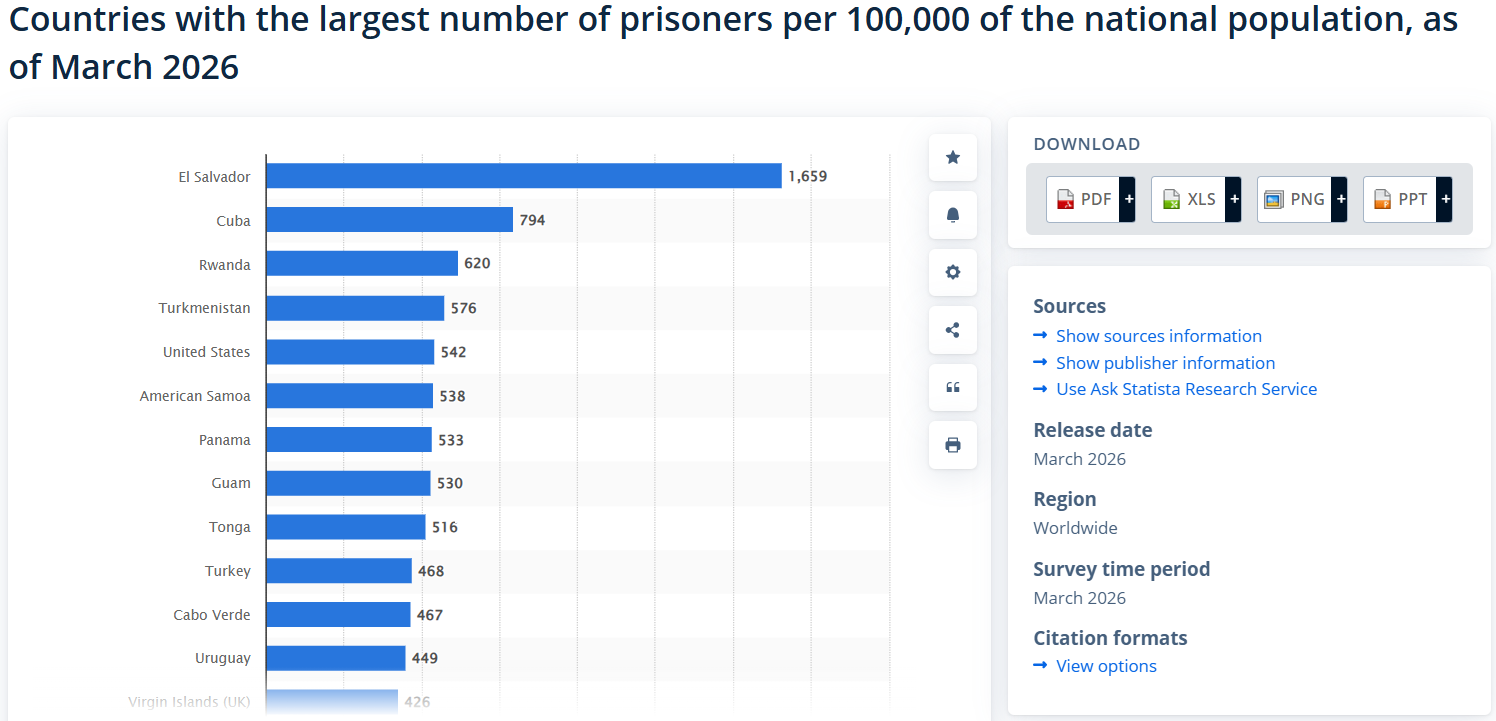
The mass arrest campaign needed somewhere to put all of these people, and fast. This is how CECOT came into existence.
CECOT: The Prison That Went Viral
The Terrorism Confinement Center, stylized as CECOT, is a 23 hectares, built in record time, with a stated capacity of 40,000 inmates. It opened in January 2023. The government was so proud of it that they gave influencers guided tours. Footage of shaved-headed inmates in matching uniforms, packed into cells, spread across social media. Bukele himself posted intake videos. It was prison as propaganda, deliberately theatrical, deliberately intimidating.
And it worked, in the sense that the optics landed globally. CECOT became the most recognizable building in El Salvador, arguably more famous than any of its beaches or volcanoes.
But here’s what the tours didn’t show: CECOT is the one facility the government lets cameras into. The other 24 detention centres across El Salvador are sealed from independent monitoring. Human rights organisations have documented torture, systematic beatings, and abuse in those facilities, the ones that don’t get influencer walk-throughs.
The Pivot: From Budget Drain to Business Model
A prison system housing 110,000+ people is eye-wateringly expensive. El Salvador spends over $200 million annually on its penitentiaries, more than 3% of the national budget. For a country already carrying public debt at 82% of GDP, or $31 billion in absolute terms, that’s a structural bleeding wound in the public finances.
This is the moment Bukele did something that no government had quite done before: he looked at his overcrowded, internationally notorious prison system and decided to monetise it.
The offer to the Trump administration was straightforward. The U.S. deports criminal aliens to CECOT, pays El Salvador $20,000 per inmate per year. That’s roughly half of what the U.S. federal prison system spends to house the same person domestically. Washington saves money. El Salvador earns money. Bukele gets an ally in the White House. Everyone at the table, except the inmates, gets something they want.
At $20,000 per head, 10,000 international inmates would generate $200 million annually, enough, as Bukele publicly stated, to make the entire prison system “self-sustainable.” You go, in theory, from one of your biggest budget liabilities to a profit centre.
Chilean conservative politicians have already expressed interest in similar arrangements, and analysts are beginning to describe El Salvador as a potential regional hub for incarceration services.
What the Model Actually Delivered
Let’s be honest about what worked, because being fair to the data matters.
On security: the transformation is real and remarkable. The homicide rate fell by more than 80% following the state of exception. El Salvador recorded 24 consecutive murder-free days in December 2024. A country that was, a decade ago, the murder capital of the world now holds a U.S. State Department Level 1 safety rating, the same designation given to France and Japan. Neighborhoods that were carved into gang territories, where residents couldn’t walk to the next street without paying a toll in cash or fear, became navigable. For millions of ordinary Salvadorans, this represented a profound, tangible change in daily life.
The security gains then unlocked the second lever: tourism. Tourist arrivals hit a record 3.9 million in 2024, up from 3.4 million in 2023. Tourism now represents 14% of El Salvador’s GDP, more than double the 6.4% recorded when Bukele first took office in 2019. El Salvador overtook Costa Rica to become the most visited country in Central America. Costa Rica, for reference, has spent decades and considerable resources building exactly that reputation.
The government’s Surf City initiative, new highways, beachfront development, luxury hospitality infrastructure along the Pacific coast, is projected to create 500,000 jobs and contribute $4 billion to the economy over the next decade.
The geopolitical upside is harder to price but arguably the most strategically valuable piece of all. El Salvador is a country of 6 million people with a GDP per capita under $6,000. It should, by every conventional measure, have zero leverage in Washington. Instead, Bukele has repositioned his country from a U.S. aid recipient into a strategic partner, a sovereign service provider with something the world’s largest economy wants to buy.
Where It All Gets Uncomfortable
Here’s the part that doesn’t make the government’s highlight reel.
The U.S. State Department’s own 2023 Human Rights Report, written by the same government that is now paying Bukele $20,000 per prisoner, documents the inside of these facilities in unflinching detail. Detainees reported receiving two tortillas, one spoonful of beans, and one glass of water per day. Released prisoners described prolonged confinement without access to sanitation. Women who gave birth in prison received only sporadic prenatal care.
The due process picture is equally stark. As of November 2023, not a single case from the state of exception had gone to trial. Some arrests were made on grounds as thin as “looking nervous” or having a tattoo with no confirmed gang connection. These aren’t edge cases, they’re documented patterns, at scale. The prison system is currently operating at over 350% of its designed capacity, with 2.6% of El Salvador’s entire adult population behind bars.
And then there’s the bigger structural question, the one that the IISS raises with real urgency: does mass incarceration actually work, long term?
The regional data is sobering. Over the past 24 years, incarceration rates surged by 224% in South America and 101% in Central America, yet homicides and crime have also risen alarmingly in many of those same countries, with some reporting up to a 94.7% annual increase. The reason is a vicious cycle: prisons don’t rehabilitate, they concentrate criminal networks. Brazil’s PCC, the First Capital Command, now one of the most powerful criminal organisations in the Americas, didn’t start as a cartel. It started as a prison gang in São Paulo, born directly out of brutal detention conditions, and expanded outward from there. El Salvador’s own MS-13 was running extortion operations from inside prison before the crackdown.
The model’s fiscal durability is also shakier than the headlines suggest. Legal challenges to the Trump administration’s use of the Alien Enemies Act, could cut off the pipeline of international prisoners entirely. If that revenue disappears, El Salvador is left with an enormous, expensive, politically entrenched prison system and a debt load it cannot grow its way out of on surf tourism alone.
So What Do We Make of All This?
El Salvador has pulled off something genuinely unprecedented: a country that took its deepest, most intractable domestic crisis, repackaged it as a service, and started selling it to wealthier nations with the same problem. It’s creative. It’s ruthless. In the short term, by several metrics, it’s working.
But the model’s foundation is indefinite detention without trial, zero rehabilitation, and a human rights record that compounds with every new report. Mass incarceration addresses the symptom, violent people on the street, while leaving the causes entirely intact: poverty, inequality, institutional weakness, lack of economic opportunity. The IISS is direct about this: mano dura policies bring short-term relief but worsen the long-term conditions that create crime in the first place.
Until the man in cell 47 gets his trial date,
Readon