
Another Depression?
Isn't that just a fancy word for the economy feeling bummed out?
At ReadOn, we don’t just report the markets. We help you understand what truly drives them, so your next decision isn’t just informed, it’s intelligent.
In October 1929, Wall Street lost over $16 billion, or 18% of the value it started the month with. What followed was the longest and deepest economic catastrophe the modern world had seen. Between 1929 and 1933, US GDP fell 30%, industrial production collapsed by 47%, and one in four American workers were unemployed. Global trade, or the connective tissue of the world economy, shrank by over two-thirds. By 1932, roughly 30 million people worldwide were out of work. The economic world had lost its bearings.
But the Depression didn’t arrive out of thin air. Before the crash came the First World War, which fractured global trade and buried nations in debt. Then a pandemic (the 1918 Great Influenza epidemic) killed tens of millions and weakened economies worldwide. Through the 1920s, stock markets roared on borrowed confidence as ordinary people took margin loans to chase ever-rising shares. Consumer debt ballooned. Optimism disconnected from reality.
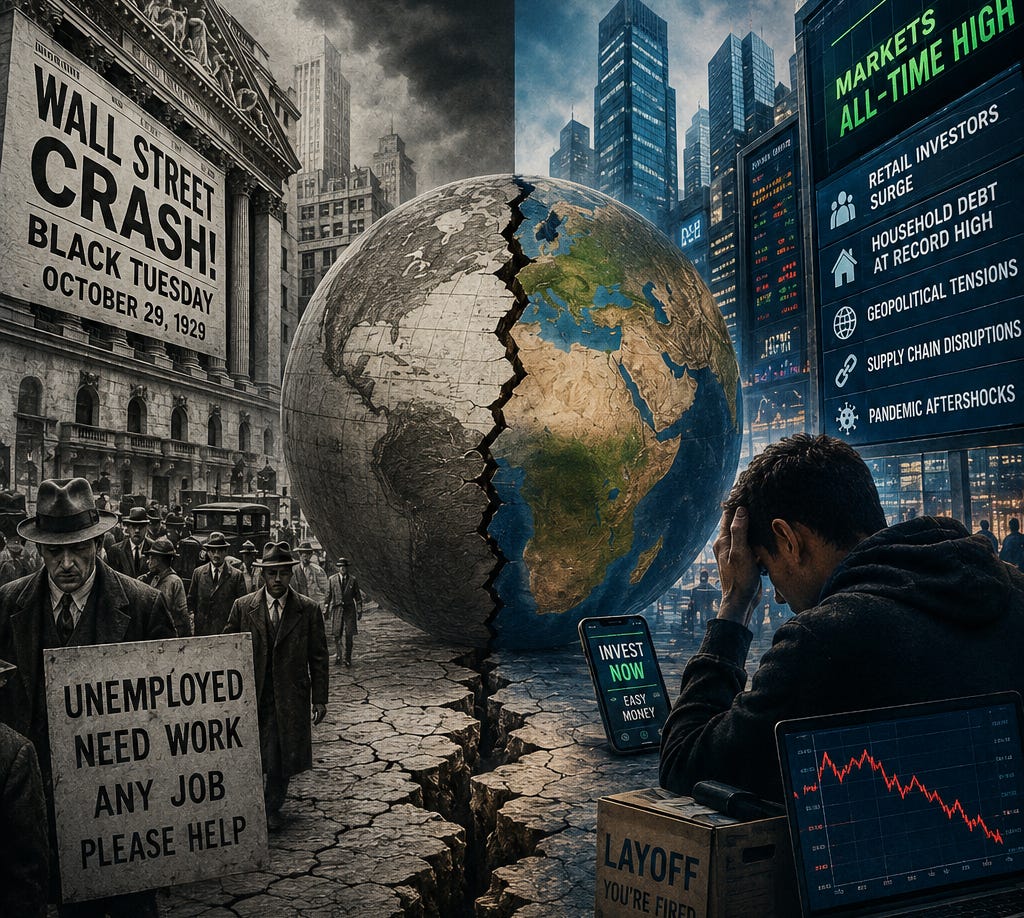
A global conflict is rattling supply chains. A pandemic that took millions. Retail investors flooding markets. Household debt is at a record high. Does any of that sound familiar, and recent?
So here’s the question: is the world heading toward another Great Depression? Let’s think through it.
What Was The Great Depression, Really?
Most people associate it with one moment. The Black Tuesday, October 29, 1929, when American stock markets shed billions in hours. That’s understandable. After all, it’s cinematic. But it’s also misleading. The Depression wasn’t just a Wall Street story. It was a global catastrophe.
Between 1929 and 1932, worldwide GDP fell by an estimated 15%, while global trade collapsed by over 60%. Every major economy was pulled under. Germany saw unemployment hit nearly 30%, an economic implosion so devastating it gave Adolf Hitler the opening he needed. By 1932, Canada’s industrial production fell to just 58% of its 1929 levels, with unemployment touching 27%. Chile, dependent on copper and nitrate exports, watched its GDP shrink to less than half of 1929 levels by 1932. Britain, once the engine of global commerce, saw unemployment climb from 10% to nearly 23% by early 1933. The knock-on effects reached colonial economies in Africa and Asia that hadn’t even participated in the speculative bubble.
What made it so devastating wasn’t any single crash. It was how each failure amplified the next. Bank collapses wiped out savings. Trade tariffs killed exports. A rigid gold standard forced interest rate hikes at precisely the wrong moment. Nobody had the tools to stop the spiral.
Many of those same ingredients are sitting around today.
What’s the Same?
Start with geopolitics. The First World War left global trade fractured and nations drowning in debt. Today, the Russia-Ukraine war, grinding on since 2022, has reshaped European energy markets and strained food supply chains across the world. US-Iran tensions in the Middle East add another fault line. Neither conflict is economically trivial, and neither is resolved.
Then there’s the pandemic comparison. The 1918 influenza infected an estimated 500 million people and disrupted economic activity across the world. COVID-19 did much the same a century later, triggering the sharpest global economic contraction since the 1930s, forcing governments into emergency borrowing, and creating supply-chain dislocations we’re still working through years later.
Add speculation. The Roaring Twenties were defined by stock market euphoria. Ordinary people borrowed to invest, margin loans swelled, and asset prices drifted further from economic reality. Today, the same story is playing out with different characters and different instruments. In India alone, demat accounts surged from 3.6 crore in 2019 to 19.4 crore by 2025 (a fivefold jump in six years). That growth came with a darker footnote: SEBI data showed that 93% of individual retail traders lost money, collectively shedding ₹1.8 lakh crore between FY22 and FY25. When access outpaces education, speculation tends to fill the gap.
And then there’s debt. In the 1920s, rising consumer borrowing fuelled the boom and deepened the bust. Today, global debt has hit a fresh record of $346 trillion as of Q3 2025, per the Institute of International Finance. Global household debt alone stands at $65.3 trillion. Governments and corporations borrowed a combined record $27 trillion in 2025 alone. And much of it sits at shorter maturities, making it more vulnerable to interest rate shocks.
On paper, it looks like the dominoes are lined up.
What’s Different?
Here’s the thing: the world of 1929 and the world of 2025 are fundamentally different. The Great Depression was, among other things, an instruction manual for what not to do, and we’ve largely followed it.
The most instructive test case is 2008. Despite a global collapse in confidence, the Federal Reserve acted as a lender of last resort, governments deployed fiscal stimulus, and deposit insurance prevented the bank runs that had devastated the 1930s. Unemployment peaked at 10%. It was painful, but nowhere near the Depression’s 25%. The Federal Deposit Insurance Corporation, created in 1933 precisely because of what happened, worked.
The gold standard, which was a rigid mechanism that forced countries to raise interest rates mid-crisis, pouring fuel onto a burning economy, is gone. Central banks now have the flexibility to respond to shocks with monetary easing. The IMF and World Bank, born from the 1944 Bretton Woods agreement, exist to provide emergency liquidity and coordinate policy between nations in ways that were simply absent in the 1930s. Automatic fiscal stabilisers like unemployment insurance and social spending programmes act as economic shock absorbers that didn’t exist in 1930. And for the first time in history, the world has a shared institutional memory of exactly how bad it can get.
These aren’t guarantees. But they’re meaningful guardrails.
The Takeaway
Another Great Depression, as the world experienced it, is unlikely. Situations like banking panics, a rigid gold standard, zero fiscal response, and no lender of last resort have been largely dismantled or mitigated. These were the mechanisms that turned a bad recession into a decade-long catastrophe.
But there’s a more sobering point underneath all this. What’s standing between us and the abyss isn’t luck. It’s systems. And systems, as history has shown repeatedly, can fail.
Two intellectual frameworks offer a useful lens here. Historians William Strauss and Neil Howe, writing in 1997, predicted that America would enter a crisis phase around 2005-2025, calling it a “Fourth Turning” marked by institutional upheaval and deep societal stress. Many would argue we’re in it. Separately, political scientist Graham Allison’s Thucydides Trap theory warns that 12 of 16 historical cases where a rising power challenged a ruling one ended in war. The US-China dynamic maps onto this template uncomfortably well.
History doesn’t repeat. But it rhymes. The safeguards are stronger. The knowledge is better. And yet the warning signals are louder than they’ve been in decades. That’s not a reason to panic. It’s a reason to pay attention, though.
Until next time, ReadOn!