
A New Axis?
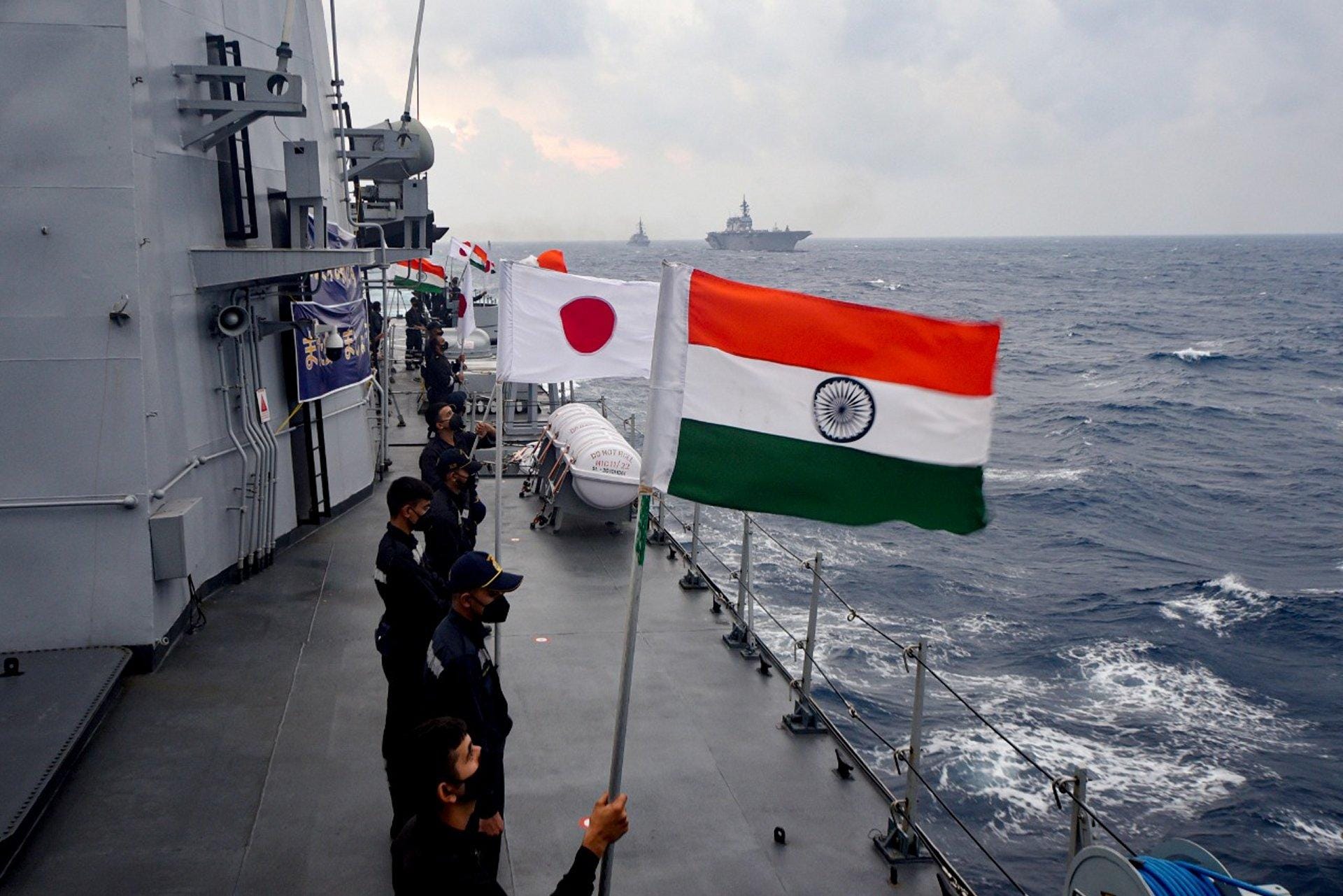
No wars, just new friendships, using warships.
At ReadOn, we don’t just report the markets. We help you understand what truly drives them, so your next decision isn’t just informed, it’s intelligent.
Japan is offering to hand India the complete design to its prized Mogami-class stealth frigate, a $500 million warship, along with the rights to build it right here, in Indian shipyards, using Japanese materials. No country has ever received this offer from Tokyo before.
Japan’s Mogami-class is not surplus hardware or a legacy design offloaded to a friendly buyer. These are frontline vessels that only entered service with the Japan Maritime Self-Defence Force (JMSDF) in 2022, and are still being actively built. Mitsubishi Heavy Industries launched the 12th and final unit, the Yoshii, as recently as December 2025, and were selected by Australia in August 2025 to replace its ageing Anzac-class frigates in a deal valued at AU$10 billion ($6.5 billion).
The Mogami is arguably Japan’s most consequential defence export story in the post-war era. And India is now being offered something even Australia wasn’t, local co-production from the start.
This is not a routine arms deal. Let’s see what’s going on.
What Exactly Is Being Offered
The proposal, which surfaced in the third week of April 2026, goes well beyond selling completed ships. Tokyo has reportedly offered to transfer design plans, construction rights, and selected materials, enabling India to build the frigates domestically under its Make in India and Atmanirbhar Bharat frameworks. The offer also extends into jointly designing next-generation frigates that could serve both the Indian Navy and the JMSDF. That’s a level of integration that moves far past buyer-seller territory.
On top of the frigate programme, discussions have reportedly touched on collaboration in intelligence, surveillance and reconnaissance (ISR), cybersecurity, and combat management systems, or the digital nervous systems that make modern navies tick.
The Mogami is an impressive platform to be building around. The frigate operates with about half the crew size of an equally sized peer, thanks to an unusually high degree of automation. Its weapons suite includes a 127mm naval gun, eight Type 17 anti-ship missiles, a SeaRAM close-in defence system, lightweight torpedoes, and a 16-cell Mk 41 vertical launch system (VLS). The upgraded variant, which Australia chose, and which India may also receive, bumps the VLS capacity to 32 cells and extends the hull to roughly 142 metres, significantly improving air-defence and strike range.
And there is one more piece of the puzzle. In November 2024, Japan’s Acquisition, Technology & Logistics Agency (ATLA) signed a memorandum of intent with India to transfer the “Unicorn” integrated stealth antenna system fitted aboard Mogami-class vessels. This would make it Japan’s first defence equipment export to India under their bilateral transfer agreement signed in 2015.
Why Japan Is Doing This
For most of the post-war period, Japan’s pacifist constitution kept it almost entirely out of the global arms business. That changed in 2014, when Tokyo relaxed its defence export guidelines for the first time in decades. But even then, the country remained cautious about transferring complete warship architecture or sensitive naval technologies. The Mogami-India proposal represents a decisive step beyond all previous thresholds.
Why now? The short answer is China.
China increased its military spending by 7.0% in 2024 to an estimated $314 billion, marking its thirtieth consecutive year of growth, as per Stockholm International Peace Research Institute (SIPRI). Its navy is rapidly expanding its carrier fleet, its submarine deployments into the Indian Ocean are increasing, and its assertiveness in the East China Sea around the Senkaku Islands (Japanese-administered territory that Beijing claims) has intensified. Japan faces pressure from the northwest; India from the southwest. Neither can solve this problem alone.
On April 21, 2026, just days after the Mogami proposal surfaced, Japan’s cabinet revised its rules restricting exports of defence equipment and technology, further widening the window for deals like this one. The timing was deliberate.
Tokyo’s 2023 revised Three Principles on Transfer of Defence Equipment and Technology are explicit about the logic. Such transfers are “a key policy instrument to ensure peace and stability, especially in the Indo-Pacific region, to deter unilateral changes to the status quo by force.”
In plain terms, Japan is trying to build a distributed network of militarily capable partners across the region, and India, with its enormous coastline, naval shipbuilding capacity, and existing Quad membership alongside Japan, the US, and Australia, is the most important node available.
What Each Side Gains
For Japan, the calculus is layered. The Mogami-Australia deal, worth $6.5 billion and covering 11 frigates, validated that Tokyo could compete as a defence exporter against established European shipbuilders. The global military frigates market is projected to grow from $24 billion in 2025 to $36 billion by 2032, and Japan now has a credible platform to compete across it. An Indian programme of 6 to 8 frigates at $450–$500 million per unit could represent a programme valued between $2.7 billion and $4 billion.
Strategically, Indian production facilities would give Japan a manufacturing buffer outside Northeast Asia. That’s critical redundancy if a future regional contingency were to strain Japanese shipyards directly. The Quad’s logic increasingly involves not just joint exercises, but shared supply chains, distributed production, and resilient industrial networks. The Mogami proposal is exactly this logic made concrete.
For India, the gains are more immediate. The Indian Navy continues to grapple with a challenging procurement pipeline. Warship construction in India takes an average of 85 months, compared to Japan’s 27. Access to Mogami’s design and production methods would allow India to effectively leapfrog decades of frigate design learning into a single programme. The low crew requirement of 90 sailors addresses a persistent headache for Indian naval planners around recruitment and retention of skilled personnel. And any eventual integration of the BrahMos supersonic anti-ship missile that is already deployed aboard several Indian warships into a Mogami hull could yield a genuinely hybrid Indo-Pacific platform that combines Japanese stealth design with Indian missile architecture.
The most likely Indian shipyards for the programme are Mazagon Dock Shipbuilders, which already builds the Navy’s Project 17A Nilgiri-class stealth frigates and recently made international headlines for acquiring Colombo Dockyard PLC in Sri Lanka, and Garden Reach Shipbuilders & Engineers in Kolkata.
The Caveat
No government on either side has formally confirmed negotiations. No request for proposals has been issued, no contracts signed. The proposal emerged from reports and briefings in mid-to-late April; its official trajectory remains uncertain. Integrating Indian weapons systems, particularly BrahMos, which is substantially larger than the Japanese Type 17, into a Mogami hull would require significant redesign, not merely a technology transfer. These are not trivial challenges.
But even at the proposal stage, what Tokyo is signalling carries weight throughout the region. Japan now sees India not merely as a buyer or a diplomatic partner, but as a co-producer of the maritime order it is trying to defend.
The Takeaway
The Mogami proposal to India is Japan’s most ambitious defence export initiative since it reopened the door to arms sales in 2014. It is also something more fundamental. It’s an acknowledgement that the Indo-Pacific’s security architecture cannot be maintained by any one country acting alone, and that building resilience now means building warships together.
The axis is still forming. But the blueprints are on the table.
Until next time, ReadOn!